Algorithmic Stablecoins Explained
Most stablecoins hold their value by being backed with real assets — dollars, government debt or crypto collateral. Algorithmic stablecoins try something more ambitious: holding a peg mainly through code and incentives, with little or no full backing. This guide explains how they work, why they're fragile, and why several have collapsed.
The 20-second version
Algorithmic stablecoins try to stay at $1 using rules and a partner token instead of holding full reserves. When confidence holds, they work. When it breaks, they can spiral to near zero — which is exactly what happened to several of them, most famously Terra's UST.
What is an algorithmic stablecoin?
A fiat-backed stablecoin like USDC keeps a dollar in reserve for every token. An algorithmic stablecoin tries to avoid holding all that backing. Instead, it uses software rules — and often a second, volatile 'partner' token — to expand and shrink supply so the price stays near $1.
The pitch is appealing: a stablecoin that's capital-efficient and decentralised, without trusting a company to hold reserves. The problem is that the whole design leans on one fragile thing — continued confidence.
How they try to hold a peg
The most common design pairs the stablecoin with a partner token. Rules let users swap between the two at a fixed value, which is supposed to absorb demand and keep the peg. And however you weigh the trade-offs, keep meaningful holdings in cold storage — a Trezor Safe 5 — rather than on an exchange.
- Above $1 — the system mints more stablecoin, increasing supply to push the price down.
- Below $1 — users are incentivised to 'burn' the stablecoin for the partner token, reducing supply to push the price up.
- The catch — this only works while people believe the partner token has value.
The death spiral
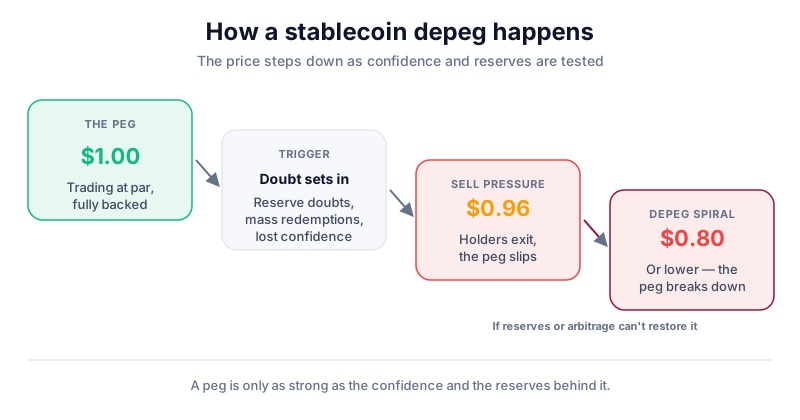
If confidence drops, holders rush to exit, the system mints huge amounts of the partner token, its price crashes, and that destroys the very backing meant to defend the peg. This self-reinforcing collapse is called a 'death spiral' — and it can happen in days.
A history of failures
Algorithmic stablecoins have a poor track record. The most catastrophic example was TerraUSD (UST), which collapsed in May 2022 alongside its partner token LUNA, wiping out tens of billions of dollars in value. Earlier and later projects have suffered similar depegs and collapses.
We cover the most important case study in detail in our guide to the Terra/Luna collapse. The pattern repeats: smooth on the way up, brutal on the way down.
Treat 'algorithmic' as a red flag
Many of crypto's largest losses have come from algorithmic or 'high-yield' stablecoins that turned out to be far less stable than their name suggested. A high advertised return on a 'stable' asset is a warning sign, not a feature. This is education, not financial advice — never put in money you can't afford to lose.
Key takeaways
- Algorithmic stablecoins try to hold $1 with code and a partner token, not full reserves.
- They rely on continued confidence — and that's exactly what can vanish overnight.
- When confidence breaks, a 'death spiral' can crash them to near zero in days.
- Their history is full of collapses, the largest being Terra's UST in 2022.
Frequently asked questions
Are algorithmic stablecoins actually stable?
Often not. They hold a peg only while confidence lasts, and several have collapsed entirely. The label 'stable' describes the goal, not a guarantee.
What is a death spiral?
A self-reinforcing collapse where panic selling forces the system to mint huge amounts of its partner token, crashing its price and destroying the backing meant to defend the peg.
Is DAI an algorithmic stablecoin?
No. DAI is crypto-collateralised and over-collateralised, which is a different and more robust design than a pure algorithmic peg.
Keep reading
What Is a Stablecoin? How the Peg Works (and Fails)
A clear guide to stablecoins: how they aim to hold a steady value, the different types, and the very real peg
The Terra/Luna Collapse: What Happened and Why It Matters
A factual, cautionary account of the May 2022 TerraUSD (UST) depeg and LUNA collapse — what the system was, ho
Stablecoin Risks Explained
Stablecoins aim for $1, but they aren't risk-free. A clear, balanced guide to depeg risk, issuer and reserve r