What Is USDC? A Plain-English Guide
USDC is a stablecoin designed to always be worth one US dollar. It's known for leaning into regulation and transparency, which makes it many people's default 'cautious' stablecoin. This guide explains what USDC is, how it holds its value, how its reserves are structured, and the risks — including the time it lost its peg.
The 20-second version
USDC is a token that aims to always be worth $1. It's issued by a US company called Circle, which backs it with cash and short-term US government debt and publishes monthly reserve reports. It's still a private token, not a bank deposit — so trust and regulation matter.
What is USDC?
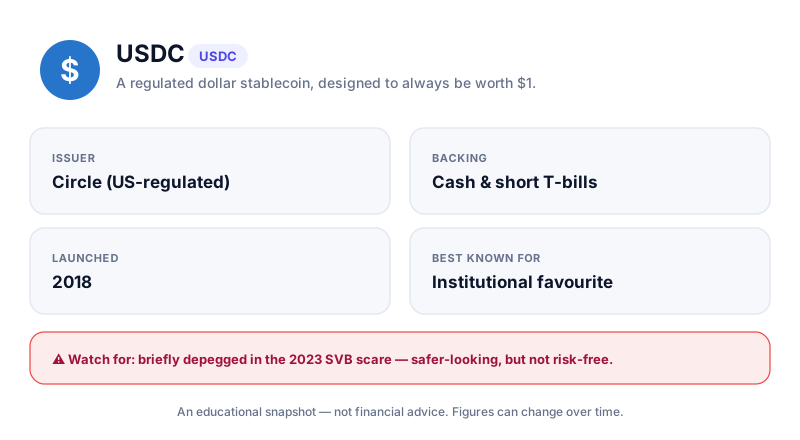
USDC (USD Coin) is a fiat-collateralised stablecoin that tracks the US dollar. One USDC is meant to always be redeemable for roughly $1. Like USDT, it lets people hold a dollar value inside crypto without the volatility of coins like Bitcoin.
USDC is issued by Circle, a US-based company. It launched in 2018 and has built its reputation on a more compliance-focused, transparency-forward approach than some rivals. USDC runs on many blockchains, so the same token can move across networks like Ethereum, Solana and others.
How USDC stays near $1
Every USDC is meant to be backed by an equivalent amount of reserves. Circle states these are held in cash and short-dated US Treasuries, with a portion managed through a regulated money-market fund.
- Backing — Circle publishes monthly reserve reports from a major accounting firm describing what's held.
- Redemption — eligible customers can mint and redeem USDC for dollars at 1:1 with Circle.
- Arbitrage — if USDC drifts from $1, redemption and minting let traders profit from the gap, pulling it back toward the peg.
Transparency is a spectrum, not a switch
USDC is widely seen as one of the more transparent stablecoins because of its regular reserve reporting. That reduces some risk — but it doesn't make any stablecoin risk-free, as the events of March 2023 showed.
When USDC lost its peg
In March 2023, a US bank — Silicon Valley Bank — failed. Circle disclosed it held a portion of USDC's cash reserves at that bank, and over a weekend USDC briefly fell as low as around $0.87 as people worried the funds could be stranded.
When US regulators guaranteed depositors at the failed bank, confidence returned and USDC climbed back to $1 within days. No holder ultimately lost money on the peg — but the episode is a clear, real-world lesson: even a well-regarded, fully-reserved stablecoin can depeg if the assets behind it come into question.
The takeaway from March 2023
A stablecoin is only as stable as the assets backing it and the institutions holding those assets. 'Backed 1:1' still depends on where that backing sits. Treat any stablecoin as something that can move, not something that can't.
Risks and how USDC compares
USDC's main appeal is its regulatory and reporting posture, but it still shares the core risks of any stablecoin.
- Issuer and custody risk — you're trusting Circle, and the banks where reserves sit, as the SVB episode showed.
- Depeg risk — confidence shocks can briefly push USDC off $1.
- Regulatory risk — rules can change how USDC is issued, frozen or used; addresses can be blocklisted.
- No yield by default — holding USDC is not a bank deposit and carries no deposit insurance.
Compared with USDT, USDC is often viewed as the more transparency-focused option, while USDT is larger and more widely traded. Neither is automatically 'safer' in every way — the right framing is understanding what you're trusting in each case. And however you weigh the trade-offs, keep meaningful holdings in cold storage — a SafePal S1 — rather than on an exchange.
Key takeaways
- USDC is a dollar stablecoin issued by Circle, designed to always be worth about $1.
- It backs tokens with cash and short-term US government debt, and reports reserves monthly.
- It briefly depegged to around $0.87 in March 2023 after a bank holding some reserves failed.
- It's known for transparency — but it's still a private token, not a guaranteed bank deposit.
Frequently asked questions
Is USDC safer than USDT?
USDC is generally seen as more transparent and regulation-focused, but both are private stablecoins with their own risks. 'Safer' depends on what you're worried about — neither is risk-free, and this isn't advice to choose either.
What happened to USDC in 2023?
It briefly fell to about $0.87 when Silicon Valley Bank, which held some of its reserves, failed. It recovered to $1 within days once depositors were protected.
Does holding USDC earn interest?
Not by itself. Any 'yield' on USDC comes from lending or staking it through a third party, which adds extra risk. Holding the token alone earns nothing and has no deposit insurance.
Keep reading
What Is a Stablecoin? How the Peg Works (and Fails)
A clear guide to stablecoins: how they aim to hold a steady value, the different types, and the very real peg
What Is USDT (Tether)? A Plain-English Guide
A clear, balanced guide to USDT (Tether) — what it is, how the world's biggest stablecoin stays near $1, who i
Stablecoin Risks Explained
Stablecoins aim for $1, but they aren't risk-free. A clear, balanced guide to depeg risk, issuer and reserve r