The Biggest Meme Coin Winners of 2026 So Far
Every year throws up a fresh batch of meme coins that seem to come from nowhere and dominate the timeline for a few weeks. 2026 is no exception. This is a neutral look at the kinds of coins that grabbed attention this year and — far more usefully — why they spread and why the ones you hear about are the rare exceptions, not the rule.
The 20-second version
A few meme coins gained outsized attention in 2026, mostly on Solana, riding culture, communities and launchpad mechanics. But the winners you hear about are a tiny minority of the tens of thousands that quietly went to zero — which is exactly why 'these did well' is the wrong lesson to take.
Read this before the list
We need to set the framing before naming anything, because the framing is the whole point. Listing a coin that rose is not a hint to buy it, a prediction about where it goes next, or a suggestion that it's any safer than the rest. We can't honestly tell you what any of these will do tomorrow, and neither can anyone else. What we can do is explain why they caught on, so you can read the next wave more clearly.
This is a recap, not a recommendation
Nothing here is financial advice. A coin appearing below means it got attention in 2026 — nothing more. Every one of them is volatile and speculative, several have already fallen heavily from their highs, and any could be near-worthless by the time you read this.
What caught attention in 2026
Rather than rank coins by price — a number that dates the moment we publish — it's more useful to group them by the kind of story that carried them. In 2026 the attention clustered into a few recognisable buckets, almost all of them on Solana, which remains the centre of gravity for this corner of the market.
- Long-running Solana names — a handful of older Solana meme coins with established communities, such as BONK, kept drawing attention partly because they survived previous cycles when most coins didn't. Longevity becomes its own selling point.
- 'PolitiFi' coins — politically themed tokens, including ones tied to public figures, continued to act as on-chain proxies for news-driven excitement. They spike on headlines and fade just as fast.
- Brand and character coins — tokens attached to recognisable mascots or internet characters, like Pudgy Penguins' PENGU, leaned on existing fanbases and merchandise to stand out from the noise.
- AI-flavoured and 'absurdist' coins — a continuing 2025 theme, coins tied to AI agents or deliberately ridiculous jokes (Fartcoin being the obvious example) kept finding audiences who treated the absurdity itself as the appeal.
Notice what these have in common: a story, a community, and a hook that made people want to share them. None of it is about fundamentals, because — as how meme coins work explains — there usually aren't any. The 'product' is the meme and the crowd around it.
Why these spread when thousands didn't
If creating a coin costs cents and tens of thousands launch every day, why do a tiny few break out? The honest answer is a mix of ingredients that's easy to describe afterwards and almost impossible to predict in advance.
| Ingredient | Why it helped a coin spread |
|---|---|
| A sticky community | People who stay and evangelise give a coin a reason to exist past day one |
| A timely or funny hook | A joke or news angle that's easy to share spreads on its own |
| Visible momentum | Rising charts and volume attract more buyers, which is partly self-fulfilling |
| Influencer attention | A large account posting about a coin can move a crowd — for better or worse |
| Exchange listings | Getting onto bigger venues brings new buyers and a sheen of legitimacy |
Here's the catch: every coin that failed had some of these too. Plenty had communities, jokes and influencer posts and still went to zero. The ingredients raise the odds of going viral; they don't guarantee it, and they certainly don't make a coin safe. You'll find these dynamics dissected further in notable meme coins, which covers the older, established names in the same neutral spirit.
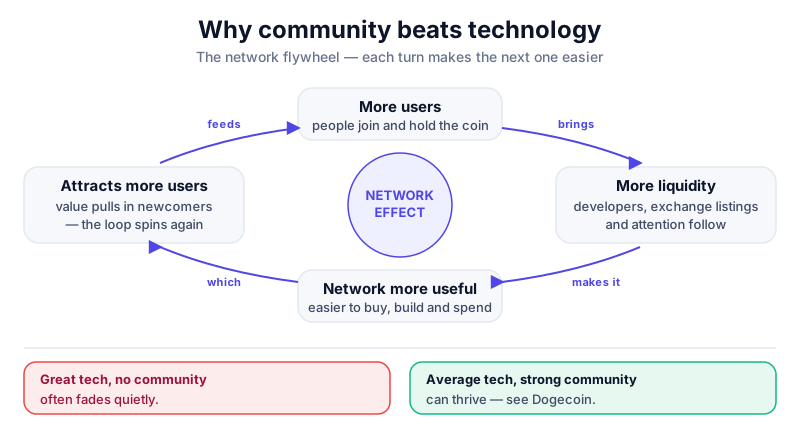
Momentum is partly a feedback loop
A rising price attracts buyers, whose buying pushes the price higher, which attracts more buyers. That loop looks like proof the coin is 'working' — right up until it runs in reverse, which it always eventually does. A chart is not a fundamental.
The trap: survivorship bias
This is the most important section, so slow down here. Any 'biggest winners' list — including this one — suffers from a brutal distortion called survivorship bias. You only ever see the survivors. The tens of thousands of coins launched the same week as the winners, the ones that dropped to zero within hours, simply don't make any list because nobody's posting about their losses.
The result is that the odds look enormously better than they are. For every coin held up as a 2026 success, there are thousands of silent failures. If you study only the winners and try to copy the pattern, you're learning from a sample that's been ruthlessly filtered to mislead you. It's like concluding lottery tickets are a smart investment by interviewing only the jackpot winners.
- The winners are loud, the losers are silent — so your sense of the odds is badly skewed.
- Past rises don't predict future ones — a coin that went up has no obligation to keep doing so, and many round-trip back to near-zero.
- Today's winner is often tomorrow's cautionary tale — several coins that topped lists in earlier years have since collapsed.
- Copying the winners' 'formula' usually fails — because the same formula produced far more failures than successes.
A list of winners is a list of survivors. The graveyard next to it — the part you never see — is thousands of times bigger.
How to actually use this information
If a recap like this is so heavily caveated, what's it good for? Reading the landscape, not picking the next winner. Knowing which themes are circulating helps you understand the conversation and — more importantly — recognise the patterns that scammers exploit, because they imitate whatever's hot.
Before going anywhere near any coin, famous or new, the safety lessons matter far more than any list. Run it through how to research a meme coin, check the warning signs in meme coin risks and red flags, and learn to spot the worst outcome in how to spot a rug pull. The fame of a coin is no substitute for any of that — if anything, popularity attracts more copycat scams using the same name and logo.
Treat 'winners' lists as history, not forecasts
These coins did something in the past. That's all a recap can ever honestly say. It tells you nothing about the future, and the future is the only part that would cost you money.
The bottom line
A few meme coins genuinely captured attention in 2026 — long-running Solana names, political and character coins, and the ongoing AI-and-absurdism wave. And if you were one of the few who actually banked gains, remember they're taxable in the UK — Koinly can work out what you owe. Understanding why they spread is useful: it's culture, community and shareable hooks, amplified by momentum loops and the odd influencer, not fundamentals. But the coins you hear about are the survivors of a process that quietly buries the overwhelming majority.
So take the recap for what it is — a snapshot of what was loud this year, not a map to riches. Crypto is volatile and you can lose everything you put in, and meme coins are the most volatile, most scam-prone corner of all. If you ever do choose to risk money here, only ever risk what you can afford to lose entirely. — the Latest Crypto team
Key takeaways
- A few 2026 meme coins drew big attention — mostly on Solana — across long-running names, PolitiFi, character coins and AI/absurdist themes.
- They spread on community, timely hooks, momentum loops and influencer attention, not fundamentals.
- Any 'winners' list is distorted by survivorship bias: the silent failures vastly outnumber the loud successes.
- Past rises don't predict future ones, and yesterday's winners often become cautionary tales.
- Use the recap to read patterns, not pick coins — and lean on the safety checklists before going near anything.
Frequently asked questions
Which was the best meme coin to buy in 2026?
We don't answer that, because it's a buy recommendation and a prediction rolled into one — and nobody can honestly give either. We can only describe which coins got attention and why. Any 'best' framing ignores the thousands that failed and the fact that past performance tells you nothing about the future.
If a coin already went up a lot, is it safer to buy?
No — often the opposite. A big rise can mean more room to fall and that early buyers are looking to cash out on later ones. A rising chart is momentum, not a fundamental, and it can reverse hard. Judge any coin on its own merits using how to research a meme coin.
Why won't you just tell me the next big meme coin?
Because nobody knows, and anyone claiming to is selling something. The winners are a tiny, unpredictable minority of a flood of launches, most of which go to zero. Our job is to explain the mechanics and risks neutrally, not to point you at a gamble. See meme coin risks and red flags.
Keep reading
Notable Meme Coins (A Neutral Overview)
A factual, balanced look at the best-known meme coins — Dogecoin, Shiba Inu, Pepe and others — with heavy risk
How Meme Coins Work (Under the Hood)
How meme coins are created, traded and priced — tokens, liquidity pools, market caps and the mechanics that ma
Meme Coin Risks and Red Flags
The core safety lesson on meme coins: the real risks, the warning signs to look for, and the scams that separa