Bitcoin Treasury Companies, Explained
Some of the biggest buyers of bitcoin aren't funds or governments — they're listed companies whose main business, increasingly, is holding bitcoin on their balance sheet. Buy their shares and you're not buying coins; you're buying a leveraged, sentiment-priced wrapper around coins. That can amplify gains, but it adds two failure modes plain bitcoin doesn't have. This is an educational look at how the machine works, and why 2026 gave it a real-world stress test.
The 20-second version
A bitcoin treasury company raises money on the stock market and uses it to buy and hold bitcoin. When its shares trade at a premium to the coins it owns, it can issue more shares, buy more bitcoin, and grow 'bitcoin per share' — a self-reinforcing 'flywheel'. But when that premium collapses, the flywheel runs in reverse, and the debt behind it still has to be refinanced on a clock. It is a leveraged bet on sentiment, not a safer way to own bitcoin.
What is a bitcoin treasury company?
A bitcoin treasury company is a listed business that deliberately holds a large amount of bitcoin as its primary treasury asset — in many cases, holding bitcoin *is* the point of the company. Rather than parking spare cash in bonds or a bank, it puts it (and, crucially, borrowed money) into bitcoin and reports that stack as its headline reason to exist.
The model was pioneered by Michael Saylor's firm, then called MicroStrategy, from 2020 onwards — it has since renamed itself Strategy. What makes it different from a company that just happens to own some crypto is *how it funds the buying*. It doesn't wait for operating profits. It taps the capital markets: issuing new shares, selling convertible notes (bonds that can turn into shares), and issuing preferred stock — then spends the proceeds on more bitcoin.
As of mid-2026, Strategy is by a wide margin the largest corporate holder, with well over half a million bitcoin on its books (trackers disagree on the exact figure, and it keeps buying — check the current number rather than trusting any headline). Listed companies collectively hold somewhere in the region of 1.1 to 1.3 million BTC by some trackers, a meaningful single-digit slice of bitcoin's 21-million cap. Those totals grew fast through 2026 and sources conflict, so treat every number here as a snapshot, not gospel.
This is not the ETF route
A spot bitcoin ETF also gives you exposure without touching a wallet, but the structure is different: a fund holds coins and its price tracks them closely, with a redemption mechanism keeping it honest. A treasury company is a leveraged operating business whose shares can trade well above or below the bitcoin behind them. We cover the fund route separately in The Future of Bitcoin ETFs.
How the 'flywheel' actually works
To follow the model you need one metric: mNAV, or market-cap-to-net-asset-value. It's the company's stock-market value divided by the value of the bitcoin it holds.
- mNAV above 1.0 — the shares trade at a *premium* to the bitcoin behind them. The market values the wrapper at more than the coins.
- mNAV below 1.0 — the shares trade at a *discount*. The market values the whole company at *less* than its bitcoin is worth.
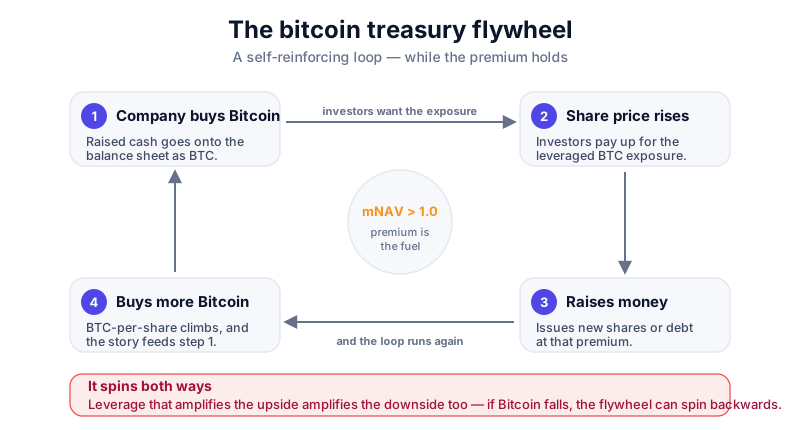
The premium is the fuel. Here's the loop, sometimes called the flywheel. When the shares trade at a premium, the company issues new shares *above* the value of the bitcoin those shares represent, takes the cash, and buys more bitcoin. Because it paid for the coins with 'expensive' equity, every existing shareholder ends up owning *more* bitcoin per share than before. Strategy brands this growth as its 'BTC Yield' — the percentage rise in bitcoin held per diluted share.
- Shares trade at a premium to the bitcoin they represent (mNAV above 1.0).
- The company issues new shares at that premium and raises cash.
- It spends the cash on more bitcoin.
- Bitcoin-per-share rises for existing holders — the 'accretive dilution' trick.
- A higher stack and a good story support the premium, which lets the loop run again.
It only works while two things hold
The flywheel adds bitcoin-per-share *only* while the shares trade at a premium and bitcoin rises faster than the cost of the debt and equity funding it. Take either leg away and the maths flips from adding value to destroying it. That isn't a footnote — it's the whole risk.
Why the narrative matters: leverage and copycats
The pitch to shareholders is *leverage plus the flywheel*. Because the company borrows to buy, its shares have historically moved more than bitcoin itself — up harder in bull runs, and down harder in falls. For a stretch, Strategy's stock was treated as a high-octane bitcoin proxy, a way to get amplified exposure inside an ordinary brokerage account.
Success bred imitators. A wave of firms bolted a bitcoin treasury onto their balance sheets in 2025 and 2026 — among them Japan's Metaplanet, Twenty One Capital, Semler Scientific, some bitcoin miners that already held large stacks, and a long tail of tiny overseas firms. We name these only to illustrate the trend, not as endorsements. The important thing to notice: many of the smaller ones welded a bitcoin treasury onto an unrelated or struggling core business, which is a very different — and riskier — proposition than a large firm with cheap access to capital.
A quick sniff test
When a small company with a fading main business suddenly reinvents itself as a 'bitcoin treasury', treat the story with care. It can be genuine strategy, or it can be a share-price play dressed up in a hot narrative. The same instincts that help you spot crypto scams apply to listed shares too.
When the flywheel spins in reverse
The obvious question is: what happens when the premium goes away? In 2026 we found out. The reflexivity risk that sceptics had warned about stopped being hypothetical.
Some analyses reported Strategy's premium compressing sharply through 2026 — mNAV falling from around 2.0x back towards roughly 1.07x, according to one widely-cited snapshot (treat those precise figures with caution; they're a single source at a single moment). The mechanism matters more than the exact numbers: once mNAV drops below 1.0, issuing new shares to buy bitcoin *reduces* bitcoin-per-share instead of raising it. The accretive-dilution trick becomes value-destroying dilution, and the funding engine stalls.
This isn't a small crowd. By some trackers, a quarter to as much as 40% of listed bitcoin treasury firms were trading *below* the value of their own bitcoin at points during 2026 (the percentage moves around and sources differ). Below NAV, the market is effectively saying the corporate wrapper is a liability rather than a bonus. Several executives openly predicted 2026 would be a consolidation year, with stronger balance sheets absorbing weaker ones.
The discount trap
There's no redemption mechanism forcing the share price back to the value of the coins. Unlike an ETF, you can't hand in shares and take out bitcoin. So a discount can persist — the premium and discount are pure market sentiment, with no arbitrage floor underneath them.
The honest risks: premium, refinancing, forced selling
Beyond the premium collapse, the risk most often described — and most often described *wrongly* — is forced selling. So let's be precise.
Myth: 'a bitcoin crash triggers an automatic margin call'
For Strategy, that's largely not how the debt is built. Its borrowing is mostly *unsecured* convertible notes (a lot of it at 0% coupon) plus perpetual preferred shares. That means a falling bitcoin price alone does not automatically trigger a margin call or forced sale. Getting this wrong is the single most common error in coverage of the topic.
The genuine pressure point is the refinancing wall, not a margin call. Reports point to roughly $12–$13 billion of sector debt maturing largely across 2027 and 2028, with a Strategy convertible of around $1 billion maturing near September 2027 (dates and figures vary by source — check current filings). If a convertible matures while the share price sits below its conversion price, holders want cash rather than shares. The company then has to refinance — possibly on worse terms — or, in a bad scenario, sell some bitcoin. Strategy has said it built a multi-year cash reserve (reported at roughly $2.25 billion) precisely so it can meet interest and dividends without selling coins.
- Premium collapse — the flywheel needs mNAV above 1.0; below it, the funding model breaks down.
- Refinancing timing — unsecured debt still matures. Rolling it over in a weak market is the real squeeze, not a price-triggered margin call.
- Conversion-price risk — if the share price is below a convertible's conversion price at maturity, that debt effectively comes due in cash.
- Leverage cuts both ways — the same borrowing that amplified gains amplifies losses, and smaller imitators typically have worse, more expensive access to capital.
- No coins in your pocket — you own equity in a company, with all its corporate and refinancing risk, not bitcoin you control.
Treasury stock vs ETF vs holding your own bitcoin
Three very different ways to get bitcoin exposure, three very different risk profiles. This is education, not a recommendation — we never tell anyone what to buy.
| Route | What you actually own | Key trade-off |
|---|---|---|
| Treasury company shares | Equity in a leveraged company that holds bitcoin | Amplified moves and a premium/discount with no redemption floor; corporate and refinancing risk on top of bitcoin's own |
| Spot bitcoin ETF | Fund units backed by bitcoin, tracking the price closely | Lower-friction, regulated exposure; you still don't control the coins, and it's as volatile as bitcoin |
| Your own bitcoin (self-custody) | The coins themselves, controlled by your keys | No leverage, no wrapper, no premium games — but you carry full responsibility for security |
For a regulated, lower-friction way to get exposure without corporate leverage, the ETF route is the usual comparison — and worth reading alongside this piece. UK readers should also understand how the rules apply to them; start with the FCA and UK crypto rules.
And if what you actually want is bitcoin you truly hold — not a share, not a fund unit — that's a different philosophy entirely: self-custody. A treasury stock gives you no coins you control. Holding your own means understanding hot vs cold wallets and getting the basics of crypto opsec right first.
A treasury stock is a bet on a company; self-custody is a bet on holding the asset itself. If that's the philosophy you're drawn to, a hardware wallet keeps your keys offline and in your hands. The Ledger Nano X is our top pick for most people — read our review first. This is an alternative approach, not a nudge to sell anything.
Whichever route interests you, it helps to see the whole picture in one place — our guide to tracking your crypto portfolio walks through weighing direct holdings against proxies like these.
Key takeaways
- A bitcoin treasury company raises money on the stock market to buy and hold bitcoin — buying its shares is buying a leveraged wrapper, not coins you control.
- The 'flywheel' only works while the shares trade at a premium (mNAV above 1.0) and bitcoin outpaces the cost of capital; below NAV it destroys bitcoin-per-share instead.
- 2026 stress-tested the model for real — premiums compressed and, by some trackers, a large share of these firms traded below the value of their own bitcoin.
- The main debt risk is a refinancing wall in 2027–2028, not an automatic margin call — much of Strategy's borrowing is unsecured, so a price fall alone doesn't force a sale.
- This is a leveraged bet on sentiment, not a safer or smarter way to own bitcoin; an ETF or self-custody are simpler comparisons worth understanding first.
Frequently asked questions
Is buying a bitcoin treasury stock the same as owning bitcoin?
No. You own equity in a company that holds bitcoin, not the bitcoin itself. Crucially, there's no redemption right — you can't hand in your shares and take out coins the way an ETF's structure allows. That means the share price can trade well above or below the value of the bitcoin behind it, driven purely by market sentiment, and you also carry the company's leverage and refinancing risk on top of bitcoin's own volatility.
What does mNAV mean, and why does trading 'below NAV' matter?
mNAV is market-cap-to-net-asset-value — the company's stock-market value divided by the value of the bitcoin it holds. Above 1.0 means the shares trade at a premium to the coins; below 1.0 means a discount. It matters because the whole funding model relies on a premium: above 1.0, issuing shares to buy bitcoin raises bitcoin-per-share, but below 1.0 it reduces it, stalling the engine. A persistent discount is the market saying the corporate wrapper is a liability rather than a bonus.
Could a bitcoin treasury company be forced to sell its bitcoin?
It's possible but often mis-stated. A falling bitcoin price alone does not automatically trigger a margin call for a firm like Strategy, because its debt is largely unsecured convertibles and perpetual preferred shares rather than secured loans. The real risk is timing: debt still matures. If a convertible comes due while the share price is below its conversion price, holders want cash, and the company may have to refinance on poor terms or, in a bad scenario, sell some bitcoin. Reports point to a sector refinancing wall largely across 2027 and 2028.
Why not just buy a spot bitcoin ETF instead?
That's exactly the comparison to think through. A spot ETF gives regulated, lower-friction exposure that tracks bitcoin closely, with a redemption mechanism keeping the price honest — but no leverage and no flywheel. A treasury stock offers amplified, leveraged exposure with the chance of a premium, at the cost of corporate risk, a premium that can evaporate, and no floor under the price. Neither removes bitcoin's underlying volatility, and neither is 'safer' in the abstract — they're different risk profiles. See our ETF explainer for the fund route in full.
Keep reading
The Future of Bitcoin ETFs
Where spot Bitcoin ETFs go next: inflows and outflows, what they mean for adoption, the spread to other crypto
What Is Tokenomics? How Crypto Supply and Incentives Work
Tokenomics explained in plain English: supply, distribution, emissions, utility and incentives — and how to re
Hot vs Cold Wallets: What's the Difference?
A plain-English hot vs cold wallets comparison — how each works, the security trade-offs, and how to combine b