Centralised vs Decentralised Exchanges (CEX vs DEX)
There are two very different ways to swap one crypto for another: a centralised exchange that holds your funds for you, or a decentralised exchange where you trade directly from your own wallet. This guide explains how each works and the trade-offs that actually matter.
The 20-second version
A centralised exchange (CEX) is like a crypto bank — easy to use, but it holds your coins. A decentralised exchange (DEX) lets you swap directly from your own wallet, so you keep custody, but you take on more responsibility and risk. Most beginners start with a CEX; DEXs come into play once you're comfortable self-custodying.
What a centralised exchange is
A centralised exchange (CEX) is a company that runs a marketplace for buying, selling and trading crypto — think Coinbase, Kraken or Binance. You create an account, pass identity checks, deposit money, and trade through their app.
The key point: while your funds sit on a CEX, the exchange holds the keys, not you. It's custodial — much like a bank holding your cash. That's convenient, but it means you're trusting the company to stay solvent, secure, and honest.
- Easy to use — familiar apps, customer support, password resets.
- Fiat on-ramps — buy with a card or bank transfer.
- Custodial — they hold your coins, so 'not your keys, not your coins' applies.
What a decentralised exchange is
A decentralised exchange (DEX) is not a company but a set of smart contracts running on a blockchain. You connect your own wallet (such as MetaMask) and swap tokens directly — the funds move from your wallet to another, with no middleman holding them in between. DEXs are a core part of DeFi.
Instead of matching buyers and sellers like a traditional exchange, most DEXs use liquidity pools — shared pots of two tokens that an algorithm prices automatically. You're trading against the pool, not a person.
- Self-custody — you keep your keys the entire time.
- No account or identity check — you just connect a wallet.
- More responsibility — no support line, no undo, and you pay network gas fees for each swap.
Side by side
| Feature | Centralised (CEX) | Decentralised (DEX) |
|---|---|---|
| Who holds your coins | The exchange | You (your own wallet) |
| Ease of use | Beginner-friendly | Steeper learning curve |
| Buy with cash/card | Yes | Not directly |
| Identity check (KYC) | Usually required | Usually none |
| If something goes wrong | Support may help | No support; mistakes are final |
| Main risks | Hacks, freezes, insolvency | Bad approvals, scam tokens, user error |
The risks on each side
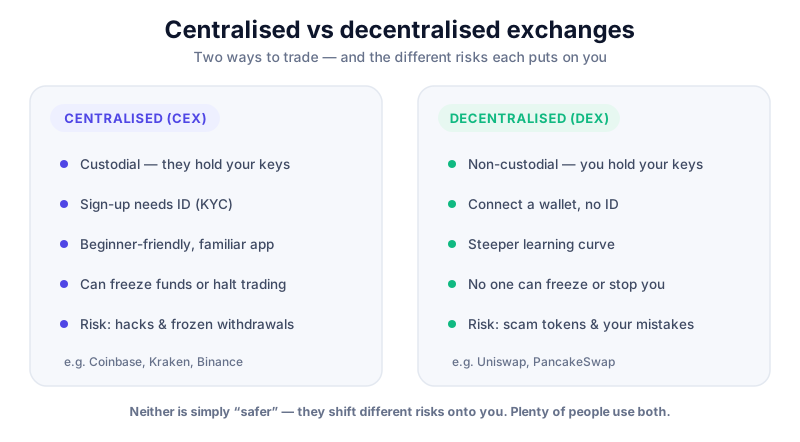
Neither option is 'safe' or 'unsafe' in the abstract — they fail in different ways, and understanding how helps you avoid the common pitfalls.
- CEX risks — the exchange can be hacked, can freeze withdrawals, or in the worst cases collapse. History has examples of large exchanges failing, taking customer funds with them.
- DEX risks — there's no one to call. Risks include approving a malicious contract, swapping a fake copy of a token, price slippage, and outright rug pulls.
Custody is the core trade-off
On a CEX you trust a company; on a DEX you trust yourself. Either way, don't leave large amounts on an exchange long-term — move serious holdings to your own secure storage. This is education, not financial advice.
Which should you use?
There's no single right answer, and many people use both for different jobs. A common pattern looks like this:
- Use a reputable CEX to convert cash into crypto and for simple buying — it's the easiest on-ramp.
- Learn self-custody before moving on: understand seed phrases and how to avoid scams.
- Once comfortable, use a DEX to access tokens or DeFi apps a CEX doesn't list — starting with small amounts.
- Keep long-term holdings off both, in your own hardware wallet.
Coinbase is one of the more approachable centralised exchanges for first-time buyers, with a clean app and strong fiat support. Read our full Coinbase review for the details. We may earn a commission at no cost to you, and it never changes our verdicts.
Key takeaways
- A CEX holds your coins for you; a DEX lets you trade from your own wallet.
- CEXs are easier and support fiat; DEXs keep you in self-custody.
- They fail differently — CEXs to hacks and freezes, DEXs to bad approvals and scams.
- Don't leave large amounts on any exchange — move them to your own storage.
Frequently asked questions
Is a DEX safer than a CEX?
Neither is automatically safer — they shift the risk. A DEX removes the risk of an exchange holding (and losing) your funds, but adds the risk of user mistakes and malicious contracts, with no support to fall back on.
Do I need to verify my identity to use a DEX?
Usually not — you just connect a wallet. CEXs, by contrast, typically require identity verification (KYC) before you can trade or withdraw.
Can I buy crypto with a debit card on a DEX?
Not directly in most cases. DEXs swap one crypto for another, so people usually buy their first crypto on a CEX and then move it to a wallet to use a DEX.
Keep reading
What Is DeFi? Decentralised Finance Explained
A beginner's guide to decentralised finance: what DeFi is, how lending, trading and yield work without a bank
How to Buy Bitcoin Safely (Step by Step)
A careful, beginner-friendly walk-through of buying Bitcoin on a regulated exchange — verifying your account,
Binance vs Coinbase: Which Exchange Is Right for You?
A balanced Binance vs Coinbase comparison — fees, coin selection, ease of use, regulation and security — to he