Common DeFi Exploits Explained (And How to Stay Safe)
DeFi opens up lending, trading and earning without a bank — but it also exposes users to a catalogue of exploits, most of which lean on the same handful of tricks. This guide walks through the most common DeFi exploits in plain English, how each one works, and the practical habits that protect you from the majority of them.
The 20-second version
Most DeFi losses come from rug pulls, flash loan and oracle manipulation, malicious token approvals, and outright scams dressed up as opportunities. You can't audit code, but you can stick to established protocols, limit approvals, start small, and keep savings in cold storage.
Why DeFi is a target
DeFi runs on public smart contracts that hold real money and execute automatically. The code is open for anyone — including attackers — to study, transactions can't be reversed, and there's no support desk to freeze a theft. That combination makes it fertile ground for exploits.
The good news: most attacks reuse a small number of patterns. Learn the patterns and you'll spot most danger before you're in it.
Rug pulls
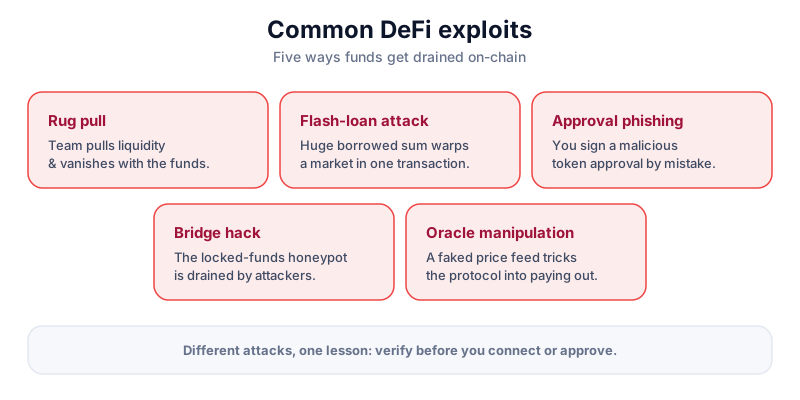
A rug pull is when the people behind a project drain it and vanish. It's less a clever hack than a confidence trick wearing DeFi clothes.
- Liquidity rug — developers withdraw the pool of funds that backs a token's price, leaving holders with something they can't sell.
- Hidden mint or backdoor — the contract secretly lets the team create unlimited tokens or withdraw user deposits.
- Slow rug — hype, a steady drain, then the team quietly disappears.
Guaranteed returns are the tell
Promises of fixed, high, 'risk-free' yields are the clearest red flag of a rug or Ponzi. Real DeFi yields fluctuate and carry risk. See how to avoid crypto scams for the full playbook.
Flash loan and oracle attacks
These are the technical exploits behind many headline DeFi thefts. They abuse how protocols read prices and how DeFi lets you borrow huge sums for an instant.
- Flash loans let an attacker borrow a massive amount with no collateral, as long as it's repaid in the same transaction. Honest uses exist, but attackers use the borrowed firepower to manipulate a market.
- Oracle manipulation — many protocols read an asset's price from an on-chain source. By distorting that source momentarily (often with a flash loan), an attacker tricks the protocol into mispricing assets and drains the difference.
- Reentrancy — a flaw where a contract can be called again before it finishes updating its balances, letting an attacker withdraw repeatedly.
You can't prevent these yourself, but you can prefer protocols that use robust, well-tested price oracles and have survived a long time unbroken.
Malicious approvals and phishing
This is the category that most often hits ordinary users directly, and it's the one you have the most control over. Instead of breaking a protocol, the attacker tricks *you* into authorising the theft.
- Malicious approval — a fake or compromised site asks you to approve a token, and the approval grants a drainer contract permission to spend it.
- Signature phishing — a 'permit' or off-chain signature that quietly authorises moving your tokens with no obvious transaction.
- Fake airdrops and tokens — a worthless token appears in your wallet; interacting with it sends you to a draining site.
- Lookalike front-ends — a cloned version of a real DeFi site at a similar URL.
Read every signature request
Never approve or sign something you don't understand, and never act on urgency from a link, pop-up or DM. A drainer needs only one careless signature. If you've already been hit, see how to recover a hacked wallet.
Protocol and bridge failures
Even honest, careful projects can fail. A single bug in a contract, a stolen admin key, or a connected protocol breaking can cascade through everything built on top of it.
- Code bugs in a protocol's contracts that an attacker discovers and exploits.
- Admin-key compromise — a developer's privileged key is stolen and used to drain funds.
- Bridge hacks — cross-chain bridges are a special, high-value case covered in crypto bridge hacks explained.
- Composability cascades — when one protocol depends on another, a failure in the first ripples outward.
How to stay safe in DeFi
- Stick to established protocols with long track records and large amounts safely locked over the newest, highest-yield project.
- Start small and test with an amount you can afford to lose before committing more.
- Use a separate hot wallet for DeFi, kept apart from the cold storage holding your savings.
- Read and limit token approvals, and revoke old ones regularly with a reputable approval checker.
- Bookmark official sites and never reach a DeFi app through a link in a DM, ad, or email.
- Treat 'guaranteed' or unusually high yields as a warning sign, not an opportunity.
Education, not advice
DeFi carries real and frequent risk of loss. Only ever use funds you can afford to lose, and never borrow to chase yield. This guide is education, not financial advice.

Many exploits trick you into *approving* a malicious transaction. An air-gapped wallet like the Keystone shows you exactly what you're signing on a big screen before anything leaves your wallet — no cable, no Bluetooth, no blind clicks.
Key takeaways
- Most DeFi losses reuse a few patterns: rug pulls, flash loan/oracle manipulation, and malicious approvals.
- The risk you control most is signatures and approvals — read them, limit them, and revoke them.
- Favour established protocols, start small, and treat 'guaranteed' yields as a red flag.
- Keep long-term savings in cold storage and use a separate wallet for experimenting.
Frequently asked questions
What's the most common way people lose money in DeFi?
For ordinary users, it's malicious approvals and phishing — being tricked into signing a transaction or approval that lets a drainer spend their tokens. Rug pulls run a close second. Both are largely avoidable by never signing what you don't understand.
What is a rug pull?
A rug pull is when a project's creators drain its funds — usually by pulling liquidity or using a hidden backdoor — and disappear, leaving holders with worthless tokens. Promises of guaranteed high returns are the classic warning sign.
How do I avoid DeFi scams?
Stick to established protocols, start small, read every approval and signature, revoke old approvals, reach apps only via bookmarked official links, and keep savings in cold storage. See how to avoid crypto scams for more.
Keep reading
What Is DeFi? Decentralised Finance Explained
A beginner's guide to decentralised finance: what DeFi is, how lending, trading and yield work without a bank
Smart Contract Risk Explained (Plain English)
Smart contracts are the code that runs DeFi, NFTs and DEXs — and their bugs can cost users real money. Here's
Crypto Bridge Hacks Explained (Why They Keep Happening)
Cross-chain bridges have lost more to hackers than almost anything else in crypto. Here's what a bridge is, wh