Crypto in Brazil: Adoption, the Legal Framework and Pix
Brazil is the largest crypto market in Latin America, with strong retail adoption, heavy stablecoin use, and a legal framework that gives the central bank a clear supervisory role. This guide explains how crypto works in Brazil, the 2022 law, and how the Pix payment system fits in. It's general education, not financial advice.
The 20-second version
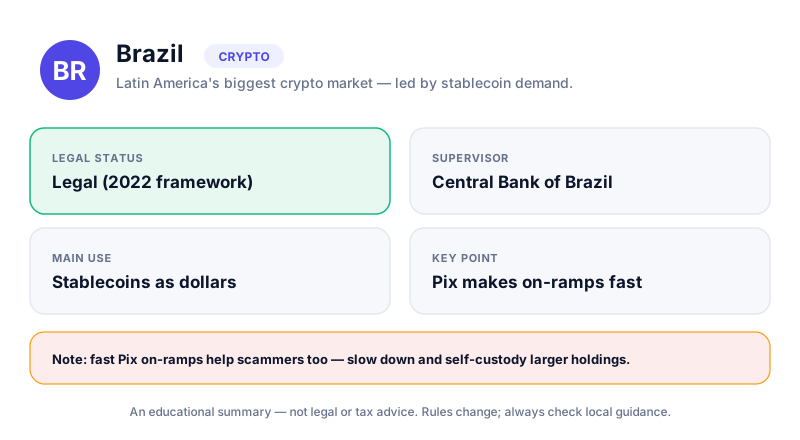
Brazil passed a crypto legal framework in 2022 and put the central bank in charge of supervising virtual-asset service providers. Stablecoins dominate flows as a dollar proxy, and Brazil's instant-payment system, Pix, makes moving in and out of crypto fast.
A leading market in Latin America
Brazil consistently ranks among the highest crypto-adoption countries in Latin America. A large population, a sophisticated banking sector and high inflation in past years have all driven interest in Bitcoin and especially stablecoins as a way to hold dollar-pegged value.
Data from the central bank and industry surveys repeatedly show that stablecoins make up the bulk of crypto value moving in and out of Brazil — used less for speculation and more as digital dollars.
The 2022 legal framework
In December 2022 Brazil enacted a law (often called the Legal Framework for Virtual Assets) that established rules for crypto service providers and brought them under formal supervision. The Central Bank of Brazil was given responsibility for regulating and overseeing virtual-asset service providers, while the securities regulator (CVM) handles assets that qualify as securities.
- Central Bank of Brazil — supervises virtual-asset service providers.
- CVM — oversees crypto assets that are classified as securities.
- Licensing and consumer protection — the framework aims to bring exchanges into a regulated perimeter.
How Pix changed the on-ramp
Pix is Brazil's instant-payment system, run by the central bank, and it's become central to how people move money. Because Pix transfers are instant and effectively free for individuals, buying and selling crypto on local exchanges is fast and low-friction — you can fund an account and trade in minutes.
Fast on-ramps cut both ways
Quick funding is convenient, but it also makes impulsive decisions and scam transfers easier. Slow down before sending money, and never move funds because someone created urgency.
Using crypto safely in Brazil
Brazilians have access to both large global exchanges and strong local players. Whichever you use, the platform holds your keys until you withdraw to your own wallet — so for meaningful amounts, learn how to store crypto safely and what a seed phrase is. If you need to work out what you owe locally, Koinly imports your history and supports the tax rules of dozens of countries.
Volatility and risk
Crypto is volatile and you can lose money, and Brazil has seen large 'guaranteed return' fraud schemes. Only risk what you can afford to lose, and read how to avoid crypto scams. Education, not financial advice.
Key takeaways
- Brazil is Latin America's largest crypto market, led by stablecoin demand.
- A 2022 legal framework put the central bank in charge of supervising providers.
- The Pix instant-payment system makes funding and exiting crypto very fast.
- Fast on-ramps help scammers too — slow down and self-custody larger holdings.
Frequently asked questions
Is crypto legal in Brazil?
Yes. Brazil enacted a legal framework for virtual assets in December 2022, giving the Central Bank of Brazil responsibility for supervising crypto service providers.
Why are stablecoins so popular in Brazil?
Stablecoins track the US dollar, so they let people hold dollar-pegged value and move money easily. They make up the bulk of crypto flows in and out of the country. See what is a stablecoin.
How does Pix relate to crypto?
Pix is Brazil's instant, low-cost payment system. It makes funding and withdrawing from crypto exchanges fast — convenient, but a reason to be careful about impulsive or scam-driven transfers.
Keep reading
Crypto in Nigeria: Adoption, Rules and How It Works
A plain-English guide to cryptocurrency in Nigeria — why adoption is so high, how the naira and CBN rules have
Crypto in the UAE: Dubai, VARA and a Pro-Crypto Hub
How cryptocurrency works in the United Arab Emirates — Dubai's VARA regulator, free zones, the tax picture, an
What Is a Stablecoin? How the Peg Works (and Fails)
A clear guide to stablecoins: how they aim to hold a steady value, the different types, and the very real peg