Crypto in South Korea: Rules, Exchanges and the 'Kimchi Premium'
South Korea has one of the most enthusiastic retail crypto cultures anywhere, paired with strict rules designed to keep it transparent. This guide explains the real-name banking system, the big local exchanges, the famous 'kimchi premium', and the country's investor-protection law. It's general education, not financial advice.
The 20-second version
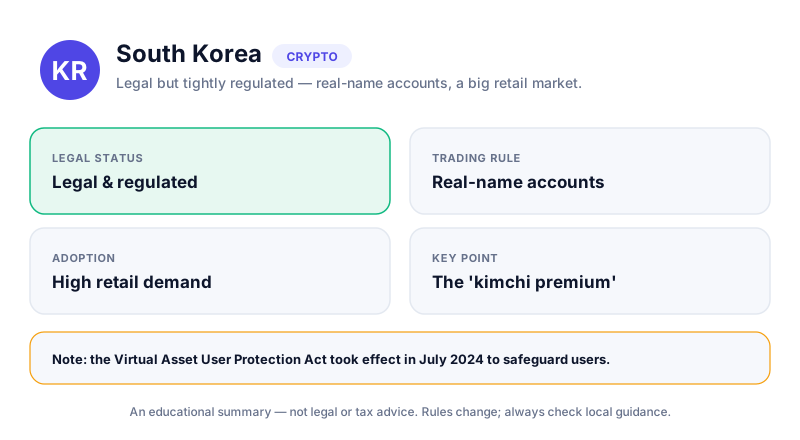
South Korea requires real-name, bank-verified accounts to trade crypto, and trading is dominated by a few big local exchanges. Prices sometimes run higher than abroad — the 'kimchi premium'. A new investor-protection law took effect in 2024 to safeguard users.
Real-name trading and the exchanges
South Korea's defining rule is the real-name system. To trade on a domestic exchange, you generally need a verified bank account in your own name at a partner bank, linking your identity to your trading. This anti-money-laundering measure is why anonymous trading on local platforms is effectively impossible.
The market is concentrated in a handful of large domestic exchanges, with Upbit and Bithumb among the best known. Korean retail interest in Bitcoin, Ethereum and smaller altcoins is famously high.
What is the 'kimchi premium'?
The 'kimchi premium' is the nickname for times when crypto trades at a noticeably higher price on Korean exchanges than on international ones. It tends to appear when local demand surges and capital can't easily flow in and out to even prices up.
- Strong local demand can push prices above the global average.
- Capital controls and banking friction make cross-border arbitrage harder.
- It's not free money — moving funds to capture it carries cost, delay and risk.
The investor-protection law
After the 2022 collapse of the Terra/Luna project — which was closely associated with a Korean founder and hit many local investors hard — South Korea accelerated formal rules. The Virtual Asset User Protection Act took effect in July 2024, requiring exchanges to safeguard user assets, segregate funds, and tighten oversight of unfair trading.
Protection isn't a guarantee
Rules reduce some risks but don't remove volatility or the chance of platform failure. For meaningful holdings, learn how to store crypto safely in your own wallet.
Getting started safely
Newcomers in Korea typically start on a regulated local exchange after completing real-name verification. As anywhere, the platform holds your keys unless you withdraw to self-custody. If you need to work out what you owe locally, Koinly imports your history and supports the tax rules of dozens of countries.
Volatility and risk
Crypto is highly volatile and you can lose money. Only risk what you can afford to lose, never borrow to buy, and treat 'guaranteed return' offers as scams. See how to avoid crypto scams. Education, not advice.
Key takeaways
- Trading requires a real-name, bank-verified account on domestic exchanges.
- Upbit and Bithumb dominate a very active retail market.
- The 'kimchi premium' is when local prices run above global ones.
- The Virtual Asset User Protection Act took effect in July 2024.
Frequently asked questions
Why do I need a real-name account in South Korea?
It's an anti-money-laundering rule. Domestic exchanges link your trading to a verified bank account in your own name, so anonymous local trading isn't possible.
Can I profit from the kimchi premium?
In theory the price gap looks like an opportunity, but capital controls, banking friction, fees and timing risk make it far harder to capture than it appears. This is education, not a strategy recommendation.
Is crypto regulated in South Korea?
Yes. Alongside real-name trading rules, the Virtual Asset User Protection Act took effect in July 2024 to safeguard users' assets and curb unfair trading.
Keep reading
Crypto in Japan: Regulation, Exchanges and Tax
How cryptocurrency works in Japan — one of the world's most regulated markets. Licensing under the FSA, the le
Crypto in the UAE: Dubai, VARA and a Pro-Crypto Hub
How cryptocurrency works in the United Arab Emirates — Dubai's VARA regulator, free zones, the tax picture, an
What Is Ethereum? A Plain-English Guide
A beginner-friendly explanation of Ethereum: what it is, how it differs from Bitcoin, what smart contracts do,