DeFi & NFT Tax in the UK: A Plain-English Guide
DeFi and NFTs are where UK crypto tax gets genuinely hard. The same transaction can be income or capital depending on the fine detail, and a single 'click to confirm' can hide several taxable events. This is a plain-English guide to the general principles HMRC sets out — not personal tax advice.
The 20-second version
HMRC has specific (and complicated) guidance for DeFi and NFTs. DeFi returns may be taxed as income or as a capital gain depending on the 'nature of the return', and moving tokens into or out of a protocol can itself be a disposal. With NFTs, buying with crypto is a disposal of that crypto, and selling an NFT is a disposal too. Because this area is so fact-specific, check HMRC's Cryptoassets Manual and consider a qualified accountant.
Read this first
This is education, not tax advice
Tax rules, rates and allowances change, and DeFi and NFT activity is unusually fact-specific — two people doing what looks like the same thing can have very different tax outcomes. Nothing here is personal advice. Always check the current official HMRC guidance (the Cryptoassets Manual, including the DeFi sections) or speak to a qualified accountant before filing.
Why DeFi and NFTs are the hard part
Most people get their heads around the basics fairly quickly: you buy crypto, you sell it later, and any profit can fall under Capital Gains Tax. DeFi and NFTs break that simple picture. A single action in a DeFi app — supplying liquidity, wrapping a token, bridging to another chain — can trigger one or more taxable events that aren't obvious from the wallet screen. If you're new to the territory, our explainers on what DeFi is and what an NFT is set the scene.
The core difficulty is that HMRC does not have a single, simple rule that says 'all DeFi is income' or 'all DeFi is capital'. Instead, the treatment depends on the nature of the return and what is actually happening at a transaction level. That means the labels an app uses ('earn', 'yield', 'rewards') don't decide the tax — the underlying substance does.
The recurring theme: 'is it income or capital?'
Across DeFi, the same question comes up again and again. If a return looks more like interest or a fee for a service, it may be income. If it looks more like a growth in the value of an asset you hold, it may be capital. HMRC asks you to look at the real nature of the return, not the marketing label.
DeFi: income or capital gain?
HMRC's guidance treats DeFi returns (from lending and staking-style activity within protocols) as either income or a capital gain depending on the nature of the return. It points to factors such as whether the return is known up front or speculative, whether it's paid like interest over time, and the overall economic reality of the arrangement. There is no shortcut here — it genuinely is a case-by-case judgement.
Lending and 'earn' products
When you lend crypto through a protocol and receive a return, that return might be income (taxed when it arises) or capital (relevant when you later dispose of the asset). A separate question is whether transferring your tokens to the protocol is itself a disposal — HMRC's view is that this depends on whether you keep beneficial ownership of the tokens. If you don't, putting them in may be a disposal for Capital Gains Tax purposes, even though it doesn't feel like a 'sale'.
Liquidity pools and LP tokens
Adding to a liquidity pool often means handing over two tokens and receiving an LP token in return. Depending on the arrangement, that swap can be a disposal of the tokens you put in. The same can happen in reverse when you withdraw. This is one of the most common ways people accidentally rack up disposals they never recorded.
| DeFi action | Possible taxable event(s) |
|---|---|
| Lend tokens to a protocol | Possible disposal on transfer in; return may be income or capital |
| Receive an LP token for a deposit | Possible disposal of the deposited tokens |
| Claim yield / rewards | May be income when received, or affect cost basis |
| Withdraw from a pool | Possible disposal of the LP token |
| Wrap a token (e.g. ETH to wrapped ETH) | Possibly a disposal — fact-dependent |
| Bridge to another chain | Possibly a disposal — fact-dependent |
Because staking and similar reward mechanics overlap heavily with DeFi, and because every protocol is structured differently, the table above lists *possible* outcomes only. The right answer for your specific transactions depends on the detail. For the underlying mechanics, see our explainer on what staking is.
Wrapping, bridging and 'invisible' disposals
Two actions catch people out repeatedly because they feel like admin rather than trades:
- Wrapping — converting a token into a wrapped version so it works on a particular protocol. Depending on the facts, swapping token A for wrapped token A can be a disposal.
- Bridging — moving an asset from one blockchain to another. Again, whether this is a disposal depends on what's really happening to ownership, not on the fact you 'still have the same coin' in your head.
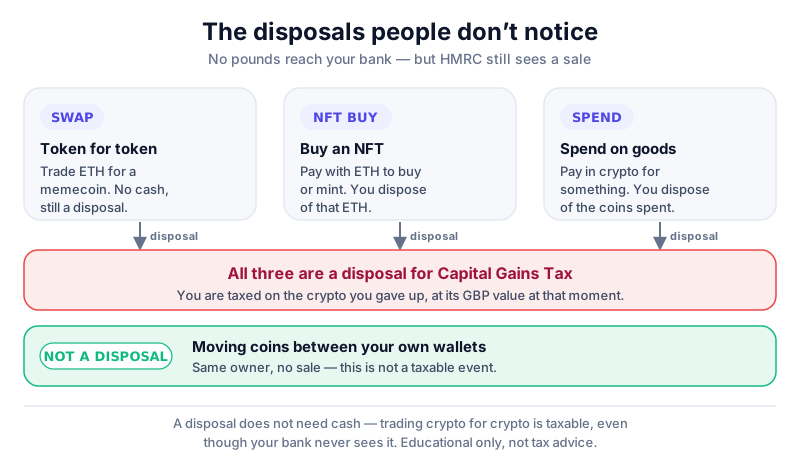
Remember that under HMRC's general approach, swapping one crypto for another is a disposal — you can owe Capital Gains Tax even though no pounds changed hands. We cover that core idea in more depth in do you pay tax swapping crypto in the UK. DeFi simply stacks lots of these swaps together, sometimes inside a single transaction.
Treat every protocol interaction as a question, not an assumption
A useful habit: whenever you deposit, withdraw, wrap, bridge or claim, ask 'did ownership of an asset change here?' If you can't answer confidently, flag the transaction for review rather than assuming it's tax-free.
NFTs: two disposals hiding in one purchase
NFTs are often bought with crypto, and that's where the surprise sits. Buying an NFT with crypto is a disposal of that crypto — you've effectively sold (say) the ETH you spent, so any gain on that ETH since you acquired it can be within Capital Gains Tax. Then, separately, selling the NFT later is a disposal of the NFT. One round trip can therefore involve gains to think about at both ends.
- You buy an NFT using ETH — this is a disposal of your ETH, so work out the gain or loss on that ETH.
- You hold the NFT — no disposal while you simply hold it.
- You sell the NFT (for crypto or pounds) — this is a disposal of the NFT, so work out the gain or loss on the NFT.
- If you bought it with crypto and sell for crypto, you may also be acquiring a new asset to track from that point.
For most people, NFT gains sit under Capital Gains Tax in the same way other crypto disposals do, and you'd follow the usual capital gains calculation approach including the pooling and matching rules. But NFTs can also raise harder questions — for example whether very frequent trading looks more like a trade (income) than investment, or how royalties received as a creator are taxed. Those are exactly the situations where professional advice earns its keep.
Royalties and creator income are different again
If you mint and sell NFTs or receive ongoing royalties, that activity can look like income or even a trade rather than simple investment gains. The treatment depends on your circumstances, so don't assume the Capital Gains route applies to creators automatically.
Records: the only thing that makes this survivable
The practical reality of DeFi and NFT tax is that you cannot reconstruct it from memory. Protocols generate dozens or hundreds of on-chain events, values move minute to minute, and the GBP value at the moment of each transaction matters. Good records are not optional admin — they're what stands between you and a guess at filing time.
- Wallet addresses and the protocols you've interacted with
- Date and time of each deposit, withdrawal, swap, wrap, bridge and claim
- The GBP value of each asset at the time of each event
- Any fees paid (gas and protocol fees), which can affect your figures
- NFT purchase price (in crypto and its GBP value), sale price, and any royalties
Because the volume is so high, most people in this area lean on tax software to pull transactions from chains and wallets and apply HMRC's pooling and matching rules automatically. We compare options in the best UK crypto tax software, and the general principles still trace back to the overview in crypto taxes in the UK. Whatever tool you use, sense-check the output — DeFi edge cases are exactly where automated tools can disagree.

Koinly connects your exchanges and wallets, pulls in DeFi and NFT activity, and applies HMRC's pooling plus the Same-Day and 30-day rules for you. It's free to preview your position, and you only pay when you download the SA108-ready report.
Key takeaways
- DeFi returns can be income or a capital gain — it depends on the nature of the return, not the app's label.
- Depositing, withdrawing, wrapping and bridging tokens can each be a disposal for Capital Gains Tax.
- Buying an NFT with crypto is a disposal of that crypto; selling the NFT is a disposal too.
- NFT creators and very active traders can face income or trading treatment, not just capital gains.
- Detailed, transaction-level records are essential — and this is the area to get professional advice.
Frequently asked questions
Is DeFi yield taxed as income or capital gains in the UK?
It can be either. HMRC's guidance says the treatment depends on the nature of the return — whether it behaves more like interest or a fee (pointing towards income) or more like growth in an asset you hold (pointing towards a capital gain). Because it's fact-specific, check HMRC's Cryptoassets Manual or an accountant.
Do I pay tax when I add or remove liquidity from a pool?
Possibly. Receiving an LP token in exchange for your deposited tokens can be a disposal of those tokens, and withdrawing can be a disposal of the LP token. Whether it is depends on the specifics of the protocol and whether ownership changed, so it's worth confirming for your transactions.
Do I pay tax when I buy an NFT with crypto?
Spending crypto to buy an NFT is generally a disposal of that crypto, so any gain on the crypto since you acquired it can fall under Capital Gains Tax. Selling the NFT later is then a separate disposal. One purchase-and-sale can therefore involve gains at both ends.
Does wrapping or bridging a token trigger tax?
It can. HMRC looks at whether ownership of an asset actually changes, so wrapping a token or bridging it to another chain may be a disposal depending on the facts. Don't assume it's tax-free just because it feels like a technical step rather than a sale.
Keep reading
Crypto Taxes in the UK: A Plain-English Overview (HMRC)
How HMRC generally treats crypto for UK taxpayers — capital gains, income, record-keeping and allowances — exp
Koinly Review (2026): The Best Crypto Tax Software for UK Users?
Our Koinly review: the most HMRC-ready crypto tax software we've used, with Same-Day and Bed-and-Breakfasting
Crypto Staking & Mining Tax in the UK: Income or Capital Gains?
How HMRC generally treats UK staking, mining, lending and DeFi rewards — usually Income Tax on receipt, then C