Ethereum Staking Explained
We mentioned proof-of-stake back in how Ethereum works — staking is the engine behind it, and the reason Ethereum no longer needs mining. This lesson explains what staking actually is, the main ways people take part, and — just as importantly — the real risks hiding behind the advertised rewards. Staking is one of the more genuinely useful things you can do with ETH, but it is routinely mis-sold, so we'll be straight with you about both sides.
The 20-second version
Staking means locking up ETH to help secure the network, and earning a modest reward for doing so honestly. There are several ways to take part, each with different risks. The rewards are not guaranteed and not free money.
What staking actually is
Staking is the engine behind Ethereum's proof-of-stake system. Instead of miners burning electricity to compete for the right to add blocks, validators lock up ETH as a security deposit and take turns proposing and checking blocks. Behave honestly and you earn a small reward; cheat or go offline and part of your stake can be taken away. The locked ETH is the skin in the game that keeps everyone honest — the network doesn't need to trust you, because your own money is on the line.
A useful way to picture it: staking is like leaving a refundable deposit to become a trusted referee. As long as you call the game fairly, you get the deposit back plus a small fee for your trouble. Try to cheat and you forfeit part of it. Multiply that across hundreds of thousands of validators and you get a network that's expensive to attack and cheap to keep honest. That's the clever bit — security comes not from goodwill but from everyone having something to lose.
If the general idea is new to you, start with what is staking, which covers the concept across all networks, and what is slashing if you want to understand the penalty side. Here we focus on how it works specifically on Ethereum — and on the risks the marketing tends to skip right over.
The main ways to stake ETH
There isn't one single way to stake — there's a spectrum, and where you sit on it trades control for convenience. At one end you do everything yourself and answer to no one; at the other, someone does it all for you and you simply trust them. Each step along that line carries a different set of risks, so it's worth understanding the choices before handing over any ETH rather than after.
| Approach | What it involves | Main trade-off |
|---|---|---|
| Solo staking | Run your own validator with 32 ETH | Most control; needs technical skill and reliable uptime |
| Staking pool / liquid staking | Pool ETH with others via a service | Easier and no 32 ETH minimum; you rely on a third party's contract |
| Exchange staking | Let an exchange stake on your behalf | Simplest; least control, and the exchange holds the keys |
Liquid staking is especially popular because it hands you a token representing your staked ETH that you can use elsewhere while it earns — so your capital isn't simply frozen in place. You can think of it as a cloakroom ticket for your staked ETH that you can spend or trade while the coat stays checked. Handy, but it adds smart-contract risk and another layer of complexity, and those liquid-staking tokens can occasionally trade for slightly less than the ETH they represent. As a rule of thumb on Ethereum, convenience and risk tend to move together: the easier an option feels, the more trust you're quietly placing in someone else's code or custody.
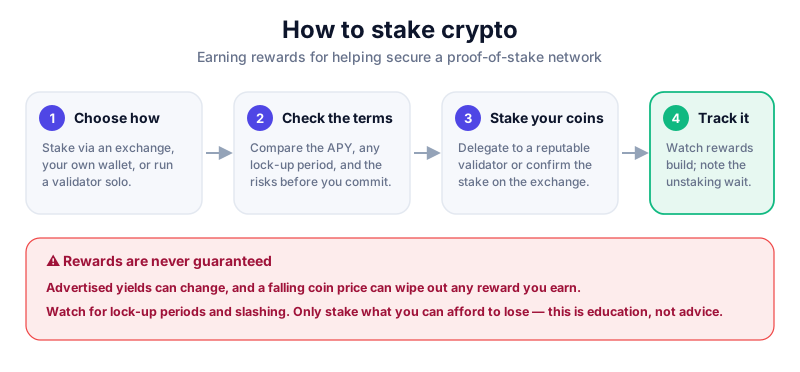
The real risks
Staking is often sold as 'earn interest on your ETH', which makes it sound like a savings account at the bank. It isn't, and that framing is the most misleading thing about how staking is marketed. It hides genuine risks you should understand fully before taking part — none of them is exotic, but each can cost you real money, and they can stack on top of each other:
- Price risk. Your reward is paid in ETH, whose value can fall. You can earn a perfectly good percentage and still end up worth less than when you started, because the coin itself dropped — a 5% reward means nothing if the price halves.
- Slashing. Validators that misbehave or go badly offline can lose part of their stake. With a pool, a problem at the operator running things can hit you even if you personally did nothing wrong.
- Lock-ups and delays. Depending on how you stake, withdrawing can take time — sometimes days. You may not be able to exit the instant you want to, which matters a great deal in a fast-moving market.
- Smart-contract risk. Liquid-staking and pool services rely on code that could contain bugs or be exploited, and the large pots of funds inside them are a juicy target for attackers.
- Counterparty risk. Exchange or service staking means trusting a third party that could fail, freeze withdrawals, get hacked, or simply mismanage things — and if they go down, your ETH may go with them.
Rewards are not free money
Staking yields are a reward for taking on risk and helping secure the network — not guaranteed interest, and definitely not free money. They can change, and your ETH can lose value at the same time. This is education, not financial advice. Be especially wary of anything promising unusually high, 'guaranteed' returns — that's the oldest red flag there is.
Staking scams to avoid
Because staking sounds like easy passive income, it's a favourite theme for scammers. They lean on the same instinct that makes staking appealing — 'put money in, get more money out' — and dress up a straightforward robbery as a once-in-a-lifetime opportunity. Treat sky-high yields and any pressure to 'connect now' as bright red flags, not exciting offers.
- Fake 'staking' sites that ask you to approve a contract, then use that approval to drain your wallet — this is exactly the token approvals risk from the last lesson, weaponised.
- Anyone asking for your seed phrase to 'set up staking' — no legitimate service ever needs it, and the request itself is proof of a scam. End the conversation there.
- Promises of fixed double-digit daily or weekly returns. Real Ethereum staking rewards are modest, single-digit annual figures, not get-rich-quick numbers — if it sounds too good to be true, it is.
If you do stake from a self-custody wallet, only approve contracts you've genuinely researched, double-check the address character by character, and read how to avoid crypto scams first. A few minutes of caution is far cheaper than a drained wallet, and there's no undo button once the funds leave.
Where to go next
Staking is just one of several ways people use Ethereum beyond simply holding ETH — and one of the more straightforward and honest ones, provided you go in with eyes open. To see the wider landscape of apps, and the much sharper risks that come with them, the final lesson covers Ethereum DeFi and dapps. And whatever you do on-chain, keep one eye on gas fees so the costs never catch you out. You're nearly at the end of the course now — the deep end is next. One habit worth adopting from day one: delegate from a hardware wallet like the Keystone 3 Pro, so staking never means exposing your keys.
Key takeaways
- Staking secures Ethereum's proof-of-stake network in place of mining.
- There's a spectrum from solo staking to exchange staking, trading control for ease.
- Rewards are not guaranteed: price falls, slashing, lock-ups and contract risk all apply.
- Treat high 'guaranteed' yields as a scam signal, and never share your seed phrase.
Frequently asked questions
How much ETH do I need to stake?
Running your own validator needs 32 ETH, but pools, liquid-staking services and exchanges let you stake much smaller amounts. Each option carries its own risks, so easier isn't automatically better.
Is staking safe?
It's not risk-free. You face price falls, possible slashing, withdrawal delays and — with services — smart-contract and counterparty risk. Understand all of these before taking part rather than after.
Can I lose my staked ETH?
Yes, in several ways: validators can be slashed, the ETH price can fall while it's locked, and a flawed service or contract could fail. Rewards are compensation for these risks, not free money.
Keep reading
How Ethereum Works: Smart Contracts, the EVM and Gas
A clear, high-level look at how Ethereum works — smart contracts, the Ethereum Virtual Machine, gas fees, and
What Is Staking? How It Works and What It Costs
A plain-English guide to crypto staking: how it secures proof-of-stake networks, how rewards work, and the loc
Ethereum DeFi and Dapps Explained
What decentralised apps and DeFi are on Ethereum, the main categories, the serious risks involved, and how to