How Bitcoin Works (Without the Jargon)
In lesson one we said Bitcoin is money no bank controls, yet nobody can forge or spend twice. Said quickly, that can sound like magic — and a healthy sceptic should distrust magic. So this lesson pulls back the curtain and explains, in plain English, how it actually works: the shared ledger, what happens when you send a payment, how mining keeps everyone honest, and why there will only ever be 21 million coins. No equations, just the mental model that makes everything later in the course click into place.
The 20-second version
Bitcoin runs on a shared public ledger called a blockchain. Every ten minutes, computers called miners bundle new transactions into a block, do expensive maths to confirm it, and earn new bitcoin for the work. That process keeps the ledger honest and makes cheating wildly impractical — you'd have to out-spend the entire network at once.
The shared ledger at the centre of it all
Forget coins for a moment. Bitcoin is really a giant, public list of who owns what — a ledger. Picture a notebook recording every payment ever made. Now imagine that instead of one bank keeping that notebook locked in a back room, thousands of computers around the world each keep an identical copy, constantly checking each other's against their own. If one copy disagrees with the rest, the others simply ignore it. This is the blockchain, and it's the foundation everything else sits on.
Because every copy has to agree, no single person can quietly edit the record to give themselves more bitcoin. If you tried, the other thousands of copies would disagree with yours and reject it outright. To change the ledger you'd have to convince the whole network at once — which, as we'll see, is so expensive it isn't worth attempting. That shared agreement, with no boss in charge and no head office, is what 'decentralised' really means in practice. It's not a marketing word here; it's the actual design.
Why 'blockchain'?
Transactions are grouped into 'blocks', and each block carries a fingerprint of the one before it — forming a chain. Tampering with an old block would change its fingerprint and break every link after it, so the network would instantly spot the forgery and reject it. The deeper a transaction is buried under newer blocks, the more set-in-stone it becomes.
What happens when you send Bitcoin
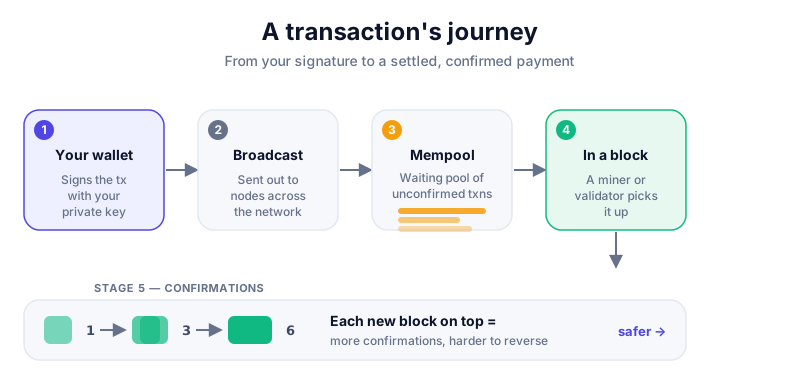
When you send bitcoin, you're not emailing a file or posting an object across the internet. You're broadcasting a signed message to the network that says, in effect, 'move this amount from my address to theirs.' Your wallet signs that message with your private key — a secret only you hold — to prove the instruction genuinely came from you and hasn't been tampered with. Think of it like a wax seal that anyone can recognise as yours but nobody can copy: everyone can verify it, no one can forge it.
- Your wallet creates and signs the transaction using your private key, proving ownership without ever revealing the key itself.
- The network checks the signature is valid and that you actually have the coins you're trying to spend.
- Miners include your transaction in the next block, confirming it for good and writing it into the permanent record.
Notice what this means: only the keys can authorise a spend. There's no password reset, no 'forgot my login', no manager who can wave a transaction through. Whoever holds the key holds the coins — full stop. That's exactly why protecting your keys matters so much, a theme that runs right through the rest of this course when we cover storing Bitcoin safely. It's also why no scammer can simply 'hack your balance' — they have to trick you into handing over the key, which is a story for lesson six.
Mining: how new blocks are confirmed
Roughly every ten minutes, miners compete to confirm the next block. They race to solve a hard numerical puzzle that takes enormous computing power to crack but is trivial for anyone else to check — a bit like a combination lock that's slow to guess but instant to verify once you've got the right number. The first miner to solve it gets to add the block and is rewarded with newly created bitcoin plus the transaction fees inside it. This whole system is called proof of work, and there's a fuller tour of it in what is Bitcoin mining.
The expense is the feature, not a bug. Because confirming blocks burns real electricity and real hardware, rewriting history would mean out-spending the entire honest network at once — for a payoff that would crash the price of the very thing you stole. Attacking Bitcoin costs far more than it could ever earn, so the rational move is to play by the rules and collect the rewards instead. It's security bought with maths and money rather than with trust in a name on a building. That's a genuinely different way to make money work, and it's the heart of why Bitcoin holds together.
The halving
About every four years, the mining reward is cut in half — an event called the halving. It slows how fast new bitcoin enters circulation and is baked into the code, not decided by anyone. This predictable, shrinking issuance is how Bitcoin gradually approaches its hard cap of 21 million.
Why there will only ever be 21 million
Bitcoin's supply is capped at 21 million coins, and that limit is enforced by the same rules every participant's software runs. There's no central bank that can decide to print more, and no emergency button to mint extra in a crisis. If a single person tried to create coins out of thin air, every other node would check the rules, see the block is invalid, and throw it away. This is the core of why supporters describe Bitcoin as scarce 'digital gold' — its scarcity is mathematical and verifiable by anyone, not a pledge you have to take on faith.
Crucially, you never need to buy a whole bitcoin. Each one divides into 100 million tiny units called satoshis, so you can own a fraction worth a few pounds or dollars and still hold genuine, 'real' Bitcoin — the same asset, just a smaller slice. The cap is about the total supply, not the smallest amount you're allowed to touch. So if a coin's headline price ever makes Bitcoin feel out of reach, that's a misunderstanding worth shaking off early.
Scarcity is not a price prediction
A capped supply does not guarantee value, and it certainly doesn't guarantee the price will rise. Plenty of scarce things are worth nothing. Bitcoin is highly volatile and can fall sharply. This guide is education, not financial advice — only ever risk what you can afford to lose, and never borrow to buy.
Where to go next
That's the machinery demystified: a shared ledger, signed transactions, mining to keep it honest, and a fixed supply enforced by code rather than by trust. With lesson two behind you, you've got the mental model you need for everything practical that follows. If you fancy going deeper on the foundations, explore how blockchains work or what is Bitcoin mining. Otherwise, it's time to get hands-on — the next lesson covers buying Bitcoin safely, and then we'll lock down storing it so it's properly yours.
Once you own Bitcoin, *not your keys, not your coins* is the rule that matters. A simple hardware wallet like the BitBox02 keeps your keys offline and off exchanges — the safest way to hold for the long term.
Key takeaways
- Bitcoin is a shared public ledger copied across thousands of computers that must all agree.
- Transactions are signed messages — only your keys can authorise a spend, with no reset button.
- Mining (proof of work) confirms blocks and makes cheating uneconomic by design.
- Supply is capped at 21 million, enforced by code — but that's no guarantee of value.
Frequently asked questions
Who controls Bitcoin?
No one. It's run by a global network of users, node operators and miners who all follow the same open rules. Changes only happen if a broad majority voluntarily adopts them — no single party, company or government can force an update on everyone else.
What stops someone spending the same bitcoin twice?
The network only accepts one version of history. Once a transaction is confirmed in a block, any attempt to spend those same coins again is checked against the ledger and rejected as invalid. This 'double-spend' problem is exactly what Bitcoin was invented to solve.
Does mining waste energy?
Mining uses significant electricity, and that's a genuine, ongoing debate worth taking seriously rather than waving away. A growing share comes from renewable or otherwise stranded energy, but the environmental impact is a fair criticism to weigh in the balance.
Keep reading
What Is Bitcoin? A Plain-English Guide
A beginner-friendly explanation of what Bitcoin is, how it works, and how to think about it — with no hype and
How Blockchain Works (Without the Jargon)
A plain-English explanation of what a blockchain actually is, how blocks are linked and confirmed, what makes
What Is Bitcoin Mining? How New Coins Are Made
A clear guide to Bitcoin mining: how proof-of-work secures the network, what miners actually do, the halving,