How Coin Gabbar's Paid Listings Really Work — In Its Own Words
Coin Gabbar is one of the most-cited crypto directories in presale marketing — the 'featured' badge on its presale list is a fixture of the promotional articles we review every week. So we did something simple: we read its own published pages. Its editorial policy describes 'paid listing promotion' as a 'separate business product'. Its press-release page promises publication within 24 hours and refunds for rejected submissions. And placement on its domain is openly retailed by third-party PR marketplaces from $100. None of this is hidden — it's on their own website — and understanding it changes how you should read every rating, badge and 'top presales' list you'll ever meet.
The 20-second version
By its own description, Coin Gabbar sells promotional placement: press releases, sponsored posts and 'paid listing promotion'. Its directory pitch offers projects *'instant exposure to a highly targeted audience of early adopters'* — that audience is you. A directory can be both a real information site and a shop window; the skill is telling which part you're looking at, and this page shows you how.
What Coin Gabbar is
Coin Gabbar describes itself as *'home to unbiased, independent, and free crypto information'* and a *'Crypto Information and Research Marketplace'*. Its own pages name its owner as DCG Tech FZCO (UAE), with Gabbar MediaTech Pvt Ltd as 'Delivery Partner' and 'Coin Gabbar Private Limited, India' appearing on its disclaimer page; the domain dates to January 2022. It is fully accessible to UK readers and publishes UK-targeted commercial content, including a co-founder-bylined 'Best Crypto Exchange UK' buyer's guide. It also publishes real news coverage and carries risk disclaimers across its pages — this article is about how its commercial products work, in its own words.
The products it sells, as it describes them
Coin Gabbar's editorial policy states: *'Paid listing promotion is a separate business product and is labelled as Sponsored.'* Its press-release page pitches '500,000+ Monthly Readers', publication *'within 24 hours'*, Google News indexing, and — the line that confirms the commercial nature of the product — *'Rejected submissions receive a full refund.'* Its disclaimer page lists 'Submit Crypto Press Release' and 'Submit Sponsored Post' among its services. And its presale directory invites projects directly: *'Ready to get your project in front of serious investors? Use our submit crypto presale feature to list your token and gain instant exposure to a highly targeted audience of early adopters… boost credibility, increase visibility, and build momentum before launch.'*
Read that pitch from the buyer's side
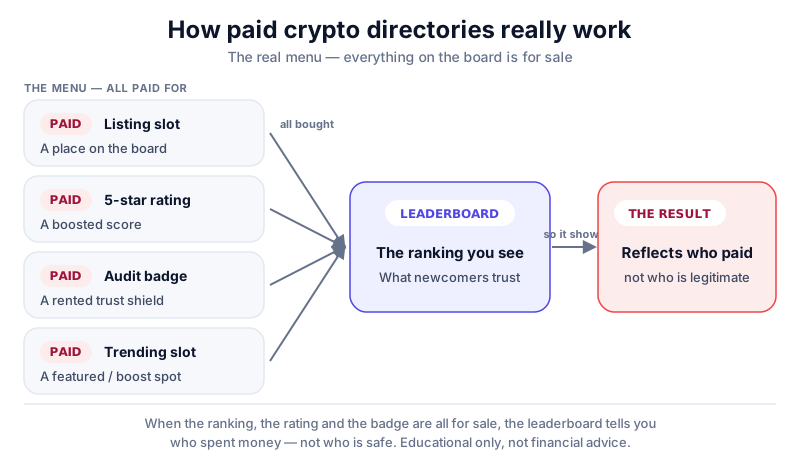
'Boost credibility' is the product being sold — to the project, about you. When a listing's job is manufacturing credibility, the listing can't also be your evidence of credibility. That's not an accusation; it's the business model as advertised.
The 'featured' badge and the missing methodology
When we checked the presale directory on 4 July 2026, three listings carried a 'featured' badge: Pepeto, Candy Coin and Bullski Coin. Nowhere on the site could we find a definition of what 'featured' means or how a project obtains it. The directory names six evaluation criteria — utility, roadmap, tokenomics, team transparency, community, security — but publishes no scoring methodology, no weights, and no per-project scores. Its own disclaimer is candid about what a listing is worth: *'CoinGabbar's listing of a project does not constitute an endorsement or financial advice.'* We agree — and suggest taking them at their word.
The reseller economy: placement, retailed
Placement on coingabbar.com is openly sold by third parties. Web3Newswire retails a 'Press Release on Coin Gabbar' for $100 (regular $110), pitched on *'exposure to 84.7K monthly visitors'* and the domain's SEO authority. PRNews.io carries a listing titled *'Coin Gabbar.com — add sponsored post to boost your online visibility'*. A gig-marketplace listing has offered *'Press Release publishings on CoinGabbar + 20 other website, 2 DF'* — 'DF' meaning dofollow links, the kind that pass Google ranking authority — for $125. Two observations follow. First, the reseller's '84.7K monthly visitors' pitch sits oddly beside Coin Gabbar's own '500,000+ Monthly Readers' claim — both are just claims, and we endorse neither. Second, when placement is retailed as bundled SEO inventory, the 'news' you find when googling a presale may simply be the $100 product, syndicated.
The labelling promise, and what we found
Coin Gabbar's editorial policy makes specific promises: *'Every sponsored content piece on CoinGabbar is clearly labelled at the top of the page'*, before the article body, and *'sponsored content is never shown as independent editorial content'*. Its policy also promises that every price-prediction article carries a disclaimer *'at the top of the article, not just in the footer'*. When we checked four of its presale-promotion articles on 4 July 2026 — including a 'Nexchain Presale Guide', a 'Best Crypto Presales 2026' list and a Pepeto price-prediction piece using countdown-urgency language — none displayed a sponsored label, and the price-prediction piece carried its disclaimer at the bottom. To be precise about what that does and doesn't show: we have no evidence that any of those specific articles was paid for — they may all be ordinary editorial. What we can report is the distance between the labelling policy as written and the pages as we found them, on that date.
The generic lesson
This is why our paid-listings guide says to treat promotional-toned coverage as advertising until proven otherwise, wherever you find it: labels are a policy choice, applied imperfectly across the whole industry — so the burden of scepticism sits with you, not the label.
The UK reader's problem
Coin Gabbar actively publishes for UK readers, and its presale pages carry genuine but generic risk language — *'crypto presales are inherently high-risk'* — rather than the prescribed warning UK financial promotions must display. Whether the UK's financial-promotion regime captures an overseas directory's presale promotion is a live legal question we won't pretend to settle. What matters practically: the presale listings you meet there have not passed through the UK's s21 approval gate, so the protections that regime exists to give you — prescribed warnings, banned incentives, cooling-off — are absent. You are your own compliance department.
In fairness
Several things deserve stating plainly. Coin Gabbar's policy explicitly commits that ratings and rankings are never changed for payment, and we found nothing contradicting that commitment on ratings specifically. Its presale listing pages can carry genuinely useful warnings — its own Pepeto page flags the *'anonymous team with an unverified Pepe co-founder claim'* and a *'19+ month sale with no token distribution yet'*, which is franker than most of the promotional ecosystem manages. Its policy promises anonymous-team presales are only covered *'with a clear risk warning'*, and on the page we checked, it followed that rule. User reviews are mixed — an aggregate around four stars, with individual complaints about listing accuracy and reward payouts alongside praise for its news coverage. And its own disclaimer says the quiet part clearly: the company *'makes no warranties as to the reliability or accuracy, completeness, or quality of any information'*. We'd simply note that 'unbiased, independent' and 'no warranties as to accuracy' are doing very different jobs on the same website.
How to use any directory safely — and how we checked
Use directories for discovery, never verification: they tell you what exists and what's being promoted, and that's genuinely useful. Then run the checks no listing fee can buy — the team, the whitepaper, the on-chain money, the full checklist. Every teardown in Scam Watch is built that way, and several of the presales we've flagged carried perfect-looking directory coverage right up to our checks.
How we checked (4 July 2026): direct review of coingabbar.com's editorial policy, presale directory, press-release submission page, about and disclaimer pages, and four presale-promotion articles, quoting each verbatim; the Web3Newswire, PRNews.io and gig-marketplace reseller listings; WHOIS and public company records as displayed on its own pages. This article is independent editorial commentary on published commercial practices, in the public interest — not an allegation of unlawful conduct, and not financial advice. Open questions we invite Coin Gabbar to answer (and will publish alongside this piece): what does the 'featured' badge denote, and is it paid? Why did the four named articles carry no sponsored label on 4 July 2026? Are the third-party resellers authorised? If you represent Coin Gabbar and believe anything here is inaccurate, email hello@latestcrypto.co.uk with verifiable evidence and we will review and correct promptly.
Key takeaways
- Coin Gabbar's own policy describes 'paid listing promotion' as a 'separate business product'; its PR product offers refunds on rejection
- Placement on its domain is openly resold from $100, including as dofollow-link SEO inventory
- 'Featured' presale badges appear with no published definition, methodology or scores
- Its labelling policy promises top-of-page sponsored labels; the four promo articles we checked carried none — a dated observation, not proof any article was paid
- Use any directory for discovery only — verification is your job, and it's free
Frequently asked questions
Is Coin Gabbar a scam?
We don't say that, and the evidence doesn't either: it's a real, functioning site with real news output, mixed user reviews and published policies. What its own pages document is a promotional business — paid placement, resold access, undefined badges. Read it as media with a shop attached, and never as an auditor.
Does a 'featured' or highly-visible listing there mean a project paid?
We can't tell you — and neither can the site, which publishes no definition of 'featured' and no methodology. That undecidability is itself the practical answer: a badge whose meaning you can't verify carries no evidential weight, so assign it none.
Are the presales it lists safe to buy?
The directory's own disclaimer answers this: listing 'does not constitute an endorsement', and 'some are outright scams' (its words). Several presales carrying prominent coverage there — Pepeto, Nexchain, Little Pepe among them — failed our independent checks; the teardowns are on the Scam Watch hub.
Keep reading
How Paid Crypto Listings and 5-Star Ratings Really Work
Presale directories and crypto 'news' sites look like independent journalism — but much of it is paid placemen
How to Check If a Crypto Presale Is a Scam (Step by Step)
The complete pre-flight check for any crypto presale: verify the team, the whitepaper, the audit and the actua
Is the Pepeto ($PEPETO) Presale a Scam? Red Flags Reviewed
Pepeto claims a $10m raise, a coming Binance listing and a 'Pepe co-founder' — with no verifiable team, demo-s