The UK Rule That Exposes Illegal Crypto Promotions (Use It as a Scam Detector)
Here's a shortcut most UK investors don't know they have: promoting cryptoassets to UK consumers is a regulated activity, with rules so specific that scam marketing fails them on sight. You don't need to audit a smart contract to bin most presale ads — you just need to know what a legal promotion is required to look like, and notice that the one in front of you doesn't.
The 20-second version
Since 8 October 2023, UK crypto promotions must be made or approved by an authorised/registered firm, carry a prescribed risk warning, ban refer-a-friend bonuses, and give first-time investors a 24-hour cooling-off period. Breaching this is a criminal offence. A presale ad with none of it isn't just risky — it's likely operating illegally in the UK, and that's all the verdict you need.
What the rules actually say
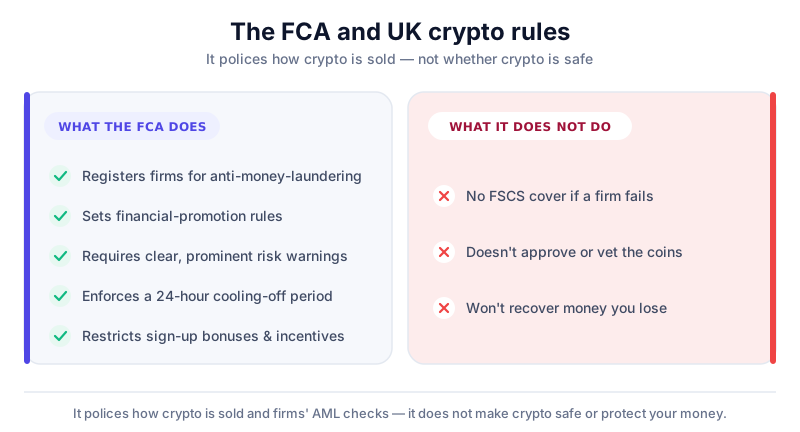
The financial promotion regime (section 21 of the Financial Services and Markets Act 2000) was extended to 'qualifying cryptoassets' from 8 October 2023. In plain English: an advert, website, social post or influencer plug that invites UK consumers to buy crypto must be communicated or approved by a firm that's FCA-authorised (or, for cryptoasset firms, FCA-registered) — or fit a narrow exemption. The FCA's rules for those promotions then require, among other things:
- A prescribed risk warning — wording to the effect of: *'Don't invest unless you're prepared to lose all the money you invest. This is a high-risk investment and you should not expect to be protected if something goes wrong.'* Prominent, not buried.
- No incentives to invest — refer-a-friend bonuses, deposit bonuses, 'invite 3 friends for extra tokens' are banned outright.
- A 24-hour cooling-off period for first-time investors with a firm, before the purchase can go ahead.
- Fair, clear, not misleading communication — which guaranteed-return claims and fabricated scarcity are not.
Communicating an unapproved crypto promotion to UK consumers is a criminal offence (up to two years' imprisonment and/or a fine). The FCA has issued thousands of warnings about non-compliant crypto promotions since the regime went live, and publishes a Warning List of firms promoting illegally.
Why this is such a powerful scam filter
Think about what compliance requires: a real, identifiable firm willing to put its regulatory status behind the promotion. That's precisely what an anonymous presale run from a three-week-old domain cannot produce. So the checklist almost marks itself:
- No risk warning anywhere? The promotion is almost certainly illegal in the UK. An operation that ignores criminal law in its *marketing* is telling you how it'll treat your money.
- 'Invite friends, earn 10% of their deposit'? Banned incentive — instant fail, and a favourite of giveaway and pyramid-shaped schemes.
- 'Buy in the next 15 minutes before the price rises'? The opposite of a cooling-off period — legal promotions are built to slow you down, scams to speed you up.
- 'Guaranteed 40x at listing'? Fails 'fair, clear and not misleading' on its face — no one can promise an open-market price.
The reverse isn't true
A compliant-looking risk warning doesn't make a project safe — warnings can be copy-pasted by scammers too, and plenty of legal, registered offerings are still terrible investments. This filter is for ruling out, not ruling in. For ruling in, run the full presale checklist.
Where you'll see it break the rules
Offshore presale sites, paid directory listings and sponsored 'reviews', influencer posts with referral codes, and 'price prediction' content that exists to funnel you to a buy button — most of it targets UK readers daily with none of the required protections. The publishers sit offshore and bet on never being pursued. You can't fix that; you *can* use it: every missing risk warning is a free, instant verdict that took you zero research.
How to report an illegal promotion (or a scam)
Reporting feels pointless from the inside — it isn't. Reports feed the FCA Warning List, drive wallet and browser blocklists, and build the intelligence picture that gets payment rails and domains cut off:
- Report the promotion to the FCA — their website has a dedicated 'report a scam or unauthorised firm' route (search 'FCA report a scam'), and the consumer helpline is 0800 111 6768. Include the URL, screenshots and any wallet addresses involved.
- Lost money, or targeted directly? Report the crime — Action Fraud (actionfraud.police.uk, 0300 123 2040) for England, Wales and Northern Ireland; call 101 for Police Scotland if you're in Scotland.
- Flag the infrastructure — report the domain in your wallet's built-in reporter (MetaMask, Phantom and others feed shared blocklists), and to Google Safe Browsing. This is what puts the red warning screen in front of the next visitor.
- Keep your evidence — screenshots with dates, transaction hashes, addresses. Five minutes of filing is the difference between a report that acts and one that can't.
If you're mid-incident — wallet connected, funds at risk — deal with that first via the emergency guide, then come back and report.
What this means for how we cover presales
It's also why Scam Watch works the way it does: we're not promoting cryptoassets, we're publishing independent editorial analysis of publicly verifiable evidence — and we hold ourselves to the same standard we demand, with a safety notice on every page, no signup bonuses, no urgency, and receipts for every claim. If a page anywhere tells you to hurry, that page is not on your side.
Key takeaways
- Since October 2023, crypto promotions to UK consumers need FCA-gated approval, a risk warning, no incentives, and a 24-hour cooling-off period
- Promoting without it is a criminal offence — a missing risk warning is a one-glance verdict
- Urgency, referral bonuses and guaranteed returns aren't just red flags; they're each individually non-compliant
- The filter rules out, never in: compliant-looking warnings don't make an investment good
- Report illegal promotions to the FCA and crimes to Action Fraud — reports power the blocklists
Frequently asked questions
Does this mean FCA-compliant platforms are safe to use?
Safer on specific dimensions — a registered firm has anti-money-laundering obligations and something to lose. But crypto itself remains high-risk and largely unprotected: no FSCS compensation for crypto losses, and generally no Ombudsman route. Compliance is a floor, not a recommendation.
Why do I still see non-compliant crypto ads everywhere?
Because most originate offshore, beyond easy enforcement, and platforms remove them slower than they appear. The regime's real value to you isn't that it cleans the internet — it's that it hands you an instant test any promotion must pass before it deserves a second look.
Will reporting actually get anyone's money back?
Usually not directly — recovery from crypto scams is rare, and anyone who contacts you *promising* recovery for a fee is running a follow-up scam. Report to protect others and to feed enforcement; treat recovery promises as round two.
Are meme coins and presales on this site's Scam Watch list illegal by definition?
No — we assess each case on evidence. A promotion can be non-compliant while the project is merely reckless, and a project can be a scam behind superficially compliant marketing. That's why the missing-warning test rules things out quickly, and the deeper checks decide anything that passes.
Keep reading
How to Check If a Crypto Presale Is a Scam (Step by Step)
The complete pre-flight check for any crypto presale: verify the team, the whitepaper, the audit and the actua
How Paid Crypto Listings and 5-Star Ratings Really Work
Presale directories and crypto 'news' sites look like independent journalism — but much of it is paid placemen
Connected Your Wallet to a Scam Site? Do This Now
The calm, step-by-step emergency drill: revoke token approvals, move assets to a fresh wallet, refuse 'unlock