How Paid Crypto Listings and 5-Star Ratings Really Work
Search any presale's name and you'll find glowing articles, five-star directory ratings and price predictions promising the next 100x. It looks like consensus. Much of it is inventory: bought placements, written to a template, published by outlets whose real customer is the token team — not you. Here's how the machine works, and the tells that expose it.
The 20-second version
Treat presale directories and 'best coins to buy' articles as advertising until proven otherwise. Look for the buried 'sponsored' label, check whether the same outlet has ever published a negative review, and never treat a rating as an audit — a five-star score is a product listing, and the payer is the project.
The business model in one paragraph
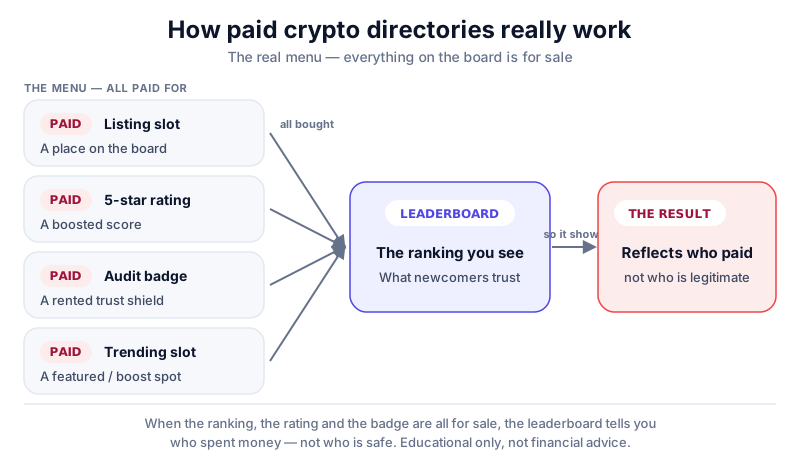
Crypto tracking directories and low-tier news sites sell visibility. Token teams buy listing packages, 'featured' slots, rating boosts, press-release syndication and pre-written 'review' articles — often bundled. The output is styled to look like editorial coverage, because that's what converts. None of this is illegal in itself where it's disclosed, but the disclosure is the part that gets minimised: a tiny grey 'sponsored' tag, a disclaimer page nobody visits, or nothing at all. In the UK, undisclosed paid promotion of cryptoassets isn't just misleading — it usually breaches the financial promotion rules too.
Why scammers love directories
A scam site you built yourself is one link. A scam site *plus* twenty directory listings, ten syndicated articles and a wall of five-star reviews is an ecosystem — and search engines and newcomers struggle to tell it from real reputation. Manufactured consensus is the product being bought.
Tell 1 — Find the sponsored label (it's there, or it's worse)
Scroll the whole listing or article. Look at the byline, the top corner, the footer, the small print: *Sponsored. Partner content. Press release. Promoted. This article does not constitute editorial.* Outlets add these labels to protect themselves, in the least visible way the ad buyer will tolerate. Finding one reclassifies everything above it as advertising. Finding none on obviously promotional coverage tells you the outlet doesn't even bother — which is worse.
Quick test of any outlet's independence: search it for a single genuinely negative review of a presale it lists. Publications that only ever publish praise aren't reviewing — they're invoicing.
Tell 2 — The review-bot loop
Community ratings get gamed with purchased accounts. The pattern is recognisable once you've seen it:
- Velocity spikes. An unknown token collects hundreds of five-star reviews within hours of listing — real reputations accrete over months.
- Robot phrasing. 'Great project!', 'To the moon!', 'Best team!' repeated with minor variations, review after review, often with broken English in identical ways.
- Empty reviewers. Profiles created the same week, each rating the same clutch of tokens five stars and nothing else.
- Silence everywhere else. Thousands of 'community members' on the directory, yet no organic discussion anywhere independent. Real communities argue; bought ones only cheer.
The same playbook runs on Telegram and X: 50,000-member channels where three accounts talk, flooded with 'wen launch' and 'gem 💎'. Manufactured hype is a service you can buy by the thousand-account block — treat crowd noise as decoration, not evidence.
Tell 3 — The audit badge that audits nothing
Directories and presale sites love a shield icon that says 'Audited'. Click it. A real audit resolves to a report hosted by the audit firm itself — CertiK, Hacken, SolidProof and peers all publish theirs — naming the exact contract addresses covered. The fakes fall apart on inspection: badges that link nowhere, PDFs hosted only on the project's own site, audits of a *different* contract, or genuine reports whose findings table lists critical unresolved issues the marketing never mentions. An audit you haven't opened is a logo, not a safeguard.
Tell 4 — Price predictions on a conveyor belt
'[Token] Price Prediction 2026: Can It Reach $5?' articles exist to occupy search results, not to inform. The tells: no named author, the same skeleton reused across dozens of tokens ('could be the next Pepe'), precise-sounding targets with no methodology, and a quiet affiliate link to the presale at the bottom. No one can predict an unlaunched token's price — a site claiming otherwise has told you its business model. It's the same FOMO machinery that drives every manufactured pump.
How to use directories without being used
Directories aren't useless — they're a discovery layer. Use them to find names, then do the verification they don't: the team check, the whitepaper check, and above all the on-chain money check. Our full presale checklist runs all of it in about fifteen minutes. A five-star rating took the project five minutes to buy; your fifteen minutes of checking beats it every time.
Key takeaways
- Directory listings and 'best presale' articles are paid inventory until proven otherwise
- Hunt for the buried 'sponsored' tag — and distrust outlets that never publish a negative word
- Hundreds of five-star reviews in hours, from empty profiles, in identical phrasing = bought
- Click every audit badge through to the audit firm's own site and read the findings
- Use directories for discovery only — verification is your job, and it's free
Frequently asked questions
Are all crypto directories and news sites corrupt?
No — real outlets exist, and even mixed ones carry some honest data. The safe posture is simply to treat ratings and rankings as marketing by default, and to rely on things no marketing budget can fake: the blockchain, real audits, and verifiable people.
Isn't LatestCrypto affiliate-funded too?
Yes — and that's exactly why we disclose it on every page, mark every affiliate link, and never let it touch a verdict. The difference that matters isn't whether a site earns money; it's whether the money buys the conclusions. Ours doesn't, and our negative reviews are the proof.
A directory shows a project as 'KYC verified' — does that make it safe?
It means someone sent the directory identity documents you can't see, verified to a standard you can't check. It's weak evidence at best. On-chain behaviour and real audits are stronger signals than any directory badge.
Keep reading
How to Check If a Crypto Presale Is a Scam (Step by Step)
The complete pre-flight check for any crypto presale: verify the team, the whitepaper, the audit and the actua
The Recycled Whitepaper Trick: Expose a Template Scam in One Search
Scam factories don't write whitepapers — they find-and-replace old ones. The quotation-mark Google trick catch
How to Spot Fake (and AI-Generated) Crypto Team Photos
Scam presales invent executive teams with stolen photos and AI faces. Learn the one-search reverse-image check