How to Swap Tokens (Step by Step)
A swap trades one token for another in a single step — say USDC for ETH. You can swap inside a centralised exchange or directly from your own wallet using a decentralised exchange. This guide explains how swaps work, the settings that catch people out like slippage, and how to do one without nasty surprises.
The 20-second version
A swap exchanges one token for another. Check the rate, set a sensible slippage limit, and review the network fee before confirming. On a DEX you may also pay a one-time approval. Both tokens must be on the same network.
What a swap actually is
Swapping is trading one token for another without first cashing out to pounds or dollars. On a centralised exchange it works like any trade. From your own wallet, a swap routes through a DEX — code that matches your trade against a pool of tokens — so you keep custody the whole time.
Both tokens have to live on the same network. To move a token from one chain to another, you don't swap — you bridge, which is a different and riskier process.
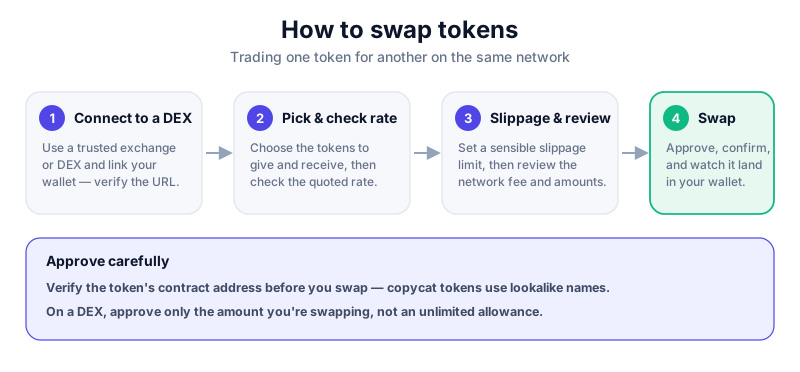
How to swap tokens, step by step
- Pick where you'll swap — an exchange you already use, or a DEX connected to your wallet.
- Choose the token you're giving and the token you want to receive.
- Check the quoted rate and the estimated amount you'll get back.
- Set your slippage tolerance — a small percentage for stable, liquid pairs; never wide open.
- On a DEX, approve the token if prompted (a one-time permission), then confirm the swap.
- Review the network fee and final amounts, then confirm. Watch it settle in your wallet.
MetaMask has a built-in swap feature that quotes several DEXs at once. Only ever download it from metamask.io and confirm every transaction yourself.
Slippage and price impact
Slippage is the gap between the price you're quoted and the price you actually get, because prices move while your transaction settles. You set a tolerance — if the price moves beyond it, the swap fails instead of filling at a bad rate. Price impact is how much your own trade moves the price, which gets worse for large trades in thin pools.
Don't set slippage too high
A very high slippage tolerance can let you receive far less than expected and exposes you to 'sandwich' attacks where bots front-run your trade. For most liquid pairs a low single-digit percentage is plenty.
Costs to expect
- Network fee — paid to the chain to process the swap; varies with congestion.
- Approval fee — on a DEX, a one-time charge to let the contract use a token. Learn to revoke approvals you no longer need.
- Spread or pool fee — built into the rate you're quoted.
- Price impact — effectively a cost on large trades in shallow liquidity.
Key takeaways
- A swap trades one token for another in a single step.
- Both tokens must be on the same network — moving chains needs a bridge.
- Set a sensible slippage tolerance; never leave it wide open.
- Expect a network fee, and on a DEX a one-time approval cost.
Frequently asked questions
What's the difference between a swap and a trade?
They're closely related. 'Swap' usually describes exchanging two tokens directly, often from your own wallet via a DEX, while 'trade' tends to describe order-book buying and selling on an exchange.
Why did my swap fail?
Most often the price moved beyond your slippage tolerance, or you didn't have enough of the network's coin to cover the fee. A failed swap can still cost a small fee.
Is swapping the same as bridging?
No. A swap exchanges two tokens on the same network. Bridging moves a token from one network to another and carries extra risks — see our bridging guide.
Keep reading
How to Use a DEX (Decentralised Exchange)
A beginner's guide to using a decentralised exchange: connecting a wallet, token approvals, slippage, fees, an
How to Bridge Tokens Between Networks (Safely)
How crypto bridges move tokens between blockchains, why bridges are among the riskiest tools in crypto, and ho
How to Revoke Token Approvals (and Why It Matters)
Token approvals let apps spend your tokens — and stale ones are a real risk. How to review and revoke approval