Litecoin Mining Explained
Mining is how new Litecoin is created and how the network stays secure. This guide explains how Litecoin mining works in plain English — the Scrypt algorithm, block rewards and halvings, the hardware involved, and whether it's realistic for a beginner today.
The 20-second version
Miners use computing power to confirm Litecoin transactions and earn newly created LTC. Litecoin uses the Scrypt algorithm, and the reward halves roughly every four years. For most people, mining solo is no longer worth it.
What is Litecoin mining?
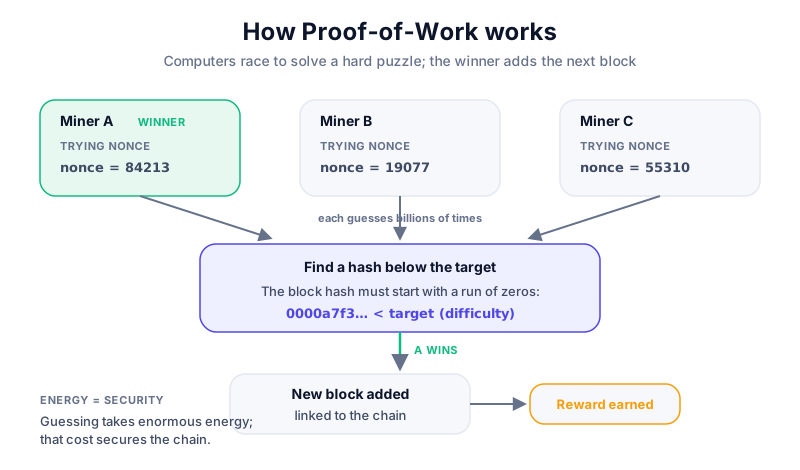
Mining is the process that keeps the Litecoin network running. Miners use computing power to bundle recent transactions into a 'block', solve a hard mathematical puzzle to confirm it, and add it to the blockchain. In return, they receive newly created LTC plus transaction fees.
This is the same 'proof-of-work' idea that secures Bitcoin — the puzzle is genuinely hard to solve but easy for everyone else to check, which makes cheating impractical.
Scrypt: Litecoin's mining algorithm
Litecoin's defining technical choice is its mining algorithm, Scrypt, rather than Bitcoin's SHA-256. Scrypt is 'memory-hard', meaning it leans on memory as well as raw processing power.
- The original goal was to keep mining accessible to ordinary computers and resist the specialised machines that came to dominate Bitcoin.
- In reality, dedicated Scrypt ASIC miners now do most Litecoin mining, so the playing field has narrowed over time.
- Merged mining lets Litecoin be mined alongside Dogecoin, since Dogecoin also uses Scrypt — a quirk that adds extra rewards for some miners.
Block rewards and halvings
Each confirmed block pays the miner a fixed reward in new LTC. That reward halves at regular intervals — roughly every four years — in an event called a 'halving', which gradually slows the creation of new coins until the 84 million cap is reached.
Halvings are a built-in part of Litecoin's supply schedule, mirroring Bitcoin's design. They reduce the rate of new supply over time, but they say nothing about future price.
Is mining realistic for beginners?
For most people, the honest answer is no. Competing with large, specialised mining operations using cheap electricity is difficult, and the upfront cost of Scrypt ASIC hardware plus ongoing power bills can outweigh what a beginner earns. Many smaller miners join a 'mining pool' to combine resources and share rewards more steadily. And however you weigh the trade-offs, keep meaningful holdings in cold storage — a Trezor Safe 5 — rather than on an exchange.
Do the maths first
Mining profitability depends on hardware cost, electricity prices and Litecoin's price — all of which can change fast. Treat any 'guaranteed returns' mining scheme or cloud-mining offer with deep suspicion, as these are common scams. This is education, not financial advice.
Key takeaways
- Mining confirms Litecoin transactions and creates new LTC as a reward.
- Litecoin uses the memory-hard Scrypt algorithm, not Bitcoin's SHA-256.
- Block rewards halve roughly every four years until 84 million coins exist.
- Solo mining is rarely worth it for beginners; beware 'guaranteed' mining scams.
Frequently asked questions
Can I mine Litecoin on a normal computer?
Technically yes, but you'd earn almost nothing. Scrypt ASIC miners now dominate the network, so an ordinary PC isn't competitive.
What is a Litecoin halving?
It's a scheduled event, roughly every four years, where the reward miners get per block is cut in half — gradually slowing the creation of new LTC.
What is merged mining?
Because Litecoin and Dogecoin both use Scrypt, miners can mine both at the same time without extra work, earning rewards in both coins.
Keep reading
What Is Litecoin (LTC)? A Plain-English Guide
A beginner-friendly explanation of what Litecoin is, how it works, how it differs from Bitcoin, and how to thi
Litecoin vs Bitcoin: A Fair Comparison
Litecoin vs Bitcoin compared honestly: speed, supply, fees, mining, security and use cases — so you can unders
What Is Bitcoin? A Plain-English Guide
A beginner-friendly explanation of what Bitcoin is, how it works, and how to think about it — with no hype and