What Is Litecoin (LTC)? A Plain-English Guide
Litecoin (LTC) is one of the oldest cryptocurrencies still running today — launched in 2011 as a faster, lighter alternative to Bitcoin. This guide explains what Litecoin is in plain English, how it works, why people call it 'digital silver', and how to think about it without the hype.
The 20-second version
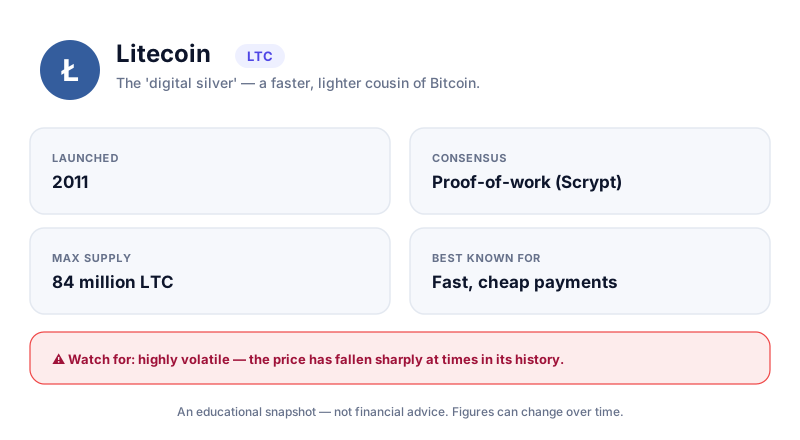
Litecoin is a peer-to-peer digital currency closely based on Bitcoin, but with faster blocks and a larger supply cap of 84 million coins. It's often called 'the silver to Bitcoin's gold'. Like all crypto, its price is volatile.
What is Litecoin?
Litecoin is a cryptocurrency — digital money you can send to anyone, anywhere, without a bank in the middle. It was created in October 2011 by Charlie Lee, a former Google engineer, who took the open-source code behind Bitcoin and tweaked a few key settings to make it faster and lighter for everyday payments.
Because it shares so much of Bitcoin's design, Litecoin is often described as 'digital silver' to Bitcoin's 'digital gold' — a complementary, more abundant cousin rather than a rival trying to replace it.
How Litecoin works
Litecoin runs on its own public blockchain — a shared ledger maintained by a worldwide network of computers. Like Bitcoin, it uses a 'proof-of-work' system where miners confirm transactions and are rewarded with new coins.
- Faster blocks — Litecoin adds a new block roughly every 2.5 minutes, versus Bitcoin's 10, so transactions confirm sooner.
- Larger supply — there will only ever be 84 million LTC, four times Bitcoin's 21 million cap.
- A different mining algorithm — Litecoin uses Scrypt instead of Bitcoin's SHA-256, a choice we explain in Litecoin mining explained.
A hardware wallet keeps your keys offline and out of reach of hackers. The Ledger Nano X supports Litecoin and thousands of other coins — but read our full review before buying.
How Litecoin differs from Bitcoin
Litecoin and Bitcoin are close relatives, but the differences matter. Litecoin's faster, cheaper transactions made it popular for smaller payments, and over the years it has often been used as a 'testing ground' where new features were trialled before reaching Bitcoin. For a side-by-side breakdown, see our Litecoin vs Bitcoin comparison.
It's worth being clear-eyed, too: Litecoin doesn't have Bitcoin's brand recognition, network size, or institutional adoption. Both are volatile, and being 'older' or 'faster' doesn't make any coin a safe bet.
What Litecoin is used for
In practice, Litecoin is mostly used as a way to send value quickly and cheaply, and as a long-term holding by people who like its simplicity and track record. It's widely accepted by payment processors and supported by most major exchanges and wallets, which makes it easy to buy and move.
A fair warning
Litecoin's price is highly volatile and has fallen sharply at times in its history. Only ever risk what you can afford to lose, and never borrow to buy crypto. This guide is education, not financial advice.
Where to go next
Now you know what Litecoin is, sensible next steps are learning how to buy Litecoin safely, then — most importantly — how to store Litecoin safely. If you're curious how the coins are created, read Litecoin mining explained.
Key takeaways
- Litecoin is a 2011 cryptocurrency based on Bitcoin's code, created by Charlie Lee.
- It has faster blocks (~2.5 min) and a larger supply cap of 84 million coins.
- It's often called 'digital silver' — a lighter complement to Bitcoin's 'digital gold'.
- It's volatile — only risk what you can afford to lose.
Frequently asked questions
Is Litecoin a good investment?
We don't give buy, sell or hold advice. Litecoin is a long-standing project, but like all crypto it's volatile and carries real risk. Do your own research and only risk what you can afford to lose.
Who created Litecoin?
Charlie Lee, a former Google and Coinbase engineer, launched Litecoin in October 2011 by adapting Bitcoin's open-source code.
How is Litecoin different from Bitcoin?
Litecoin has faster block times, lower fees historically, a larger 84 million supply cap, and uses the Scrypt mining algorithm. See our Litecoin vs Bitcoin comparison.
Keep reading
How to Buy Litecoin (LTC) Safely: Step by Step
A safe, beginner-friendly guide to buying Litecoin: choosing a reputable exchange, verifying your account, pla
How to Store Litecoin (LTC) Safely
Keep your Litecoin safe: hot vs cold wallets, hardware wallets, seed-phrase backups, and the security rules th
Litecoin vs Bitcoin: A Fair Comparison
Litecoin vs Bitcoin compared honestly: speed, supply, fees, mining, security and use cases — so you can unders