MetaMask vs Phantom: Which Wallet Should You Use?
MetaMask and Phantom are two of the most popular self-custodial wallets, but they grew out of different ecosystems. This guide compares them fairly so you can choose the one that matches the chains you actually use.
The 20-second version
MetaMask is the default wallet for Ethereum and EVM chains. Phantom is the best wallet for Solana and now supports Ethereum too. Both are free, self-custodial hot wallets — pick by ecosystem, and pair either with a hardware wallet for larger holdings.
Two wallets, two ecosystems
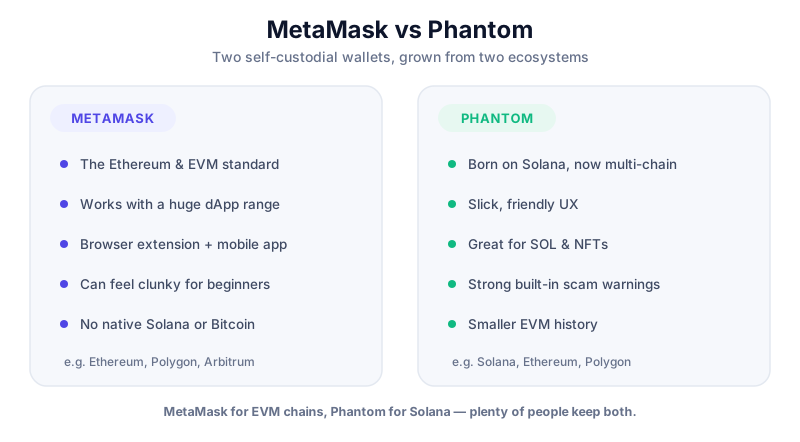
Both are self-custodial hot wallets: you hold your own keys, but they live on an internet-connected device. The core difference is reach. MetaMask was built for Ethereum and works across virtually every EVM chain — Polygon, Arbitrum, Avalanche's C-Chain and more. Phantom was built for Solana and has since added Ethereum and Polygon.
Both are hot wallets
Neither is a substitute for cold storage. Keys sit on your device, so phishing and malicious approvals are the main risks. This is education, not advice — for serious holdings, connect a hardware wallet and only risk what you can afford to lose.
MetaMask vs Phantom at a glance
| Feature | MetaMask | Phantom |
|---|---|---|
| Our review score | 4.2 | 4.3 |
| Home ecosystem | Ethereum + EVM chains | Solana |
| Other chains | All EVM networks | Ethereum, Polygon |
| Self-custodial | Yes | Yes |
| Built-in scam warnings | Improving | Strong |
| Hardware wallet support | Yes (Ledger, Trezor) | Yes (Ledger) |
| Bitcoin support | No | No |
| Best for | Ethereum + DeFi users | Solana users |
Security and ease of use
Both are reputable, open or source-available, and self-custodial. Phantom has a slight edge on built-in protection: its transaction previews and scam-detection prompts warn you before you approve something dangerous, which genuinely helps newcomers. MetaMask has been catching up with similar features. Either way, the weakest link is usually the user, not the wallet.
- Never enter your seed phrase into a website — only into the wallet app when restoring.
- Double-check every 'approve' or 'sign' prompt; that's how most wallet drains happen. See how to avoid crypto scams.
- For larger amounts, connect a hardware wallet so transactions sign on a separate device.
The verdict
Choose MetaMask if…
You spend most of your time on Ethereum and EVM chains, use DeFi and dApps, and want the wallet that nearly every app supports by default. It's the most widely compatible choice. Read our MetaMask review.
Choose Phantom if…
You're active on Solana, want the smoothest experience there, and value strong built-in scam warnings. Its Ethereum support means you may not even need a second wallet. Read our Phantom review.
You can run both
Many people keep MetaMask for Ethereum dApps and Phantom for Solana. There's no harm in having both — each backed up by its own seed phrase, stored safely offline.

MetaMask and Phantom are both *hot* wallets — handy, but your keys live on an internet-connected device. For larger amounts, a hardware wallet like the Trezor Safe 7 keeps your keys offline and makes you confirm every transaction on the device itself.
Key takeaways
- MetaMask is the default for Ethereum and EVM chains.
- Phantom is the best wallet for Solana and now supports Ethereum too.
- Both are free, self-custodial hot wallets — pick by ecosystem.
- Pair either with a hardware wallet and guard your seed phrase.
Frequently asked questions
Can I use MetaMask for Solana?
Not natively — MetaMask is built for Ethereum and EVM chains. For Solana, Phantom is the better fit, and it also handles Ethereum if you'd rather use one wallet.
Which is more secure, MetaMask or Phantom?
Both are reputable self-custodial wallets. Phantom has slightly stronger built-in scam warnings, but both are hot wallets — real security comes from guarding your seed phrase and pairing with a hardware wallet for larger sums.
Are MetaMask and Phantom free?
Yes, both are free to download and use. They earn revenue from optional in-app swaps, which cost more than trading on an exchange.
Keep reading
MetaMask Review (2026)
Our hands-on MetaMask review: how the browser and mobile wallet works, security, fees, supported networks, pro
Phantom Wallet Review (2026)
Our hands-on Phantom wallet review: Solana and multi-chain support, security features, fees, pros and cons — a
Hot vs Cold Wallets: What's the Difference?
A plain-English hot vs cold wallets comparison — how each works, the security trade-offs, and how to combine b