Notable Meme Coins (A Neutral Overview)
With the safety lessons behind us, let's put faces to the names. These are the meme coins you're most likely to hear about, and seeing them through the lens of the last four lessons is genuinely useful. We describe them factually so you understand the landscape — not as endorsements. Being well-known does not make a coin safe, and nothing here is a recommendation to buy.
The 20-second version
Dogecoin, Shiba Inu and Pepe are among the largest meme coins, but size and fame don't reduce volatility or risk. Each has fallen heavily at times, and most meme coins that follow them disappear. Understanding them is useful; buying them is gambling.
Read this first
This overview is purely educational, and that framing matters more here than anywhere else in the course. Listing a coin below is not a hint that you should buy it, and we make no claims about where any price will go next — nobody honestly can. Every coin here has experienced dramatic crashes as well as rises, often more than once, and the ones we don't list vastly outnumber the ones we do.
Fame is not safety
The best-known meme coins are still extremely volatile and speculative. None of this is financial advice. Only ever risk money you can afford to lose entirely, and never assume a popular coin is a safe one — popularity and safety are simply different things.
Dogecoin (DOGE)
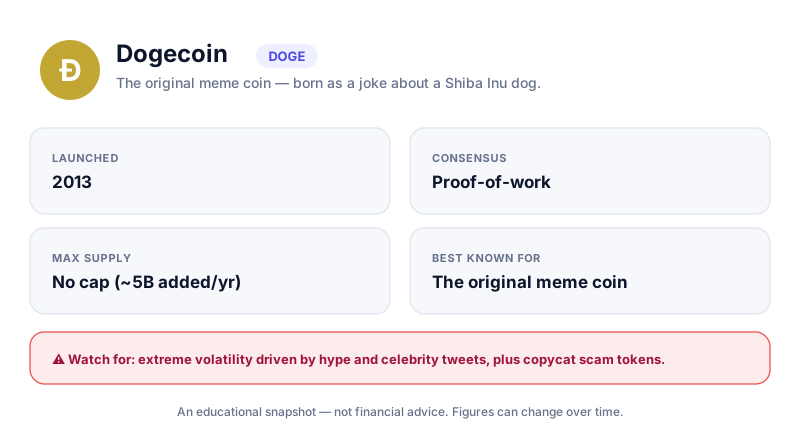
Launched in 2013 as a joke parodying Bitcoin, Dogecoin uses the Shiba Inu 'doge' meme as its mascot. It's the original meme coin and, unusually, has persisted for over a decade with a genuinely active community — the exception we mentioned back in what are meme coins. Unlike most meme coins, it runs on its own blockchain rather than as a token on someone else's, which makes it more of a true cryptocurrency in structure, if not in purpose.
Despite its longevity, Dogecoin has no supply cap — new coins are issued continuously, so it's mildly inflationary by design — and its price has historically been driven heavily by social media and high-profile celebrity endorsements. That dependence cuts both ways: the same tweet that sends it up can be absent the next month and send it down. It has fallen 80% or more from its peaks in past cycles, which is sobering for the 'safe' meme coin.
Shiba Inu (SHIB)
Shiba Inu, launched in 2020, is an Ethereum-based token that branded itself a 'Dogecoin killer' and leaned hard into the same dog theme. It gained enormous attention partly through a deliberately gigantic token supply — in the quadrillions — which gives each token a tiny fractional price. As we explained in how meme coins work, that low unit price is pure psychology: it makes the coin feel affordable and fuels '1000x' daydreams, while telling you nothing about value.
Its ecosystem has since bolted on other projects — an exchange, a layer for cheaper transactions, additional tokens — which gives it more apparatus than most meme coins. But it remains, at heart, a speculative meme asset, and it has seen drawdowns of well over 80% from its highs. A large supply and a low unit price do not make a token 'cheap' in any meaningful sense, no matter how the marketing frames it.
Pepe (PEPE) and the newer wave
Pepe, launched in 2023, is an Ethereum token based on the Pepe the Frog meme. It rose with astonishing speed on social-media attention alone and then fell just as sharply — a textbook example of the pump-and-dump shape we covered in meme coin risks and red flags, and a pattern typical of newer coins that lack even Dogecoin's decade of community to fall back on.
Each cycle conjures new themes: frog coins, animal coins, food coins, 'celebrity' and political coins, and fast, cheap chains like Solana hosting thousands of throwaway launches a day. We're deliberately not naming the latest hot one, because by the time you read this it will likely be gone. The vast, overwhelming majority of these never build any community or staying power, and fade to near-zero within weeks.
At a glance
| Coin | Launched | Built on | Notable trait |
|---|---|---|---|
| Dogecoin (DOGE) | 2013 | Own blockchain | The original; no supply cap |
| Shiba Inu (SHIB) | 2020 | Ethereum | Enormous supply; tiny unit price |
| Pepe (PEPE) | 2023 | Ethereum | Rapid hype-driven rise and fall |
Why we don't list 'the next big one'
We deliberately avoid hyping newer or smaller coins. New launches carry the highest risk of rug pulls and scams, and pointing you at one would be exactly the kind of behaviour this whole course warns against. If you're researching any coin — famous or not — use the same rigorous checklist.
What the famous coins teach us
Read across these three and a few honest lessons fall out — lessons that apply just as well to whatever coin is trending the day you read this. If you punt on this end of the market anyway, keep the stake small — and keep your core holdings well away from it, in cold storage on a BitBox02.
- Even the largest, most established meme coins are deeply volatile and have crashed 80%+ repeatedly.
- The survival of a famous few does not predict the survival of the many — most imitators vanish without a trace.
- Endorsements and social-media buzz drive prices up and down, not fundamentals, because there usually aren't any fundamentals.
- A low per-token price reflects a huge supply, not value or a bargain — a point worth re-reading until it sticks.
Whichever coin you're curious about, treat fame as marketing, not safety. Run every single one through the same process in how to research a meme coin and check for the warning signs in how to spot a rug pull — which is exactly where we head in the final lesson.
Key takeaways
- Dogecoin, Shiba Inu and Pepe are the best-known meme coins — described here neutrally, not recommended.
- Being famous or large does not make a meme coin safe or less volatile.
- Each has crashed heavily; most imitators disappear entirely.
- Treat fame as marketing and always do your own research.
Frequently asked questions
Which meme coin is the safest?
We don't rank meme coins by safety, because none are safe in any ordinary sense — all are highly speculative and volatile. Even the largest have lost most of their value at times. Treat any meme-coin money as money you could lose entirely.
Should I buy Dogecoin or Shiba Inu?
We don't give buy or sell advice. We can only describe them factually and stress that both are volatile, speculative assets that have crashed hard before. Any decision is yours, and should only ever involve money you can afford to lose.
Are new meme coins riskier than the famous ones?
Generally yes — newer and smaller launches carry the highest risk of rug pulls and scams, with no track record at all to judge them by. Use how to spot a rug pull before going near any of them.
Keep reading
What Are Meme Coins? A Plain-English Guide
A clear, no-hype explanation of what meme coins are, where they came from, why they're so risky, and how to th
How Meme Coins Work (Under the Hood)
How meme coins are created, traded and priced — tokens, liquidity pools, market caps and the mechanics that ma
Meme Coin Risks and Red Flags
The core safety lesson on meme coins: the real risks, the warning signs to look for, and the scams that separa