The SEC and US Crypto Regulation Explained
US crypto regulation is famously fragmented, and the Securities and Exchange Commission (SEC) sits at the centre of the debate. This guide explains the SEC's role, the long-running argument over which coins are 'securities', and what the patchwork means for ordinary buyers.
The 60-second version
The SEC regulates assets it considers securities; the CFTC oversees commodities like Bitcoin. Which crypto falls where has been heavily contested in court. For users, the practical effect is uneven rules, occasional delistings, and the need to stick to compliant US platforms.
Who regulates crypto in the US?
Unlike the EU's single MiCA framework, the US splits crypto oversight across several bodies. No one agency owns it, which is the root of much of the uncertainty.
- SEC — regulates securities; argues many tokens are investment contracts under its remit.
- CFTC — regulates commodities and derivatives; Bitcoin is widely treated as a commodity.
- FinCEN — enforces anti-money-laundering rules on exchanges.
- IRS — treats crypto as property for tax purposes.
- State regulators — license money transmitters; New York's BitLicense is the strictest example.
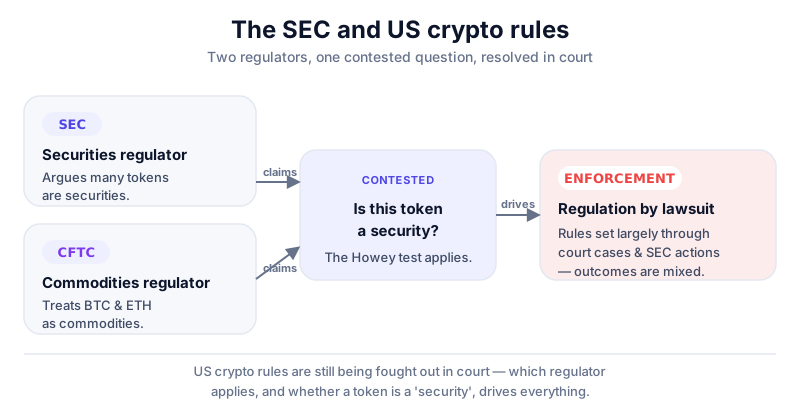
The 'is it a security?' question
The central US debate is whether a given cryptoasset is a 'security'. The SEC often applies the decades-old Howey test, which asks whether people invested money in a common enterprise expecting profits from others' efforts. If a token is a security, it must follow strict registration and disclosure rules.
Bitcoin is generally treated as a commodity, not a security. The status of many other tokens has been contested. The SEC brought high-profile enforcement actions against major exchanges and projects, and court rulings have sometimes gone for and sometimes against the agency — most notably in litigation involving XRP, where a court found certain sales were not securities offerings while others were.
Legal status is not investment advice
Whether a token is a security is a legal question, not a signal of quality or safety. Regulatory outcomes are uncertain and can change. Crypto remains volatile — only risk what you can afford to lose, and never borrow to buy. This is education, not financial advice.
Enforcement and a shifting landscape
For years the US regulated crypto largely through enforcement actions rather than tailored rules, an approach critics called 'regulation by enforcement'. The industry pushed for clearer legislation from Congress. The policy direction has shifted over time with changes in administration and SEC leadership, with periods of both tougher and lighter-touch posture. Because this area moves quickly, always check the current position rather than relying on older summaries.
What it means for everyday buyers
For ordinary users, the fragmented system mostly means uneven availability: some tokens get delisted on US platforms amid legal uncertainty, and certain products differ by state. The practical advice is unchanged — use compliant US exchanges, keep good tax records, store larger holdings in self-custody, never share your seed phrase, and learn how to avoid scams.
Key takeaways
- US crypto oversight is split across the SEC, CFTC, FinCEN, IRS and states.
- The SEC focuses on tokens it considers securities; Bitcoin is treated as a commodity.
- Court rulings, including the XRP case, have produced mixed outcomes.
- A token's legal status says nothing about whether it's a good investment.
Frequently asked questions
Is Bitcoin a security in the US?
Bitcoin is generally treated as a commodity rather than a security, placing it more under the CFTC's purview. The status of many other tokens has been far more contested.
What was the SEC's case about XRP?
The SEC alleged XRP was sold as an unregistered security. A court found certain sales to the public were not securities offerings while institutional sales were — a mixed result widely discussed in the industry. We present this as fact, not endorsement of any token.
Why do some coins disappear from US exchanges?
Platforms sometimes delist or restrict tokens amid legal uncertainty over whether they're securities. Availability can therefore differ between the US and other regions, and even between states.
Keep reading
How to Buy Crypto in the US (2026 Beginner's Guide)
A step-by-step guide to buying cryptocurrency in the United States — choosing a regulated exchange, passing ID
The FCA and UK Crypto Rules Explained
How the Financial Conduct Authority regulates crypto in the UK: registration, the financial-promotions regime,
What Is MiCA? The EU's Crypto Regulation Explained
A plain-English guide to MiCA — the EU's Markets in Crypto-Assets regulation: what it covers, how it affects e