Is Crypto Legal Around the World? A Country Overview
Crypto's legal status varies enormously from one country to the next — embraced in some, tightly restricted in others, and outright banned in a few. This guide gives a balanced overview of the global picture and why you must always check the rules where you actually live.
The 60-second version
In most major economies, owning crypto is legal but regulated. A handful of countries restrict or ban it. Rules change often and differ by country, so this is a general overview only — always verify your own local laws before buying, holding or moving crypto.
The big picture
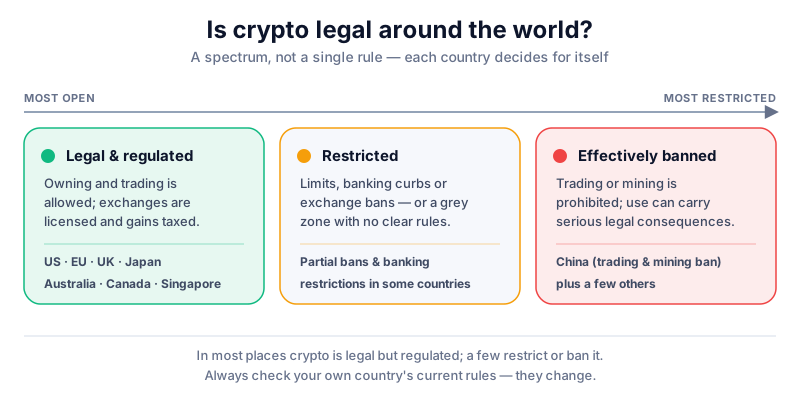
There is no single global rule for crypto. Each country decides for itself, and approaches fall roughly into three groups: places that regulate crypto and allow it, places that restrict or discourage it, and places that ban it. Most of the world's large economies sit in the first group.
Laws change — always check locally
Crypto regulation moves fast and varies sharply by jurisdiction. The summaries here are general and may be out of date for your situation. Always confirm the current rules where you live before acting. This is education, not legal or financial advice.
Where crypto is legal and regulated
Many countries treat crypto as legal to own and trade, while regulating exchanges and taxing gains.
- European Union — unified under MiCA, the most comprehensive framework of any major bloc.
- United Kingdom — legal and regulated through the FCA, with a fuller regime developing.
- United States — legal but overseen by a patchwork of agencies and state rules.
- Australia, Canada, Japan, Singapore — all permit crypto under licensing and consumer-protection regimes.
- El Salvador — went furthest by adopting Bitcoin as legal tender, though it later scaled back parts of that policy under international pressure.
Where crypto is restricted or banned
Some governments limit or prohibit crypto, often citing financial stability, capital controls, or consumer harm.
- China — banned crypto trading and mining, while developing its own state digital currency.
- Several other countries have imposed partial bans, banking restrictions, or limits on exchanges at various times.
- Many jurisdictions sit in a grey zone — not banned, but without clear rules, which carries its own risks.
Bans are not always absolute or permanent, and enforcement varies. But using crypto where it's prohibited can carry serious legal consequences — never assume it's fine.
Why approaches differ
Countries weigh different priorities: encouraging innovation and investment, protecting consumers from scams and volatility, preventing money laundering, and keeping control over their monetary systems. A country worried about capital flight may restrict crypto; one chasing fintech investment may welcome it. That's why the map looks so uneven — and why it keeps shifting.
What this means for you
Wherever you are, check your local laws first, use platforms licensed in your country, and keep records for tax. The fundamentals of safe use apply everywhere: learn how to buy crypto, store it safely, never share your seed phrase, and know how to avoid scams. For specific regions, see our guides for the UK, US and Australia.
Key takeaways
- In most major economies, owning crypto is legal but regulated.
- A few countries, including China, restrict or ban crypto.
- Approaches differ because governments weigh innovation, control and consumer protection differently.
- Rules change fast — always verify your own local laws before acting.
Frequently asked questions
Is crypto banned anywhere?
Yes. Some countries — China being the most prominent — have banned crypto trading or mining, and others impose partial restrictions. Bans vary in scope and enforcement, so check your specific jurisdiction.
Is Bitcoin legal tender anywhere?
El Salvador adopted Bitcoin as legal tender, the most notable example, though it later scaled back parts of that policy. In most countries crypto is legal to own but is not official legal tender.
How do I know the rules where I live?
Check your national financial regulator and tax authority, and use exchanges licensed in your country. Because rules change often, treat any general overview — including this one — as a starting point, not the final word.
Keep reading
What Is MiCA? The EU's Crypto Regulation Explained
A plain-English guide to MiCA — the EU's Markets in Crypto-Assets regulation: what it covers, how it affects e
The FCA and UK Crypto Rules Explained
How the Financial Conduct Authority regulates crypto in the UK: registration, the financial-promotions regime,
The SEC and US Crypto Regulation Explained
How the SEC and other US agencies regulate crypto: the securities question, the SEC vs CFTC divide, major enfo