What Are Crypto Prediction Markets? (Polymarket and Beyond)
A prediction market lets people bet on the outcome of future events — an election, a football result, whether a coin hits a price by Friday — and turns the crowd's collective guess into a live, tradeable number. Polymarket is the crypto-native version everyone talks about, and it went from niche to headline news over 2024 and 2026. It's a genuinely interesting on-chain product. It's also, for a UK reader, gambling by another name — and one you legally can't access. This guide explains how it actually works, why it got so big, and the catches the hype tends to skip.
The 20-second version
A prediction market prices a Yes/No question between 0 and 100%, and you trade shares that pay out $1 if you're right and $0 if you're wrong. Polymarket runs this on the Polygon blockchain and settles in USDC, which is why it's called a crypto prediction market. It's inaccessible to UK residents — it holds no Gambling Commission licence and its contracts fall under the FCA's ban on binary options — and even where it's allowed, it functions as gambling.
What is a prediction market?
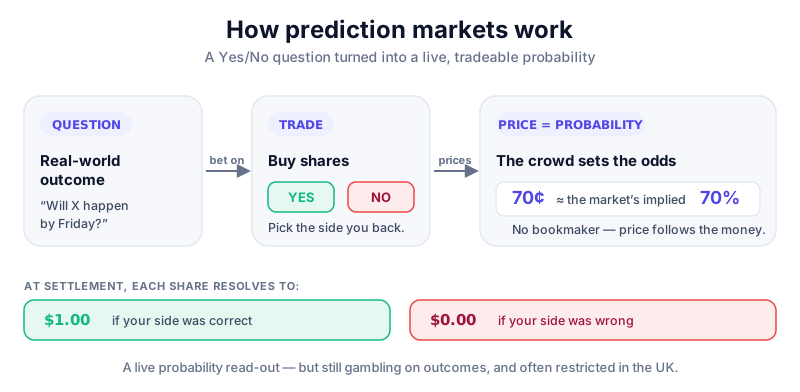
A prediction market is a marketplace where the thing being traded is the outcome of a future event. Each market is usually a simple Yes/No question: 'Will candidate X win?', 'Will Bitcoin close above $100k this year?'. You buy shares in the outcome you think will happen.
The clever part is how the price works. Shares trade somewhere between 0 and 1 — say, between 0 and 100 cents. A 'Yes' share priced at 30¢ implies the market thinks there's roughly a 30% chance the answer is yes. If you're right, each winning share redeems for $1; if you're wrong, it's worth $0. Buy 'Yes' at 30¢, and you've paid 30¢ for something that pays $1 if it happens and nothing if it doesn't.
Crucially, nobody sets those odds by hand. There's no bookmaker deciding the line. The price *emerges* from people buying and selling, which is why fans call the number a 'crowd-sourced probability'. When lots of money piles into 'Yes', the price rises; the market re-prices in real time as opinion and information shift. That's the appeal — and, as we'll see, also where the marketing gets ahead of the reality.
Price as probability, roughly
A market trading at 65¢ for 'Yes' is saying the crowd's money puts the odds around 65%. It's a useful shorthand, not a precise forecast — the number reflects who's willing to bet, not a guaranteed truth about the future.
How Polymarket actually works
Polymarket is the best-known crypto prediction market, and the 'crypto' part is not just branding. It runs on the Polygon blockchain and settles in USDC, a US-dollar stablecoin. You fund a wallet, and your shares and trades live on-chain — meaning every position and payout is publicly visible and auditable, rather than sitting on a company's private servers.
Under the bonnet, it blends two trading models. There's an order book, where buyers and sellers post the prices they'll accept and get matched — the same mechanism behind a stock exchange — combined with automated market-maker liquidity to keep trading smooth even when a market is thin. If you've read our guide on how to use a DEX, the wallet-and-on-chain-settlement pattern will feel familiar; a prediction market is essentially that machinery pointed at real-world events instead of tokens.
Historically Polymarket charged no per-trade commission — the cost to you sits in the spread (the gap between the buy and sell price) rather than an upfront fee. That can make it look cheaper than it is, because a wide spread on a thinly traded market is a real cost even when there's no visible 'fee'.
Why 'on-chain' matters here
Because everything settles on a public blockchain, you don't have to trust an operator to hold your funds or honour a payout the way you would with a traditional betting site. But it also means you're self-custodying — your wallet security is your problem, and there's no support desk if you sign the wrong transaction. See crypto opsec basics.
Why they exploded: the 2024 election and the 2026 boom
Prediction markets existed for years as a curiosity. The moment they broke into the mainstream was the 2024 US presidential election. Polymarket's market on that race reportedly processed over $3.6 billion in trading volume, with something like $2.5bn of it pouring in during October 2024 alone, across roughly 13 million individual predictions. Suddenly the 'Polymarket odds' were being quoted in newsrooms alongside the polls.
The growth didn't stop there. Weekly volume across the sector rose from around $50 million in mid-2024 to nearly $4 billion by early 2026. As of mid-2026, combined volume across the two biggest venues — Polymarket and its rival Kalshi — reached roughly $45 billion in a single month (June 2026), up sharply from the month before, boosted partly by the FIFA World Cup. Treat those figures as a snapshot: this is a fast-moving space and the numbers move month to month, so check the current data if it matters to you.
The mix tells you what people actually bet on. As of mid-2026, sports, politics and crypto made up around 90% of all volume. Elections got the headlines, but the day-to-day activity looks a lot more like sports betting than sober forecasting.
Polymarket vs Kalshi: crypto-native vs regulated
People lump the two giants together, but they're built very differently, and the distinction matters. Polymarket is the crypto one: on-chain, running on Polygon, settling in USDC, and historically operating offshore in a decentralised style. Kalshi is a US exchange regulated by the CFTC as a 'designated contract market' — it deals in ordinary dollars, not crypto, and isn't crypto-native at all.
| Polymarket | Kalshi | |
|---|---|---|
| Settles in | USDC (crypto) | US dollars (fiat) |
| Runs on | Polygon blockchain | A regulated US exchange |
| Regulation | Historically offshore; regulated US return in progress | CFTC-regulated contract market |
| Feel | On-chain, self-custody | Traditional brokerage account |
There's a twist to the Polymarket story. As of late 2025 it began a regulated US comeback: it acquired a CFTC-registered exchange, gained approval to operate as a regulated US platform, and reportedly took a strategic investment of up to around $2 billion from Intercontinental Exchange — the owner of the New York Stock Exchange — in a deal that valued it in the region of $8–9bn at the time. Those deal terms and valuations are volatile and were still settling as of mid-2026, so treat the exact numbers as approximate. The direction of travel, though, is clear: Wall Street is treating event-betting as a serious business.
The catch: disputes, oracles and 'smart money'
Here's where the honest version diverges from the hype. Two problems get glossed over: how markets *resolve*, and who actually makes the money.
Resolution risk is real. Somebody has to decide the official answer, and Polymarket uses a decentralised 'oracle' called UMA, where token-holders vote on the outcome. That sounds neutral, but it can go badly. In mid-2025, a roughly $237m market on whether Volodymyr Zelenskyy would 'wear a suit' resolved as 'No' — even though he'd appeared at a NATO event in what many outlets called a suit. Critics pointed out that oracle voters can be incentivised to vote with the perceived majority to avoid penalties, rather than for the plain truth, and that the oracle's own market value was smaller than the money riding on the outcome. No manipulation was ever proven, but the episode showed you can lose on a technicality of wording, not just on being wrong.
You can be right and still lose
Payouts depend on how a market is worded and how the oracle rules — not on your own reading of events. Contested resolutions have happened, and there's no referee you can appeal to for a better outcome.
And the 'wisdom of crowds' is oversold. The pitch is that thousands of bettors collectively out-forecast the experts. But recent academic work (from Yale, among others) finds prediction-market accuracy is driven by a small number of skilled traders who also scoop most of the winnings — not diffuse crowd wisdom. Analysts caution these markets are unlikely to replace polling. There have also been insider-trading concerns: Norwegian officials reportedly looked into a suspicious surge of bets on the 2025 Nobel Peace Prize winner shortly before the announcement. If a market can be moved by people who know something you don't, 'the crowd is smart' is a shaky foundation to bet your money on. Our guide on spotting fake community hype applies here more than you'd think.
Is it legal in the UK? (No — and it's gambling)
This is the part UK readers need most, so let's be blunt. Polymarket is not available to use legally if you live in the UK. It holds no UK Gambling Commission licence, and its binary-outcome contracts fall squarely under the FCA's permanent ban on selling binary options to retail consumers, which has been in force since April 2019. Our explainer on the FCA and UK crypto rules covers why the regulator treats this category so harshly.
In practice, a UK resident isn't personally prosecuted for it, but no UK-regulated intermediary or payment processor is allowed to help you access it — which is the whole point of the block. As of mid-2026, the Gambling Commission was expected to publish formal guidance on prediction markets, and at least one UK-licensed alternative had launched. The specifics here are volatile, so check the current position rather than relying on this paragraph a year from now.
Don't route around the block
Trying to bypass geoblocks with a VPN or a borrowed wallet doesn't make it legal or safe — you'd be self-custodying real money on an offshore platform with no UK consumer protection, and fake 'Polymarket' sites are a known scam. See how to avoid crypto scams.
It's worth naming the debate plainly. In the US, states have argued that these event contracts are unlicensed gambling dressed up as investing — one state even filed criminal charges — while federal regulators claim exclusive jurisdiction, and the fight is heading toward higher courts as of mid-2026. Prominent politicians and gaming regulators have called it 'sports betting dressed up as investing'. For a UK retail reader, strip away the on-chain novelty and it's simplest to treat a prediction market as gambling: you're staking money on an uncertain outcome, most participants lose, and the house edge lives in the spread and the resolution risk. This article explains how it works. It is not a nudge to try it.
A note on the 'POLY' airdrop hype
As of mid-2026, Polymarket had confirmed plans for a native token and airdrop tied to its US relaunch, but no official supply, snapshot date or eligibility rules had been published. Treat any 'how to farm the Polymarket airdrop' guide as speculation at best and a scam vector at worst — this piece deliberately won't tell you how to chase it.
Key takeaways
- A prediction market prices a Yes/No question 0–100%; you buy shares that pay $1 if right and $0 if wrong, so the price reads as an implied probability.
- Polymarket is the crypto-native version — it runs on the Polygon blockchain and settles in USDC — while its rival Kalshi is a CFTC-regulated fiat exchange, not crypto-native.
- Volume exploded after the 2024 US election and again into 2026, but as of mid-2026 those figures move fast and roughly 90% of activity is sports, politics and crypto.
- Accuracy is driven by a few skilled traders, not crowd wisdom, and disputed resolutions (like the Zelenskyy 'suit' market) mean you can be right and still lose.
- It's inaccessible and unlicensed for UK residents — its contracts fall under the FCA binary-options ban — and functionally it's gambling, not investing.
Frequently asked questions
Can I use Polymarket in the UK?
No. Polymarket holds no UK Gambling Commission licence, and its binary-outcome contracts fall under the FCA's permanent ban on selling binary options to retail consumers. UK-regulated intermediaries and payment processors aren't allowed to facilitate access, and trying to route around geoblocks with a VPN doesn't make it legal or safe. As of mid-2026 the Gambling Commission was expected to publish formal guidance, so check the current position.
Are prediction markets gambling or investing?
For a UK retail user, the honest answer is that they function as gambling: you stake money on an uncertain outcome, most participants lose, and the cost is baked into the spread and resolution risk. In the US, regulators and states are actively fighting over whether to classify these event contracts as gambling or as regulated financial products, and that dispute was unresolved as of mid-2026.
Are prediction market odds more accurate than polls?
Sometimes for high-profile elections, but the reputation is thinner than the hype. Recent research finds accuracy comes mainly from a small number of skilled traders rather than diffuse 'wisdom of the crowd', and analysts caution these markets are unlikely to replace traditional polling. There have also been insider-trading concerns, so the 'the crowd is always right' framing is unreliable.
What happens if a market's outcome is disputed?
Resolution runs through a decentralised oracle — Polymarket uses one called UMA, where token-holders vote on the answer. Disputes and contested rulings have happened, most famously a roughly $237m market on whether Zelenskyy wore a suit that resolved 'No' despite his appearance at a NATO event. The lesson is that payouts depend on the wording and the oracle vote, not your own reading of events, so you can lose on a technicality.
Keep reading
What Is a Stablecoin? How the Peg Works (and Fails)
A clear guide to stablecoins: how they aim to hold a steady value, the different types, and the very real peg
How to Use a DEX (Decentralised Exchange)
A beginner's guide to using a decentralised exchange: connecting a wallet, token approvals, slippage, fees, an
The FCA and UK Crypto Rules Explained
How the Financial Conduct Authority regulates crypto in the UK: registration, the financial-promotions regime,