How to Spot Fake Crypto Community Hype (Bots, Shills and Ghost Towns)
A buzzing community is the most persuasive thing a crypto project can show you — and the cheapest thing it can fake. Telegram members, X followers, comments, reactions and five-star reviews are all purchasable by the thousand-account block. The good news: bought crowds behave nothing like real ones, and once you know the tells, a five-minute scroll exposes them.
The 20-second version
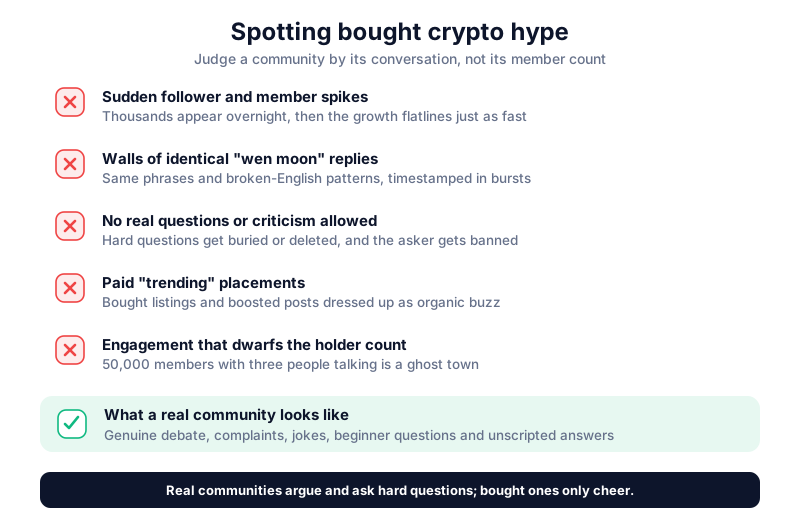
Judge a community by its conversation, not its member count. 50,000 members with three people talking, identical 'great project sir' messages, replies that never answer questions, hundreds of reviews landing in one hour, and every doubt instantly deleted — each is a tell. Real communities argue, joke, complain and go off-topic; bought ones only cheer.
Why hype is for sale
Social proof is the engine of every presale: if thousands of people seem excited, the project must be real. Scam operations know the maths — a block of fake Telegram members or a flood of bot engagement costs a rounding error, and it's often bundled into the same paid-promotion packages as the directory listings and press releases. The result is a complete counterfeit of momentum, built before a single real person has joined.
Numbers are the cheapest thing to fake
Treat every headline count — members, followers, holders, reviews — as decoration. The behaviour of the crowd is what can't be faked at scale, and that's where you look.
The Telegram tells
- The ghost-town ratio. Tens of thousands of members, single-digit people actually talking. Open the member list and scroll: fake accounts have no photos, generic names with number strings, and no shared history.
- The chorus. 'Great project!', 'To the moon 🚀', 'when listing sir' — repeated endlessly with tiny variations, often in the same broken-English patterns, timestamped in bursts. Real chat meanders; scripts loop.
- Questions that die. Ask something specific — 'where's the audit report hosted?' — and watch. In bot channels, hard questions get ignored, buried under fresh cheering, or deleted with the asker banned. In real communities, someone answers, even if the answer is 'good question, dunno'.
- Admin-only truth. Channels where only admins can post aren't communities at all — they're broadcast marketing wearing a community's clothes.
The X (Twitter) and review-site tells
- Engagement that doesn't add up. Fifty thousand followers, yet posts get a handful of real replies — and the replies are all rocket emojis from accounts created last month that also shill four other tokens.
- The reply-guy fleet. Open the profiles replying to the project's posts. Bought accounts follow thousands, are followed by nobody real, and their entire timeline is promotion.
- Review-velocity spikes. Hundreds of five-star ratings landing on a directory within hours — for a token nobody discusses anywhere independent — is a purchase, not a groundswell. Real reputation accretes slowly and unevenly.
- Recycled praise. Paste a distinctive review sentence into a search engine, quotation-mark trick style. Bought reviews get reused across projects just like whitepapers do.
The five-minute test
Pick the project's three most recent posts. Read every reply and click ten profiles. If you can't find a single reply that reads like a human being with an independent life, you've finished your research.
What real communities look like (so you recognise the difference)
Genuine crypto communities are messy. People complain about gas fees, argue about the roadmap, post memes that criticise the team, ask beginner questions and get patient (or grumpy) answers. There are regulars with history, in-jokes, and disagreement that doesn't get deleted. Scam channels can't tolerate any of that, because doubt is contagious — so they optimise for a wall of uninterrupted positivity. Ironically, that perfection is the tell: a community with no complaints is a community with no customers.
Community is also just one signal. A project can have a real, enthusiastic crowd and still be a terrible bet — hype and FOMO psychology recruit true believers to scams all the time. Run the crowd test alongside the full presale checklist: the team, the whitepaper, the audit and the on-chain money. Five checks, all free, and no bot farm can pass them together.
Key takeaways
- Member counts, followers and review totals are purchasable — behaviour is what can't be faked at scale
- 50,000 members with three people talking is a ghost town wearing a crowd costume
- Ask one hard question in the Telegram and watch what happens to it
- Hundreds of five-star reviews in an hour is a transaction, not a community
- A community with zero complaints has zero real users — perfection is the tell
Frequently asked questions
Can't real projects also buy some promotion?
Yes — plenty of legitimate projects pay for marketing, and that alone isn't damning. The difference is whether a real community exists underneath. Strip away the promotion: are there humans with history, disagreement and unscripted conversation? If the answer is no, the promotion is all there is.
How do I check when an X account or Telegram profile was created?
On X, the join date is on every profile. On Telegram there's no public creation date, but proxies work: no photo, no username history, no shared groups, and a first message that's identical to fifty others in the channel.
The project has celebrity or influencer endorsements — does that count as real hype?
Paid influencer posts are advertising with a face on it — and undisclosed ones targeting UK consumers likely breach the financial promotion rules. Some of the biggest collapses in crypto history were influencer-endorsed right to the end.
Keep reading
How to Check If a Crypto Presale Is a Scam (Step by Step)
The complete pre-flight check for any crypto presale: verify the team, the whitepaper, the audit and the actua
How Paid Crypto Listings and 5-Star Ratings Really Work
Presale directories and crypto 'news' sites look like independent journalism — but much of it is paid placemen
The Psychology Behind Meme Coin Investing
Why meme coins hijack our brains: FOMO, herd behaviour, social proof, lottery-ticket thinking and sunk cost —