What Actually Causes Alt Seasons?
Spend any time in crypto and you'll hear people ask, breathlessly, whether 'alt season' is here. The phrase describes those stretches when smaller coins suddenly outrun Bitcoin and seem to fly. It feels like a season with a start and end date — but it isn't a calendar event. It's the visible result of money, mood and liquidity sloshing around the market. This article explains what actually drives it, neutrally, and why nobody can reliably call it in advance.
The 20-second version
An alt season is a period when altcoins broadly outperform Bitcoin. It tends to happen when risk appetite is high and money rotates from Bitcoin into smaller, riskier coins. The drivers — liquidity, sentiment and Bitcoin dominance — are real but messy, which is why alt seasons are easy to describe and very hard to predict.
What 'alt season' actually means
'Altcoins' simply means any cryptocurrency that isn't Bitcoin — Ethereum, Solana, and the thousands of smaller tokens below them. An alt season is an informal label for a stretch when those coins, as a group, outperform Bitcoin by a wide margin. There's no official definition and no klaxon that sounds; it's a pattern people name after the fact.
The key word is *relative*. During an alt season, altcoins rise faster than Bitcoin — but they can also fall faster when the mood flips. Smaller coins are higher up the risk curve: thinner liquidity, less established track records, and far more sensitivity to sentiment. That's exactly why they can move dramatically in both directions.
A label, not a forecast
'Alt season' describes what has happened, not what will. By the time it's obvious, much of the move has usually already occurred. Treat the phrase as a description of market conditions, never as a signal to act.
The rotation from Bitcoin into alts
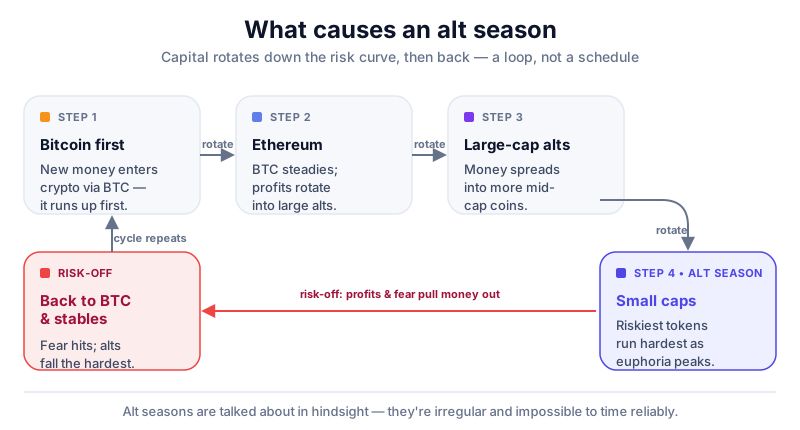
The mechanism people point to is capital rotation. In many cycles, Bitcoin moves first — it's the largest, most liquid and most familiar coin, and it's where a lot of new money enters crypto. When Bitcoin has run up and starts to stabilise, some holders take profits and look for the next thing that might move. That attention and money flows down the risk curve: first into large alts like Ethereum, then into mid-caps, and eventually into the smallest and most speculative tokens. If you're riding that rotation into riskier coins, keep your core holdings in cold storage on a Ledger Nano X.
You can picture it as a tide moving through a harbour. The biggest boats lift first, then the medium ones, and the smallest dinghies last — and when the tide goes out, the dinghies are left stranded fastest. This rotation isn't a law of nature; it's a behavioural tendency that has shown up across past cycles, often around the rhythm of the Bitcoin halving and the broader swings between bull and bear markets.
| Rough phase | What typically leads | Risk appetite |
|---|---|---|
| Early recovery | Bitcoin | Cautious |
| Mid cycle | Large-cap alts (e.g. Ethereum) | Rising |
| Late / 'alt season' | Mid- and small-cap alts | High to euphoric |
| Downturn | Everything falls; alts fall hardest | Fear |
These phases are blurry and far from guaranteed. Past cycles are not a template for future ones, and plenty of money has been lost by people assuming the pattern would repeat on schedule.
The real drivers: liquidity and risk appetite
Underneath the rotation story are two forces that matter more than any chart pattern: how much money is sloshing around (liquidity) and how willing people are to take risk (risk appetite). When both are high, capital chases bigger potential gains in smaller coins. When either dries up, the riskiest assets get sold first.
- Liquidity — when credit is cheap and money is flowing into crypto generally, there's more capital available to push into speculative coins. Tight conditions starve alts of the fuel they need.
- Risk appetite — alt seasons are emotional. They feed on optimism, FOMO and the belief that 'this time' a small coin will 10x. That same emotion reverses hard when fear takes over.
- Bitcoin's behaviour — when Bitcoin is calm and rangebound after a run, traders feel freer to gamble on alts. When Bitcoin is crashing, alts almost always crash with it.
- Narratives — themes like meme coins, AI tokens or new chains can concentrate attention and money on specific corners of the alt market for a while.
Note that thin liquidity is a double-edged sword. The same shallow markets that let a small coin rocket on modest buying can trap holders on the way down, when there simply aren't enough buyers to sell into. This is the heart of understanding crypto volatility, and it's amplified across the long tail of altcoins.
Bitcoin dominance as a rough gauge
People often watch Bitcoin dominance — Bitcoin's share of the total crypto market value — as a shorthand for where money is flowing. When dominance falls, it can suggest capital is rotating into alts; when it rises, money may be retreating back to the relative safety of Bitcoin during stress.
Dominance is a blunt instrument
Falling dominance can mean alts are pumping — or simply that Bitcoin is falling faster than alts in a downturn. The same number can point in opposite directions depending on context. It's a rough gauge of mood, not a reliable signal, and certainly not a reason to buy or sell.
The deeper problem is that dominance, like every other 'indicator', only describes the present. Stablecoins, the launch of new tokens and shifting market structure all distort the figure, so reading too much into a single number is a recipe for false confidence.
Why they're so hard to predict
If alt seasons followed a clear rule, everyone would front-run them and the rule would stop working. They don't, because they emerge from the collective, reflexive behaviour of millions of participants reacting to each other, to news, to wider markets and to pure emotion. Each cycle has had different leaders, different lengths and different triggers — and several widely expected alt seasons simply never arrived.
- Every cycle is shaped by new conditions — regulation, macro economics, technology and sentiment all shift.
- Markets are reflexive: the more people expect a move, the more its timing changes.
- Liquidity and risk appetite can vanish overnight on a single piece of bad news.
- Survivorship bias makes past alt seasons look more orderly and inevitable than they felt at the time.
The takeaway
An alt season is best understood as a description, not a prophecy: a window when altcoins broadly outpace Bitcoin, driven by capital rotating down the risk curve while liquidity and optimism are high. The forces behind it — money flow, mood and Bitcoin's own behaviour — are real and worth understanding, but they're tangled enough that no one can reliably call the timing. Anyone who claims they can is selling certainty that doesn't exist.
Understanding the mechanics helps you read the market with clearer eyes, but it is not a strategy and not advice. Altcoins are among the most volatile assets you can hold, alt seasons reverse violently, and you can lose money — including all of it. Never invest more than you can afford to lose.
Key takeaways
- An alt season is a period when altcoins broadly outperform Bitcoin — a description of conditions, not a forecast.
- It's driven by capital rotating from Bitcoin down into riskier coins when liquidity and risk appetite are high.
- Bitcoin dominance is a rough mood gauge, but the same number can mean opposite things in different contexts.
- Alt seasons are hard to predict because they emerge from reflexive, emotional crowd behaviour that changes every cycle.
- Altcoins are highly volatile and reverse sharply — none of this is investment advice, and you can lose money.
Frequently asked questions
Is alt season a fixed time of year?
No. Despite the name, it isn't a calendar event. It's an informal label for any stretch when altcoins broadly outperform Bitcoin, and those stretches vary in timing, length and leaders from cycle to cycle — if they happen at all.
Does falling Bitcoin dominance guarantee an alt season?
No. Falling dominance can mean money is rotating into alts, but it can equally mean Bitcoin is simply falling faster than alts during a downturn. It's a rough gauge of market mood, not a reliable signal of anything.
Can anyone reliably predict when an alt season will start?
No. Alt seasons come from the collective, reflexive behaviour of the whole market reacting to news, liquidity and emotion. Several widely anticipated ones never materialised. Anyone promising to time it precisely should be treated with deep scepticism.
Keep reading
Bull vs Bear Markets Explained
What bull and bear markets mean in crypto, where the terms come from, and how market cycles tend to behave — w
The Bitcoin Halving Explained
What the Bitcoin halving is, why it happens roughly every four years, how it controls Bitcoin's supply, and wh
What Is Bitcoin? A Plain-English Guide
A beginner-friendly explanation of what Bitcoin is, how it works, and how to think about it — with no hype and