What Is a Seed Phrase? (And Why You Must Never Share It)
Your seed phrase is the single most important thing to protect in crypto — it's the master backup for your entire wallet, and anyone who reads it can take everything you own, instantly and irreversibly. This guide explains what it is, how it works, and exactly how to keep it safe.
The 20-second version
A seed phrase is a list of 12–24 ordinary words that backs up your whole wallet. Whoever has the words controls the coins. Write it on paper, store it offline, and never type it into a website, photograph it, or share it with anyone — no legitimate service will ever ask for it.
What a seed phrase actually is
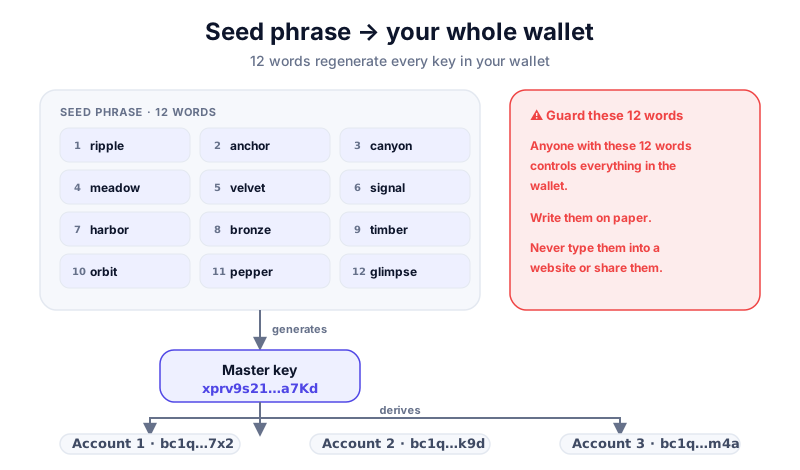
When you set up a self-custody wallet — one where you, and not a company, hold the keys — it generates a seed phrase, also called a recovery phrase or mnemonic. It's usually 12 or 24 everyday words in a fixed order, something like *ladder, ocean, velvet, rabbit, copper, anchor…*. They look almost comically ordinary, which is part of why people fail to take them seriously. Those words are a human-readable version of the master key to your entire wallet.
Here's the part that surprises newcomers: your coins are not really 'in' the wallet, like cash in a purse. Behind the scenes, the phrase is converted into the private keys that sign your transactions, and because of how blockchains work, your coins never actually leave the network at all. What you truly own is the *ability to prove* the coins are yours and to authorise moving them. The seed phrase is that proof, boiled down into words you can write on paper. Lose the words and the device, and you lose the ability to prove ownership — even though the coins still sit on the blockchain, forever out of reach.
Think of it less like a password and more like the master key to a building, cut in a way that can reproduce every other key. Whoever holds it can open every door. There is no locksmith who can re-cut it for you if it's lost, and no way to change the locks if a stranger copies it.
Why words instead of a long code?
Most wallets follow a shared standard (BIP-39) that maps your key to words from a fixed 2,048-word list. Words are far easier to copy by hand without errors than a long string of random characters — *velvet* is much harder to mistranscribe than *7fA2…*, and the standard even has built-in checks that catch many mistakes. The plain words are a usability feature, not a sign the phrase is harmless.
Why it matters so much
The seed phrase isn't a password you can reset if you forget it. It is your wallet — copying the words recreates the wallet exactly, anywhere, on any compatible device. Two consequences follow from that, and both are absolute, with no fine print and no exceptions:
- Anyone who sees your phrase can drain your wallet — from anywhere in the world, in minutes, with no way for you to stop it or reverse it. A photo glimpsed over your shoulder is enough.
- If you lose it and lose your device, your coins are gone forever. There is no support line, no 'forgot password' link, no account recovery, no exceptions made for honest mistakes. The blockchain doesn't know or care who you are.
This is the trade-off at the heart of holding your own crypto: total control comes with total responsibility. A bank can reverse a fraudulent payment and reset your login. With a seed phrase, you are the bank, the security team and the recovery department, all at once. That's not a reason to be frightened — millions of people manage it fine — but it is a reason to treat the phrase with the seriousness you'd give the deeds to your house plus the keys to your safe.
Never share your seed phrase — with anyone, ever
No exchange, wallet maker, support agent, 'wallet validator', airdrop, or giveaway will ever need your seed phrase. Anyone who asks for it — by email, pop-up, DM, phone call, or 'support' chat — is trying to steal from you, no matter how official they look. This is the number-one rule in all of crypto, and there are genuinely no exceptions to it.
How to store a seed phrase safely
The goal is simple to state: keep the words offline, private, and durable. Almost every seed-phrase disaster comes from breaking one of those three rules — putting the words online where they can be stolen, letting someone else see them, or storing the one copy somewhere it can be destroyed. Get all three right and you've handled the hardest part of crypto security. A fireproof metal backup is the simplest way to cover the 'durable' part. Here's the standard, sensible routine:
- Let your wallet or hardware device generate a brand-new phrase. Never use one someone else gave you, and never use a 'pre-filled' phrase from a wallet you bought second-hand — that's a classic trap to drain you later.
- Write the words by hand on paper, in order and numbered. Double-check every word's spelling against the device, because one wrong word can break the backup.
- Store it offline in a safe, private place — ideally two copies in two separate locations (for example, one at home and one in a bank deposit box), so a single fire or flood can't wipe you out.
- Never type it into a computer or phone, never photograph or screenshot it, and never store it in cloud notes, email, or a password manager that syncs online. The moment it touches the internet, treat it as exposed.
- For larger holdings, consider a fireproof metal backup plate, which survives the flood and fire that ordinary paper won't.
A quick test of your backup
A good backup is one you could actually use to restore your wallet on a brand-new device if your current one vanished tomorrow. If you're not quietly confident you could do that, your backup isn't finished — fix it before you add any more funds. A backup you've never sanity-checked is a hope, not a plan.
Seed phrase vs private key vs passphrase
These three terms get muddled constantly, and the confusion can be expensive, so here's the difference laid out in one place:
| Term | What it is | Scope |
|---|---|---|
| Seed phrase | 12–24 words that back up the whole wallet | Restores every account and coin in the wallet |
| Private key | The secret that signs transactions for one account | Controls a single account/address |
| Passphrase (25th word) | An optional extra word you choose yourself | Creates a separate hidden wallet on top of the seed |
In plain terms: the seed phrase is the master key to the whole building, a private key opens one room, and a passphrase is like a secret combination you add on top to create an entirely separate, hidden room. An optional passphrase adds real protection if your written phrase is ever found — a thief with the words alone still can't reach the hidden wallet. But there's a catch with teeth: if you forget the passphrase, those funds are gone for good, with no recovery at all. Only use one if you fully understand that trade-off and can store it as carefully as the phrase itself. For more on locking down larger amounts, see advanced self-custody.
Where to go next
A seed phrase only matters because you're holding your own keys — which is the whole point of crypto, and the part most worth getting right. Learn how to store Bitcoin safely, get clear on how wallets work, and — most importantly — read how to avoid the scams that exist almost entirely to trick you into revealing this phrase. Master this one habit and you've sidestepped the way most people in crypto lose everything. That's not a sales pitch; it's just the Latest Crypto team telling you the single most useful thing we know.
A hardware wallet generates and stores your seed offline, so it never touches an internet-connected device. The Ledger Nano X is our top pick for most people — buy direct from the manufacturer, never second-hand. We may earn a commission at no cost to you, and it never changes our verdicts.
Key takeaways
- A seed phrase is 12–24 words that back up your entire wallet.
- Whoever has the words controls the coins — guard it like cash.
- Write it on paper, store it offline, and keep at least two copies.
- No legitimate service will ever ask for your seed phrase — anyone who does is a scammer.
Frequently asked questions
Is it safe to store my seed phrase in a password manager?
It's far safer offline. Anything that syncs to the cloud — password managers included — adds online exposure, and that's exactly what you're trying to avoid. For any meaningful amount, handwritten paper or a metal backup kept offline is the standard for good reason.
What happens if I lose my seed phrase?
As long as your wallet or device still works, your funds are fine for now — but make a fresh backup immediately, because you're one broken phone away from losing access. If you lose both the phrase and the device, the funds are permanently unrecoverable, which is exactly why two offline copies are wise.
A support agent asked for my recovery phrase to 'verify' my wallet. Is that normal?
No. It is always a scam, every single time, no matter how convincing the agent or the website looks. Real support never needs your phrase. Stop, don't share anything, and read how to avoid crypto scams.
Keep reading
How to Store Bitcoin Safely (Step by Step)
Keep your Bitcoin safe from hackers and mistakes: hot vs cold wallets, hardware wallets, seed-phrase backups,
How to Avoid Crypto Scams: The Cornerstone Safety Guide
The common crypto scams — fake support, phishing, giveaways, romance and rug pulls — and the simple habits tha
Bitcoin Wallets Explained
What a Bitcoin wallet really is, the difference between custodial and self-custody, hot vs cold, and how to ch