Advanced Bitcoin Self-Custody: Multisig, Passphrases and Inheritance
This is the final lesson of the course, and you've earned it. By now you understand what Bitcoin is, how it works, how to buy it, store it, choose a wallet, and dodge the scams. Once you're comfortable with a hardware wallet and a backed-up seed phrase, you can go further still. This lesson covers the three pillars of advanced self-custody — multisig, passphrases and inheritance — and stays honest about the extra risk each one quietly adds. Because at this level the danger isn't a hacker outwitting you; it's you locking yourself out.
The 20-second version
Multisig requires several keys to move funds, removing any single point of failure. A passphrase adds a secret 'extra word' on top of your seed. Inheritance planning makes sure loved ones can access your Bitcoin if you can't. All three add safety — and complexity. Master the basics first, and always test recovery before you trust a setup.
Make sure you're ready
Advanced self-custody is powerful, but its biggest danger isn't theft — it's locking yourself out of your own money. Every clever layer you add is one more thing to get wrong, one more backup to lose, one more step to forget. That's why this lesson comes last, and why we'd gently steer beginners away from it for now. Before going further, you should already be confident with a hardware wallet, understand your seed phrase, and have worked through our guides on storing Bitcoin safely and wallets. If those still feel new, this genuinely isn't the place to start — come back when they're second nature.
Complexity is itself a risk
Every layer you add is another way to lose access if you slip up. Self-inflicted lockout — a forgotten passphrase, a lost descriptor — is one of the most common ways people lose Bitcoin for good, far more common than theft. Practise with tiny amounts first, and never deploy a setup you don't fully understand. This guide is education, not financial advice.
Multisignature (multisig) wallets
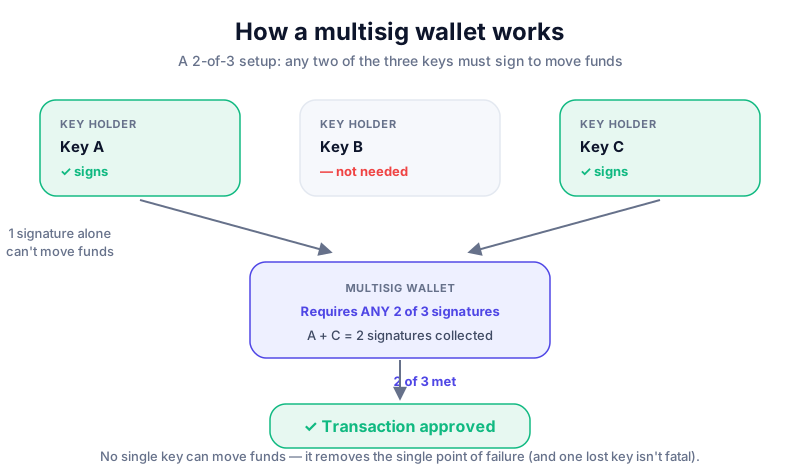
A standard wallet needs one key to spend — which means one stolen or lost key is a total disaster. A multisig wallet needs several. A common setup is '2-of-3': three keys exist, and any two of them are required to move funds. Picture a safe-deposit box that only opens when two of three trusted keyholders turn their keys together. No single device, location, or person can lose or leak your Bitcoin on its own. Lose one key entirely? You can still recover with the other two. Have one stolen? The thief still can't move a thing without a second. That redundancy is the whole appeal.
- Removes single points of failure — one lost or stolen key isn't enough to spend your coins, nor enough to lock you out.
- Spreads risk geographically — keys can live in different buildings, cities, or even with different trusted people, so a single fire, burglary or coercion can't reach them all.
- Adds complexity — you must securely back up the wallet configuration (the 'descriptor'), not just the keys themselves, or you can't rebuild the wallet even with the keys in hand.
Multisig is widely considered the gold standard for larger holdings, but it has more moving parts than a single seed phrase, and each part needs its own backup and its own plan. The reassuring news is that reputable coordinator software and well-supported hardware wallets have made it far more approachable than it was a few years ago. If you want a hands-on walkthrough, see how to use a multisig wallet.

Devices like the Trezor Safe 5 work with popular multisig coordinators. We may earn a commission at no cost to you, and it never changes our verdicts — and always buy direct from the manufacturer. Read Ledger vs Trezor before choosing.
Passphrases: the optional 25th word
A passphrase is an extra secret word or phrase you add on top of your 12–24 word seed — which is why it's nicknamed the '25th word'. Together, the seed and the passphrase unlock a completely separate, 'hidden' wallet. The clever consequence: even a thief who finds your written seed phrase sees only an empty or decoy wallet, because without the passphrase they're opening the wrong door entirely. Your real funds sit behind a door they don't even know exists. There's a deeper dive in what is a wallet passphrase.
- Strong protection — your written seed alone is no longer enough for anyone to steal your funds, which neutralises the single biggest risk of a paper backup.
- No backup, no recovery — if you forget the passphrase, the funds are gone forever. It is deliberately not stored anywhere, not even by your wallet. That's the point, and the peril.
- Easy to fumble — a single mistyped character, an accidental space, or even a stray capital letter silently creates a different, empty wallet with no error message to warn you.
A passphrase is unforgiving
There is no reset and no support line — that's the whole point, and also the whole danger. Store the passphrase separately from your seed phrase, test recovery with a small amount before trusting it with real money, and make sure your inheritance plan accounts for it. Otherwise your Bitcoin dies with you.
Inheritance: planning for the worst
Self-custody has a hard truth buried in it: there's no bank to call if something happens to you. Without a plan, your Bitcoin can be permanently lost to your family — and a genuinely heartbreaking amount already has been, sitting on the blockchain forever because no one living knows the keys. Good inheritance planning balances two opposing needs at once: keeping your keys secret while you're alive, and making them findable for the right people afterwards. Getting both right takes a little deliberate effort, but it's some of the most worthwhile work you'll do here.
- Document, in plain language, what you hold and how to access it — without writing the seed phrase itself into that document.
- Decide where the seed phrase, any passphrase, and (for multisig) the wallet descriptor are stored, and who can reach each piece.
- Consider splitting knowledge so no single person can steal it, but the right people together can recover it.
- Use multisig or a reputable inheritance service if you want keys distributed across trusted parties rather than sitting in one place.
- Tell a trusted executor that a plan exists and where to find the instructions — then review the whole thing periodically as things change.
Test it from the other side
The real test of any plan is whether someone non-technical could actually follow your instructions and recover the funds without you there to help. Have a trusted person walk through the steps on a small test wallet to find the gaps now, while you're still around to fix them.
Wrapping up the course
You don't need all three of these at once — and you certainly shouldn't rush them. Many people start with a passphrase, add an inheritance plan, and graduate to multisig only as their holdings grow and the stakes rise. Build up gradually, document carefully, and always rehearse recovery before you trust a setup with anything you can't afford to lose. Slow and tested beats clever and fragile, every time.
And that's the course. From 'what is Bitcoin?' all the way to advanced self-custody, you've gone from curious to genuinely capable — able to buy, store, secure and inherit Bitcoin without relying on anyone else's good faith or paying for advice that wasn't worth it. If you want to keep sharpening the fundamentals underneath all this, revisit Bitcoin security and scams and how to store Bitcoin safely, or take the course knowledge check to see what's stuck. From all of us on the Latest Crypto team: stay curious, stay sceptical, and only ever risk what you can afford to lose.
The safest home for anything you’re not actively trading is a hardware wallet — your private keys stay offline, out of reach of hackers and exchange failures. The Ledger Nano S Plus is the value pick we’d hand a beginner.
Key takeaways
- Multisig requires multiple keys, removing any single point of failure.
- A passphrase adds a secret '25th word' — powerful, but unrecoverable if forgotten.
- Inheritance planning ensures loved ones can recover your Bitcoin if you can't.
- Every added layer is also a new way to lock yourself out — master the basics and test recovery first.
Frequently asked questions
Do I need multisig?
Most people don't. A hardware wallet with a well-protected seed phrase is plenty for typical amounts. Multisig earns its extra complexity mainly for larger holdings or funds shared between several people who need shared control.
Where should I store my passphrase?
Separately from your seed phrase, so finding one doesn't reveal the other — but somewhere your inheritance plan can still reach. Never store it digitally alongside the seed, and never share either with anyone claiming to be 'support'.
What's the simplest way to plan inheritance?
Start with clear written instructions stored securely, a trusted executor who knows a plan exists, and a tested recovery walkthrough on a small wallet. Multisig and dedicated services can add resilience once those basics are solid.
Keep reading
How to Store Bitcoin Safely (Step by Step)
Keep your Bitcoin safe from hackers and mistakes: hot vs cold wallets, hardware wallets, seed-phrase backups,
Bitcoin Wallets Explained
What a Bitcoin wallet really is, the difference between custodial and self-custody, hot vs cold, and how to ch
Bitcoin Security and Scams: How to Stay Safe
The most common Bitcoin scams — fake giveaways, phishing, SIM-swaps, fake support, and seed-phrase theft — and