Crypto Staking & Mining Tax in the UK: Income or Capital Gains?
If you earn crypto from staking, mining, lending or DeFi, HMRC usually wants to look at it twice: once as income when it lands in your wallet, and again as a capital gain or loss when you eventually dispose of it. This is a plain-English explainer of the general principles — it is general information, not personal tax advice.
The 20-second version
Rewards from staking, mining and similar activity are generally taxed as income based on their pound value when you receive them. That same value usually becomes your cost basis, so any further rise or fall when you later sell or swap is a separate Capital Gains Tax matter. Whether mining is a hobby or a trade changes the picture. Always check HMRC's Cryptoassets Manual or a qualified accountant for your own situation.
Read this first
This is education, not tax advice
Tax rules, rates and allowances change, and your circumstances are unique. Nothing here is personal advice. Always check the current official HMRC guidance (the Cryptoassets Manual) or speak to a qualified accountant before filing, especially for staking, mining and DeFi, where treatment can be fact-specific.
Why one reward can be taxed twice
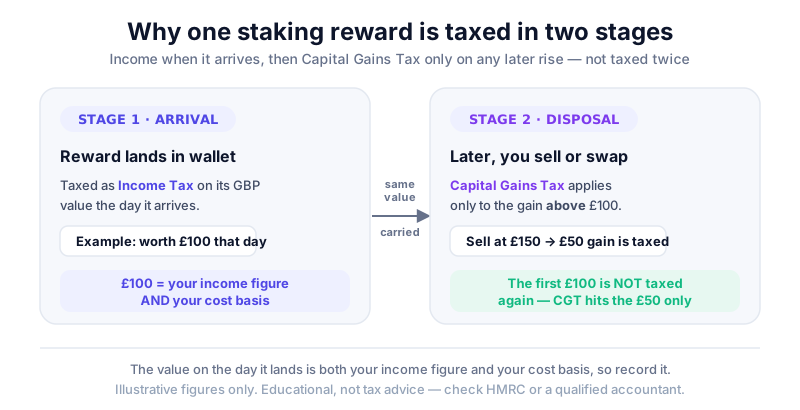
The single most useful idea here is that earned crypto can pass through two separate tax stages, not one. HMRC's general approach is that when you *receive* a reward — from staking, mining, lending or similar — it can be Income Tax on its pound value at that moment. Then, if the asset later changes in value before you dispose of it, that change is a Capital Gains Tax matter.
This catches a lot of people out. You can pay income tax on a reward, watch the token fall in price, sell it, and still need to work out a separate capital gain or loss on the move. The two stages are calculated independently — which is exactly why your records have to capture the pound value at the point of receipt.
Earned once, taxed in two stages: income when it arrives, capital gains on what happens to it afterwards.
Stage one: income when rewards arrive
Where you *receive* crypto rather than buy it, HMRC's guidance generally points towards Income Tax (and sometimes National Insurance), based on the sterling value at the time it lands in your control. The activities that commonly fall here include:
- Staking rewards — tokens earned for helping secure a proof-of-stake network.
- Mining rewards — block rewards and fees from proof-of-work mining.
- Lending and yield — interest-style returns from lending out crypto.
- Many DeFi rewards, although the treatment here is more complex and fact-specific (more below).
Practically, this means logging the GBP value at receipt for every reward — daily staking drips included. That figure does double duty: it is the income you may need to declare, and it usually becomes the cost basis for stage two. If you receive small rewards many times a day, this is where reputable crypto tax software earns its keep.
Receipt value is the number that matters
The taxable income is generally the pound value of the reward when you receive it — not when you sell it, and not what you originally paid for anything. Capture that figure at the time; reconstructing historic prices later is painful and error-prone.
Hobby or trade? Why mining is different
For mining in particular, HMRC draws a high-level distinction between activity carried out as a hobby and activity that amounts to a trade. It is a judgement based on the full picture — things like the scale, organisation, degree of effort and commercial intent — rather than a single switch you flip.
| Roughly... | Hobby / non-trade | Trading activity |
|---|---|---|
| Typical scale | Small, occasional, low effort | Organised, regular, commercial |
| How income is usually framed | Miscellaneous income | Trading profits |
| Allowable costs | More limited | Wider range of business expenses may apply |
This distinction can change *how* the income is taxed and which costs you might offset, so it is not a detail to guess at. Staking and lending sit on a similar spectrum: most casual stakers are not running a trade, but heavily organised activity can be viewed differently. If you are unsure which side of the line you fall, that is precisely the point to take professional advice.
Don't self-diagnose 'trade' status
Whether you are trading is a legal test, not a vibe. Getting it wrong in either direction can be costly. If your mining or staking looks at all business-like, ask a qualified accountant rather than assuming.
Stage two: capital gains when you dispose
Once you have received a reward and accounted for it as income, the tokens sit in your holdings like any other crypto. When you later dispose of them, the change in value since receipt is a separate Capital Gains Tax matter. A disposal is broader than cashing out — it generally includes:
- Selling the tokens for pounds or any other fiat currency.
- Swapping them for a different cryptoasset — a crypto-to-crypto swap can be a disposal even with no cash involved.
- Spending them on goods or services.
- Gifting them to anyone other than a spouse or civil partner.
The gain or loss is broadly the value at disposal minus your cost basis — and for earned tokens, that cost basis is usually the value you already declared as income. HMRC's share-pooling rules then govern how cost is worked out across coins acquired at different times. For the mechanics, see how to calculate crypto capital gains in the UK and the CGT allowance and rates. Note that the annual exempt amount has changed in recent years, so check the current figure on HMRC's site rather than relying on an old number.
DeFi, lending and keeping good records
Decentralised finance is where general rules get genuinely murky. Whether a DeFi return looks more like income or more like a capital event can depend on the fine detail of the protocol — for example, whether you receive a brand-new reward token or simply see the value of an existing position grow. HMRC's guidance treats this as fact-specific, which is a polite way of saying: it depends. Our DeFi and NFT tax explainer goes deeper, but DeFi-heavy users in particular should consider professional input.
Whatever the activity, the defence against all of this is the same — records. Because exchanges and protocols generally won't compute UK tax for you, the responsibility sits with you, and good records make both stages far less painful.
- For every reward: the date and time, the token and amount, and the GBP value at receipt.
- The type of activity (staking, mining, lending, DeFi) and the wallet or protocol involved.
- Later disposals of those tokens, with the value at disposal and any fees.
- Exchange statements and wallet addresses, kept somewhere you can find them at filing time.
For a fuller routine, see our guide to crypto tax record-keeping and, when it is time to declare, filing crypto tax through Self Assessment. Keeping a running log as you go — rather than reconstructing a year of drips at the deadline — is the single biggest stress-saver.
Koinly connects your exchanges and wallets, records the GBP value of each reward at receipt, and applies HMRC's pooling plus the Same-Day and 30-day rules to your disposals. It's free to preview, and you only pay to download the SA108-ready report.
Key takeaways
- Staking, mining and lending rewards are generally Income Tax on their pound value when received.
- That receipt value usually becomes the cost basis for a later, separate Capital Gains Tax calculation.
- Mining can be a hobby or a trade, and the distinction changes how it's taxed.
- DeFi reward treatment is complex and fact-specific — consider professional advice.
- Record the GBP value at receipt for every reward; check HMRC's Cryptoassets Manual or an accountant.
Frequently asked questions
Are my staking rewards income or capital gains?
Generally both, at different stages. HMRC usually treats the reward as income based on its pound value when you receive it, and then any change in value when you later sell or swap it is a separate Capital Gains Tax matter. Treatment can vary, so check current HMRC guidance or an accountant.
Do I pay tax on mining even if I never sell the coins?
Often the income stage can still apply when you receive the rewards, based on their value at that point, regardless of whether you have sold them. Whether your mining is a hobby or a trade affects how it's taxed. Confirm the detail for your situation with a professional.
What value do I use for a reward I received?
As a general principle, the sterling value of the reward at the time you received it. That figure is typically the income to declare and also the cost basis for working out a future capital gain or loss. Keep a record of it at the time you get the reward.
Is DeFi yield taxed the same way?
Not necessarily. HMRC treats DeFi as fact-specific: depending on how a protocol works, a return might look more like income or more like a capital event. Because it's complex, DeFi-heavy users should consider checking the Cryptoassets Manual or a qualified accountant.
Keep reading
Crypto Taxes in the UK: A Plain-English Overview (HMRC)
How HMRC generally treats crypto for UK taxpayers — capital gains, income, record-keeping and allowances — exp
Koinly Review (2026): The Best Crypto Tax Software for UK Users?
Our Koinly review: the most HMRC-ready crypto tax software we've used, with Same-Day and Bed-and-Breakfasting
How to Calculate Crypto Capital Gains in the UK (Pooling, Same-Day & 30-Day Rules)
A plain-English walkthrough of how HMRC works out crypto capital gains in the UK: the Section 104 pool, the Sa