UK Crypto Capital Gains: Allowances & Tax Rates Explained
Two numbers shape most UK crypto tax bills: the annual CGT exempt amount (the tax-free allowance) and the rate you pay on anything above it. This is a plain-English explainer of how those work in general — not personal tax advice, and not a list of guaranteed current figures, because both have changed repeatedly.
The 20-second version
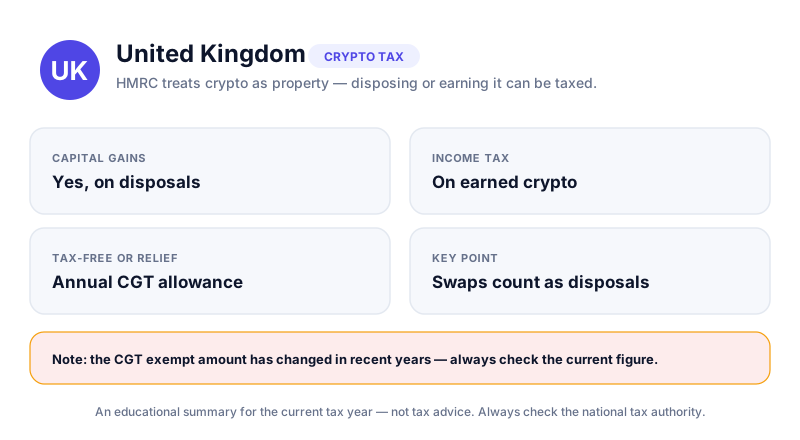
Crypto gains above the annual CGT exempt amount are taxed, and the rate you pay depends on your income tax band. Crypto you earn is taxed as income instead, at income rates. The allowance has been cut sharply in recent years, so never rely on an old number — check the current figure on GOV.UK or with a qualified accountant before you file.
Read this first
This is education, not tax advice
Tax rules, rates and allowances change frequently — the CGT exempt amount in particular has been cut more than once recently — and your situation is unique. Nothing here is personal advice or a guarantee of the current figures. Always check the official HMRC Cryptoassets Manual and GOV.UK, or speak to a qualified accountant, before you file.
Two different tax systems can apply
Before you can think about an allowance or a rate, you need to know which tax you're dealing with. In the UK, crypto activity broadly splits into two systems, and they're taxed differently.
- Capital Gains Tax (CGT) applies when you *dispose* of crypto you hold — selling for pounds, swapping one coin for another, spending it, or gifting it to anyone other than your spouse or civil partner. The full picture is in our crypto taxes in the UK overview.
- Income Tax applies when you *earn* crypto — being paid in it, mining, many staking rewards, and some airdrops. That's taxed at income rates, not CGT rates.
This matters because the allowance and rates discussed here are mostly about the CGT side. Earned crypto is folded into your income and taxed under the income system, which has its own bands and a separate personal allowance. We cover the earning side in more detail in crypto staking and mining tax in the UK.
The annual CGT exempt amount (the allowance)
Every UK taxpayer has an annual CGT exempt amount — sometimes called the annual exemption or, loosely, the CGT allowance. It's the total amount of net capital gains you can make across a tax year before any Capital Gains Tax is due. It covers all your chargeable assets together, not just crypto: shares, a second property, and crypto gains all draw on the same single allowance.
Two things are worth understanding clearly. First, the allowance applies to your gain, not the amount you sold. If you sell crypto worth several thousand pounds but your actual profit after cost basis is small, it's the profit that's measured against the allowance. Second — and this is the big one — the allowance has been reduced significantly in recent years.
Do not rely on an old number
The annual CGT exempt amount has been cut more than once in recent tax years. A figure you remember from a few years ago is very likely wrong now. Always confirm the current annual exempt amount on GOV.UK before you do your sums — we deliberately don't quote a live number here for that reason.
Because the allowance is now much smaller than it once was, far more ordinary crypto users find themselves with a reportable gain than in the past. A modest portfolio that would have stayed comfortably under the old allowance can now tip over it. That's a key reason to keep good records and check where you stand each year.
What rate you pay depends on your income
CGT is not a single flat rate. Generally, the rate you pay on gains above the allowance depends on your income tax band for the year. In broad terms, the system works like this: your taxable gains are effectively stacked on top of your income, and the part that falls within the basic-rate band is taxed at the lower CGT rate, while anything pushing you into the higher-rate territory is taxed at the higher CGT rate.
The specific percentages have changed over time and can differ by asset type, so we won't pin a live number to them here. The principle that's stable is the one to remember: your other income affects your crypto CGT rate. A higher-rate taxpayer generally pays a higher CGT rate on the same gain than a basic-rate taxpayer would.
Earned crypto is taxed differently again
If you received crypto as income — pay, mining, many staking rewards — that value is taxed at your income tax rate, not the CGT rate, in the year you received it. The same coins can then face CGT later when you dispose of them, measured from their value when you got them.
What's taxed how: CGT vs Income
The table below is a general guide to which system usually applies to common activities, and which allowance it draws on. It is a simplification — treatment can be fact-specific, especially for DeFi and NFTs, which we cover in DeFi and NFT tax in the UK. Always check the current rules.
| Activity | Usual tax | Which allowance / band |
|---|---|---|
| Selling crypto for pounds | Capital Gains Tax | Annual CGT exempt amount, then CGT rates by income band |
| Swapping one crypto for another | Capital Gains Tax | Same CGT allowance and rates — see do you pay tax swapping crypto? |
| Spending crypto on goods/services | Capital Gains Tax | Annual CGT exempt amount, then CGT rates |
| Being paid in crypto for work | Income Tax (and possibly NI) | Personal allowance, then income tax bands |
| Mining and many staking rewards | Income Tax | Income tax bands at receipt; CGT later on disposal |
| Some airdrops (where earned) | Income Tax | Income tax bands; treatment varies |
Notice that the same coin can touch both systems over its life: taxed as income when earned, then for CGT when disposed of. That's not double taxation — the CGT gain is only measured from the value you were already taxed on as income.
Working out where you stand
You don't need to guess. A rough, general process for checking whether you have CGT to think about looks like this — but the figures and final calculation must be confirmed against current HMRC guidance.
- Total up your net capital gains for the tax year, after applying HMRC's pooling rules for cost basis — see how to calculate crypto capital gains in the UK.
- Subtract any allowable capital losses you're claiming for the year.
- Compare what's left against the *current* annual CGT exempt amount from GOV.UK.
- If you're over the allowance, work out which CGT rate applies based on your income band for that year.
- Check the reporting and payment requirements and the deadlines and penalties so you don't miss a filing date.
Losses can reduce the bill
Capital losses on crypto can often be set against gains, which may bring you back within the allowance. The rules and the claim process are specific, so read crypto tax loss harvesting in the UK and confirm with HMRC or an accountant before relying on it.
If you have more than a handful of transactions, doing this by hand across multiple exchanges and wallets becomes error-prone fast. Reputable crypto tax software applies the pooling and matching rules for you, which is where a tool like the one below earns its keep.
Koinly connects your exchanges and wallets and applies HMRC's pooling plus the Same-Day and 30-day rules automatically. It's free to preview your gains, and you only pay when you want to download the SA108-ready report.
Key takeaways
- Crypto gains above the annual CGT exempt amount are taxable; the allowance has been cut sharply, so check the current figure on GOV.UK.
- The CGT rate you pay depends on your income tax band — higher earners generally pay more on the same gain.
- Crypto you earn is taxed as income at income rates, separate from the CGT allowance.
- The same coin can be taxed as income when earned and for CGT when later disposed of.
- None of these figures are guaranteed current — confirm with HMRC or a qualified accountant before filing.
Frequently asked questions
How much is the crypto CGT allowance right now?
We deliberately don't quote a live number, because the annual CGT exempt amount has been reduced more than once recently and any figure here could be out of date. Check the current annual exempt amount on GOV.UK, or ask a qualified accountant, before doing your calculations.
What rate of tax do I pay on crypto gains?
Generally it depends on your income tax band: gains falling within the basic-rate band are taxed at the lower CGT rate, and gains above that at the higher rate. The exact percentages change over time, so confirm the current rates on HMRC's site for the relevant tax year.
Is the allowance just for crypto?
No. The annual CGT exempt amount is a single allowance covering all your chargeable assets together — crypto, shares, a second property and so on all draw on the same amount in a given tax year.
Is earned crypto covered by the CGT allowance?
No. Crypto you earn — pay, mining, many staking rewards — is generally taxed as income at income tax rates and uses the personal allowance and income bands, not the CGT exempt amount. CGT can apply separately later when you dispose of those coins.
Keep reading
Crypto Taxes in the UK: A Plain-English Overview (HMRC)
How HMRC generally treats crypto for UK taxpayers — capital gains, income, record-keeping and allowances — exp
How to Calculate Crypto Capital Gains in the UK (Pooling, Same-Day & 30-Day Rules)
A plain-English walkthrough of how HMRC works out crypto capital gains in the UK: the Section 104 pool, the Sa
UK Crypto Tax Deadlines, Penalties & HMRC's 'Nudge' Letters
A plain-English guide to the UK Self Assessment timeline for crypto, how late-filing and late-payment penaltie