How Crypto Market Cycles Work
Crypto prices don't move in straight lines — they move in big, dramatic waves, soaring for months and then collapsing just as hard. People call these waves "market cycles", and a lot of folklore has grown up around them, especially the idea of a neat four-year rhythm. This guide explains the phases of a cycle, where the four-year story comes from, and — just as important — why you shouldn't treat any of it as a timetable for the future.
The 20-second version
Crypto tends to move through bull phases of rising prices and euphoria, then bear phases of falling prices and despair. A popular narrative ties this to Bitcoin's roughly four-year halving schedule. The patterns rhyme, but they're not a law of nature — past cycles never guarantee future ones.
What a market cycle actually is
A market cycle is just the journey a market takes from a low point, up to a high, and back down again. Every market does this to some degree — shares, property, gold — but crypto does it with the volume turned up. Because the market is young, relatively small, traded around the clock, and driven heavily by sentiment, the swings are far larger and faster than in traditional finance. A move that would be a once-a-decade event for a stock index can happen to crypto in a single year.
It helps to think of a cycle as a story about human emotion as much as price. Prices rise because more people want in; more people want in because prices are rising. That feedback loop runs hot until it runs out of new buyers, then unwinds in the other direction. Understanding that loop is the single most useful thing here — far more useful than any chart pattern. If you're new to why crypto swings so hard in the first place, our guide to crypto volatility is a good companion to this one.
The four phases of a cycle
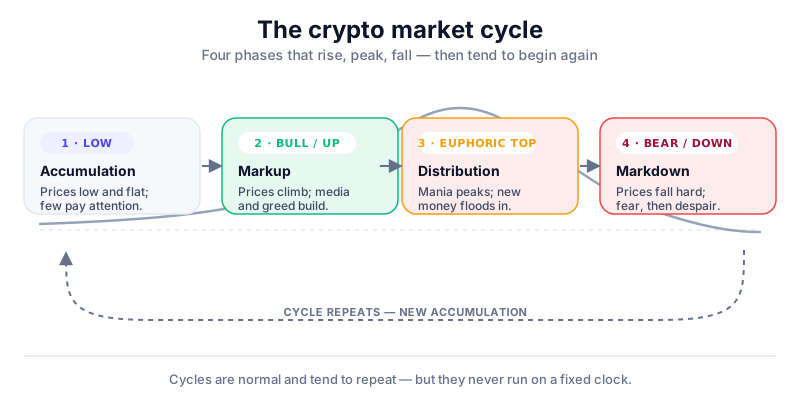
Analysts usually break a cycle into four rough phases. Real markets are messier than any tidy diagram — phases overlap, false starts happen, and you only ever know which phase you were in with hindsight. Still, the shape is useful as a mental map of the bull and bear markets we cover in more detail here.
| Phase | What's happening | The mood |
|---|---|---|
| Accumulation | Prices are low and flat after a crash; few people are paying attention. | Boredom, disinterest |
| Bull / mark-up | Prices rise steadily, then sharply; media coverage picks up. | Optimism turning to greed |
| Euphoria / top | Prices spike, everyone's talking about it, new money floods in. | Mania, 'this time it's different' |
| Bear / mark-down | Prices fall hard and keep falling; latecomers are deepest underwater. | Fear, denial, then despair |
The two emotional extremes have nicknames. Euphoria is the giddy peak where it feels like prices can only go up and your taxi driver is giving you coin tips — historically a dangerous moment to be buying. Capitulation is the opposite: the bottom of the bear market, where exhausted holders finally give up and sell at a loss, often right before things stabilise. Both are driven by emotion overwhelming judgement.
The most dangerous words in investing
"This time it's different" tends to peak exactly when a cycle does. Every euphoric top has a story explaining why the old rules no longer apply. Sometimes part of the story is even true — but it rarely justifies the prices, and the fall that follows is just as real.
Where the four-year narrative comes from
Ask why crypto cycles seem to run on a roughly four-year clock and most people point to the Bitcoin halving. Roughly every four years, the reward that Bitcoin pays miners is cut in half, which slows the rate at which new bitcoin enters circulation. The theory is that this supply squeeze, plus the attention the event generates, helps kick off each new bull run. We unpack the mechanics in detail in the Bitcoin halving explained.
It's a tidy story, and past cycles have loosely lined up with it — which is exactly why it should be handled with care. A few halvings is a tiny sample. Correlation isn't cause, and as the crypto market matures and bigger institutional players arrive, the things that drove early cycles may matter less. Interest rates, regulation, and broad investor appetite increasingly move the market too. Treat the four-year clock as a piece of folklore worth knowing, not a schedule you can set your watch by.
Cycles rhyme — they don't repeat
Each crypto cycle has looked a bit like the last in shape, but different in detail: different drivers, different durations, different depths. Anyone who tells you precisely when the next top or bottom will land is guessing, however confident they sound.
Why cycles rhyme but don't repeat
The honest reason cycles are unpredictable is that they're made of people, and people don't behave identically twice. The broad pattern — fear at the bottom, greed at the top — recurs because human psychology recurs. But the timing, the triggers and the size of each swing depend on whatever's happening in the world that particular year.
- The market keeps changing. Crypto is far bigger and more connected to mainstream finance than it was a decade ago, so the old drivers carry less weight.
- Outside forces intrude. A single shock — a major collapse like FTX, or a stablecoin implosion like Terra/Luna — can derail a cycle entirely, regardless of where the four-year clock says we are.
- Sample size is tiny. There simply haven't been enough cycles to call anything a reliable law. Patterns that 'always' held can break the moment everyone's betting on them.
This is why we're so wary of confident predictions. "Bitcoin will peak in month X" or "the bottom is in" are claims dressed up as analysis. The pattern can inform how you think about risk; it cannot tell you the future.
A calmer way to think about it
If cycles can't be timed, what's the point of understanding them? Mostly, it's to manage your own behaviour. The biggest losses in crypto tend to come not from picking the 'wrong' coin but from buying in a frenzy at the top and selling in a panic at the bottom — letting the cycle's emotions drive your decisions. Just knowing the phases exist can help you notice when you're being swept along.
One approach people use to take emotion out of the equation is dollar-cost averaging — investing a fixed small amount on a regular schedule rather than trying to time the perfect entry. It doesn't beat the market or remove risk, and it won't save you from a project that fails outright; what it does is spread your buys across the cycle so you're not betting everything on one moment of euphoria. We explain the idea, and its limits, in what is dollar-cost averaging. To be completely clear, that's an explanation of a method, not a recommendation to use it or to invest at all.
Patience over prediction
You can't reliably forecast a cycle, but you can decide in advance how you'll behave during one — how much you're willing to risk, and that you won't make decisions while euphoric or terrified. A plan made in a calm moment beats a guess made in a frantic one.
The bottom line
Crypto moves in cycles of rising and falling prices, swinging between euphoria at the top and capitulation at the bottom. A popular narrative ties the rhythm to Bitcoin's four-year halving, and past cycles have loosely echoed that shape. But cycles rhyme rather than repeat: the drivers change, outside shocks intervene, and the sample is far too small to call any of it a law. The real value in understanding cycles isn't predicting the next top — it's recognising the emotions a cycle stirs up, so they don't make your decisions for you. Crypto is highly volatile, there are no guarantees, and you can lose money, so never invest more than you can afford to lose.
Key takeaways
- Crypto moves in cycles: accumulation, bull run, euphoric top, and bear-market decline.
- The four-year 'halving' narrative is a useful piece of folklore, not a reliable schedule.
- Cycles rhyme but don't repeat — drivers change, shocks intrude, and the sample is tiny.
- The main use of understanding cycles is managing your own emotions, not timing the market — and crypto can always lose you money.
Frequently asked questions
Are crypto market cycles really four years long?
Not as a rule. The four-year idea comes from Bitcoin's halving, which happens roughly every four years, and past cycles have loosely lined up with it. But only a handful of cycles have ever occurred, the market keeps changing, and outside events can disrupt the pattern at any time. Treat the four-year clock as a rough story, not a timetable you can rely on.
What do 'euphoria' and 'capitulation' mean?
They're nicknames for the emotional extremes of a cycle. Euphoria is the giddy peak, when prices spike and it feels like they can only rise — historically a risky time to be buying. Capitulation is the opposite: the bottom of a bear market, where worn-out holders finally sell at a loss. Both are moments when emotion tends to overwhelm judgement.
Can I use cycles to time when to buy or sell?
No one can reliably time a cycle, and we don't suggest trying. Anyone claiming to know the exact top or bottom is guessing. The genuinely useful thing about cycles is behavioural: knowing the phases helps you spot when fear or greed is steering you. This is education, not financial advice — crypto is volatile and you can lose money.
Keep reading
The Bitcoin Halving Explained
What the Bitcoin halving is, why it happens roughly every four years, how it controls Bitcoin's supply, and wh
Bull vs Bear Markets Explained
What bull and bear markets mean in crypto, where the terms come from, and how market cycles tend to behave — w
Understanding Crypto Volatility
Why crypto prices swing so hard: the causes of volatility, what it means for you, and how to keep a level head