How PulseChain Works (Under the Hood)
In the last lesson we said PulseChain is a fork of Ethereum. Now let's open the bonnet. Because PulseChain copied Ethereum's design, the easiest way to understand how it works is to compare the two side by side. This lesson walks through the EVM, validators, fees and the trade-offs that make PulseChain cheaper — but smaller — than the chain it copied. None of it is as complicated as it sounds, and understanding it makes every later lesson click into place.
The 20-second version
PulseChain runs the same software as Ethereum (the EVM), so the same kinds of apps work on it. It's secured by validators staking PLS under proof-of-stake. Fees are paid in PLS and are far cheaper than Ethereum — partly by design, and partly just because the network is much smaller and carries far less traffic.
An EVM fork, explained
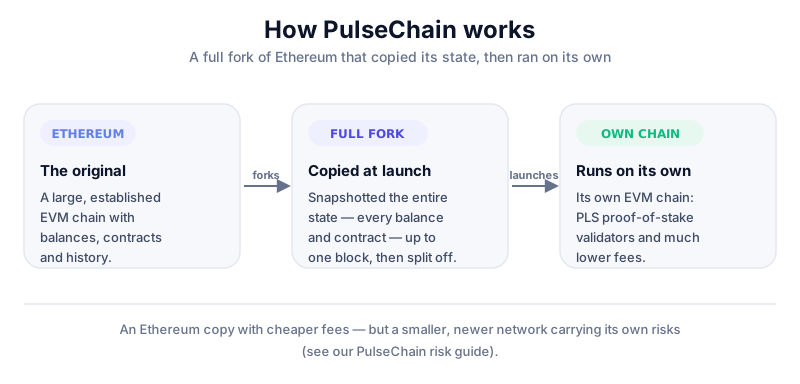
PulseChain is what's called an EVM fork. The EVM, or Ethereum Virtual Machine, is the 'engine' that runs smart contracts on Ethereum — think of it as a worldwide computer that every node in the network runs in lockstep, so they all agree on the result. Because PulseChain copied Ethereum's code, it runs the same engine. A contract or app written for Ethereum can usually be deployed on PulseChain unchanged, the same way a programme written for one make of computer runs on an identical model.
Why does that matter to you in practice? It's the reason your existing Ethereum tools mostly 'just work'. The wallet you already know, MetaMask, can talk to PulseChain. The addresses look the same. The way you sign a transaction feels the same. PulseChain didn't ask the world to learn a new system — it borrowed one millions of people already use. That's a genuine convenience, and it's a big part of the appeal. It's also why the safety habits you learn later carry straight over: the dangers are Ethereum's dangers too.
When PulseChain launched, it also copied a snapshot of Ethereum's state — balances, contracts and history up to a certain block — and then started running independently. Picture saving a video game, then loading that save into a second copy of the game: both start identical, but the choices you make afterwards happen in only one of them. Anything you did on Ethereum before the snapshot was mirrored onto PulseChain; everything after is separate. This is why holding ETH never automatically gave you the 'same' coins on both chains in any meaningful, spendable-as-one sense — they diverged the moment the copy went live.
Forks are normal in crypto
Copying open-source blockchain code is legal and common — it's how a lot of networks get started, and there's nothing inherently shady about it. What actually matters is who runs the new chain, how it's governed, and whether it earns lasting support. Learn more in what is a blockchain fork.
Validators and proof-of-stake
Like modern Ethereum, PulseChain uses proof-of-stake. Instead of energy-hungry mining (proof-of-work, the older method Bitcoin still uses), the network is secured by validators who lock up — 'stake' — PLS as a deposit. Think of that deposit as a bond: behave honestly and you earn rewards; try to cheat and the network can take a chunk of your stake. Validators take turns proposing and confirming blocks of transactions.
Here's the clever bit that makes the whole thing work without a boss. Nobody is in charge of telling validators to be honest — honesty is simply the profitable choice. Play by the rules and you collect rewards; try to fake a transaction or rewrite history and the other validators reject your work and the network 'slashes' your deposit, burning real money you put up. It's a system where good behaviour pays and cheating costs, so the rational move is to stay straight. That economic pressure, not a trusted authority, is what secures the chain.
- Validators propose and verify new blocks. They're the bookkeepers who agree on what just happened, so everyone shares one honest ledger.
- Staking aligns incentives — honest validators get paid, dishonest ones get 'slashed' (lose part of their deposit). The money on the line is what keeps them straight.
- Decentralisation depends on how many independent validators there are. A newer chain usually has fewer, and fewer hands holding the books means more concentration — something worth weighing, which we return to in the final lesson.
That last point is the one to sit with. The security of any proof-of-stake chain leans heavily on having lots of independent validators run by lots of different people in lots of different places — so no small group can collude to bend the rules. A larger, older network like Ethereum has had years to spread that out. A newer fork has had far less time and far fewer participants, so the books are held in fewer hands. It's not a flaw in the design; it's a fact about the chain's age and size, and it's a real part of the risk picture.
If staking is new to you, our general explainer on what is staking covers the concept across all chains, not just PulseChain. The mechanics here are essentially Ethereum's, just with a much smaller set of validators.
Fees and the PLS coin
Every action on PulseChain — sending PLS, swapping tokens, using an app — costs a small fee paid in PLS. This is the same idea as gas fees on Ethereum, just denominated in PulseChain's own coin. The fee is essentially what you pay the validators to include and process your transaction, a bit like postage for getting your instruction onto the chain. No PLS, no postage — which is why you always need a little on hand even just to move things around.
Fees on PulseChain are dramatically lower than on Ethereum mainnet, which is the practical draw for many users — sending a transaction can cost a tiny fraction of what the same action costs on Ethereum. Part of why is straightforward economics: fees rise when lots of people compete for limited block space, and PulseChain simply carries far less traffic, so there's rarely a queue to jump. It's the difference between posting a letter on a quiet Tuesday and trying to do it when half the country is at the counter at once. Like Ethereum, PulseChain also burns a portion of fees (removing those coins from supply), which supporters highlight as a design feature.
Cheap fees aren't a free lunch
Low fees are real and genuinely convenient. But remember why they're low: less demand means less of an ecosystem, less liquidity and fewer eyes on the network. Cheap is good; cheap *because nobody's using it much* is a fact to factor in, not a feature to celebrate.
The trade-offs of a smaller chain
Running Ethereum's proven, battle-tested software is a real strength — PulseChain didn't have to reinvent security from scratch, and that's not nothing. But a fork inherits the code, not the ecosystem. PulseChain has far fewer apps, far fewer validators, and far less money flowing through it than Ethereum or the big layer-1 and layer-2 networks. You get the engine, but not the busy city that grew up around the original — the shops, the crowds, the deep markets that took Ethereum years to build.
That gap shows up in practical ways you'll feel directly. Fewer apps means fewer genuinely useful things to do with PLS once you hold it. Fewer validators can mean more concentration, which we just covered. And thin liquidity — the issue we'll hit head-on when we cover buying PLS — can make prices swing hard and tokens harder to sell at the price you expected. The cheap fees and the thin ecosystem are two sides of the same coin: both come from the network being quiet.
Smaller means riskier
Fewer validators can mean more concentration; thin liquidity can mean prices lurch and exits are difficult. None of this is advice to buy or to avoid — just facts to factor in. Crypto is volatile; only risk what you can afford to lose, and never borrow to buy it.
Where this leads next
So that's the machine: an EVM engine borrowed wholesale from Ethereum, secured by PLS-staking validators whose honesty is paid for and whose cheating is punished, with cheap fees that come partly by design and partly from being a quiet network. With the 'how it works' under your belt, the next lesson gets practical and explains how to buy PLS — and why that's a trickier, more cautious job than buying Bitcoin or Ethereum. Whichever way you lean, the storage rule doesn't change: serious amounts belong offline, on a hardware wallet like the Ledger Nano X.
Key takeaways
- PulseChain runs the EVM, so Ethereum apps and tools largely work on it unchanged.
- It copied a snapshot of Ethereum's history, then ran as a separate, independent chain.
- It's secured by validators staking PLS under proof-of-stake, not by miners.
- Cheaper fees come partly by design and partly from being a much smaller, less-used network.
Frequently asked questions
Why are PulseChain fees so cheap?
Partly by design and partly because the network handles far less traffic than Ethereum. Fees rise when people compete for block space; low demand keeps them low — but it also reflects a smaller ecosystem.
Can I use the same wallet as Ethereum?
Often yes — wallets like MetaMask can connect to PulseChain by adding it as a custom network. We walk through that carefully in how to store PulseChain safely.
Is PulseChain proof-of-work or proof-of-stake?
Proof-of-stake. It's secured by validators staking PLS, not by miners solving puzzles, so it doesn't have Bitcoin-style energy use.
Keep reading
What Is PulseChain? A Plain-English Guide
A balanced, beginner-friendly explanation of PulseChain: what it is, who founded it, how it relates to Ethereu
How Ethereum Works: Smart Contracts, the EVM and Gas
A clear, high-level look at how Ethereum works — smart contracts, the Ethereum Virtual Machine, gas fees, and
How to Store PulseChain (PLS) Safely
Store PLS safely: add PulseChain to MetaMask as a custom network, pair it with a hardware wallet, protect your