How to Navigate Crypto Twitter (X) Without Getting Played
Crypto Twitter — or "CT", now technically Crypto X — is two things at the same time. It's a genuinely useful place to hear about a hack, a launch or a market move hours before the news sites catch up. It's also one of the most efficient manipulation machines ever built, where paid promotion, bot swarms and impersonation scams are engineered to look exactly like organic excitement. The skill isn't avoiding CT. It's reading it defensively — assuming most of the loud stuff is bought or botted until it proves otherwise, and knowing that a blue tick and a big following prove nothing at all.
The 20-second version
On CT, signal and noise are designed to look identical. Treat every enthusiastic "call" as potentially paid, every wave of hype as potentially botted, and every blue tick as proof of a card payment rather than credibility. Anyone can be impersonated, and "send crypto to receive more" is *always* a scam. Use CT for leads, never for decisions.
What "CT" actually is — and why signal and noise look identical
Crypto Twitter is the informal name for the sprawl of accounts on X that talk about crypto all day: traders, developers, researchers, journalists, meme-lords, project accounts and an enormous supporting cast of anonymous avatars. At its best it's a real-time newswire. Exploits get flagged there first, founders argue in public, and genuinely knowledgeable people share work you'd never find elsewhere.
The problem is that the same feed is where retail investors get played most. A paid promotion and an honest recommendation use the same words. A bot swarm and a genuine groundswell produce the same-looking wall of replies. That overlap isn't accidental — it's the entire business model of manufactured hype. So the goal here isn't the lazy "it's all a scam" take. Plenty of CT is real and worth reading. The honest point is that the manipulation is *deliberately camouflaged as the real thing*, and your defence is learning to tell them apart.
The one mindset that protects you
Assume nothing loud on CT is organic until you've checked. That's not cynicism — it's just matching your scepticism to how the venue actually works. Real information survives that scepticism fine; manufactured hype doesn't.
Follow the money: paid shills and the leaked price lists
The most useful thing to internalise about CT is that "organic-looking" calls are frequently bought. This isn't a conspiracy theory — it's documented. Leaked crypto "shill price lists" have shown influencers charging anywhere from a couple of hundred dollars to tens of thousands for a single promotional post, scaled to follower count, with package and retweet rates on top. Reported figures have ranged from around $200 up to $25,000 per post in one widely-covered leak, though the exact numbers vary by report and are years old now — treat them as illustrative rather than a current rate card.
The damning part isn't the price. It's the disclosure. In investigations of these deals, the overwhelming majority of paid posts weren't labelled as ads at all — one dataset reportedly found only a tiny handful out of well over a hundred accounts disclosing the arrangement. In other words, the default is that you *can't* tell a paid call from a real one by looking, because the person being paid has every incentive to hide it.
This matters legally as well as ethically. Regulators treat undisclosed paid promotion as an offence, not just bad manners. In the US, the SEC has charged social-media influencers over pump-and-dump schemes run through Twitter and Discord — including a widely-reported case involving alleged losses in the region of $100 million — and separately fined celebrities such as Kim Kardashian and Floyd Mayweather for promoting tokens without revealing they were paid to do so. If you want the deeper mechanics of who pays for visibility across the space, we cover it in how paid crypto listings really work.
Tells that a "call" might be paid
Sudden coordinated posting by several accounts within a short window; no #ad or disclosure anywhere; the token is low-float and thinly traded; and the language leans hard on urgency — "get in early", "you're still early", "last chance". None of these prove payment on their own, but together they're a strong signal to step back.
Bots and engagement farming — why manufactured hype is a red flag
Here's the counter-intuitive bit that trips up most beginners: a coin blowing up your feed is *not* evidence it's a good bet. Often it's the opposite. A Yale study of over a million tweets across dozens of crypto projects found that projects with more bot-driven posting and a high artificial "engagement coefficient" tended to see lower future returns. Heavy manufactured hype, in that data, was a negative signal — the manipulation was doing its job of pulling in buyers right before the people running it sold.
Engagement farming makes this worse. Accounts inflate their reach with reply-bait, fake giveaways and coordinated pods that like and repost each other, purely to look bigger and more credible than they are. And the bot problem is structural, not marginal. In early 2026 an algorithm change on X reportedly triggered a bot flood, with crypto tweets spiking past roughly 13 million in a single day and paid-verification accounts being used to mass-spam. The details of that episode are volatile and specific to the moment, but the lesson is durable: a wall of enthusiasm can be conjured cheaply, and often is.
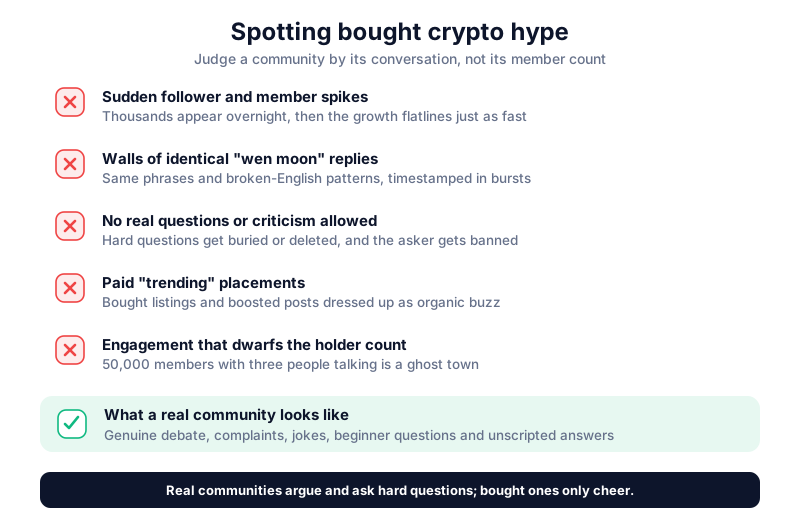
We go deeper into distinguishing a real crowd from a bought one in how to spot fake crypto community hype — the short version is to judge a community by its conversation, not its counts. And if you want to understand *why* this works on people even when they know better, the psychology of meme coin investing covers the social-proof and FOMO machinery that turns a botted feed into your buy button.
The impersonation and fake-giveaway playbook
The blue checkmark on X is not a verification of identity. It's a paid subscription — anyone can buy one. That distinction is so consequential that, as of late 2025, the EU fined X a reported €120 million under its Digital Services Act specifically over the "deceptive design" of the badge, on the basis that ordinary users read it as a trust signal it doesn't actually provide. The tick tells you someone paid a subscription fee. It tells you nothing about whether they're honest, or even who they are.
That gap is the foundation of the impersonation playbook. Scammers buy a tick, copy a well-known figure's name and avatar, and post "giveaways": send some crypto to this address and receive double back. Fake Elon Musk pinned posts and deepfake videos are a perennial — Musk is one of the most-impersonated figures in social crypto scams — and impersonation fraud has grown sharply year on year, though exact percentages vary wildly between reports and shouldn't be quoted as gospel.
The rule that never has an exception
"Send crypto to receive more" is always a scam. Every version of it. There is no legitimate giveaway, airdrop or "verification" that requires you to send funds first, and no real company or founder runs one. Full stop. The same format shows up all over the space — how to avoid crypto scams walks through the wider playbook.
The other flavour is the wallet trap: a post offering a free token or a claim that requires you to "connect your wallet" to a site. Approving that connection can hand a drainer contract permission to empty you — see wallet-drainer scams for exactly how that works. Impersonation also isn't limited to celebrities; scammers spin up convincing fake project and support accounts too, which is why the same instincts from how to spot fake crypto team photos apply to figuring out who's really behind an account.
Why influencers pump — the incentive behind the "call"
It helps to understand the machine from the promoter's side, because once you see the incentive, the behaviour stops being confusing. Shilling pays the same whether the project is real or garbage. A promoter is paid for attention, not for the token performing — so there's little reason to vet the team, read the contract or check the liquidity. That work is unpaid and only creates reasons to say no.
The manipulation works best on low-float, low-liquidity tokens, where a sudden burst of attention moves the price hard. A coordinated wave of posts drives buyers in, the price spikes, and whoever holds early positions — often insiders — sells into that spike. The followers who bought the top are left holding a token that quietly bleeds back down. That's the classic pump-and-dump shape, and celebrity or political token launches promoted heavily on X have shown it repeatedly. The 2025 $HAWK launch, for instance, was reported to crash by more than 90% within hours of touching a roughly $500 million market cap, and tokens like $TRUMP and $MELANIA have drawn pump-and-dump lawsuits. Some of these are ongoing allegations rather than settled findings, so treat the specifics as reported and time-bound — but the *pattern* is the point.
Reframe every call as an incentive
When you see someone pushing a coin, ask: what do they gain if I buy, and what do they lose if the coin fails? On CT the honest answer is usually "a lot" and "nothing". That asymmetry, not the coin's story, is the thing to weigh.
A practical filter: using Crypto Twitter without getting played
You don't need to quit CT. You need a filter that lets the useful signal through while catching the manipulation. Here's a workable one.
- Treat CT as a lead generator, never a decision-maker. A tweet can tell you a project exists. It can't tell you whether to touch it. Every interesting name goes into a "look into this later" list, not into a buy.
- Ignore the tick and the follower count. Neither is evidence of anything. Judge accounts on the substance and track record of what they post over months, not on their badge or their numbers.
- Check the account's history and incentives. New account? Timeline that's wall-to-wall promotion? Shills a different coin every week? No disclosure of paid deals? Any of these turns the volume down to zero.
- Assume coordinated hype is a red flag, not a green one. If a token suddenly floods your feed from several accounts at once, that's a reason to be *more* careful, not less — that's precisely the pattern the research links to worse outcomes.
- Never act on urgency. "Get in now" is a manipulation tactic, not information. Anything real will survive you taking a day to check it.
- Do the boring research off-platform. Before anything, run the token through a proper process — see how to research a meme coin and, for the ugliest ending, how to spot a rug pull. If a coin can't survive that, no amount of CT enthusiasm should change your mind.
Two more things. First, platform countermeasures exist but don't lean on them — in 2026 X announced measures like auto-locking accounts that mention crypto for the first time pending extra verification, which tells you the problem is bad enough to warrant blunt fixes, but features like that change or roll back and are no substitute for your own judgement. Second, once you're active on CT you become a target yourself, so tighten up your own security: crypto OPSEC basics covers protecting your accounts and wallets, and how to avoid crypto scams is the broader field guide this all feeds into.
Key takeaways
- CT is genuinely useful and an industrial manipulation machine at once — signal and noise are deliberately made to look identical
- "Organic-looking" calls are often paid, and the paid ones are almost never disclosed — assume payment until proven otherwise
- A wall of hype is frequently a red flag: research has linked heavy bot-driven engagement to worse future returns
- A blue tick is a paid subscription, not identity verification — and "send crypto to receive more" is always a scam
- Use CT for leads, never for decisions: check the incentive behind every call and do the real research off-platform
Frequently asked questions
Does a blue checkmark on X mean an account is trustworthy?
No. The blue tick is a paid subscription anyone can buy — it signals that someone paid a fee, not that their identity was verified or that they're honest. The distinction is strong enough that the EU reportedly fined X around €120 million in late 2025 over the badge's "deceptive design". Judge accounts on substance and track record, never on the tick.
How can I tell if a crypto influencer is being paid to promote a coin?
Often you can't tell for certain, because most paid crypto posts aren't disclosed — that's the whole problem. But there are strong tells: several accounts pushing the same low-float, thinly-traded token in a coordinated burst; no #ad or disclosure anywhere; and heavy urgency language like "get in early" or "last chance". Any combination of those is a reason to step back.
Are crypto giveaways on Twitter/X ever real?
The "send crypto to receive more" format is always a scam — every single time, no exceptions. No legitimate founder, project or company runs a giveaway that requires you to send funds first, and impersonation of figures like Elon Musk to run these is rampant. Be equally wary of "free claim" posts that ask you to connect your wallet to a site, which can be wallet-drainer traps.
If lots of people are hyping a coin on CT, isn't that a good sign?
Often it's the opposite. A large study of crypto tweets found that projects with more bot-driven posting and a high artificial engagement score tended to see lower future returns — manufactured hype pulls buyers in right before insiders sell. A coordinated flood of enthusiasm should make you more cautious, not less.
Keep reading
How to Spot Fake Crypto Community Hype (Bots, Shills and Ghost Towns)
Scam projects buy Telegram members, X engagement and five-star reviews by the thousand. Learn to tell a real c
How to Avoid Crypto Scams: The Cornerstone Safety Guide
The common crypto scams — fake support, phishing, giveaways, romance and rug pulls — and the simple habits tha
The Psychology Behind Meme Coin Investing
Why meme coins hijack our brains: FOMO, herd behaviour, social proof, lottery-ticket thinking and sunk cost —