How to Research a Meme Coin (Due-Diligence Checklist)
This is the final lesson, and it ties the whole course together into something you can actually do. If you're going to look at a meme coin at all, look properly. Doing your own research won't make a meme coin safe — nothing can — but it filters out the obvious scams and traps we've spent five lessons describing. Here's a practical checklist you can run before risking anything.
The 20-second version
Research a meme coin by checking its contract, liquidity, ownership spread, team and community on independent tools — not on the project's own marketing. Confirm you can actually sell. Ignore hype and urgency. If you can't verify the basics, treat that as a no.
Start with the right mindset
Everything in this course has been building to a single shift in how you look at these coins. Due diligence on a meme coin is not like researching a company — there are usually no fundamentals, no revenue and no product to analyse. As we established back in how meme coins work, you're really investigating a smart contract, a liquidity setup and a holder list. The goal is to spot the scams and traps before they cost you, then set a sensible bet size for whatever survives the filter.
It helps to flip your default. Most people approach a hyped coin asking 'why might this go up?' The researcher's question is the opposite: 'how exactly could I be robbed here, and have I ruled each of those out?' If you can't answer that, you haven't finished your research.
Research lowers risk, it doesn't remove it
Even a coin that passes every check can collapse — meme coins are speculative by nature. Only ever use money you can afford to lose entirely, and never borrow to buy. This is education, not financial advice, and never a recommendation to buy.
1. Verify the contract
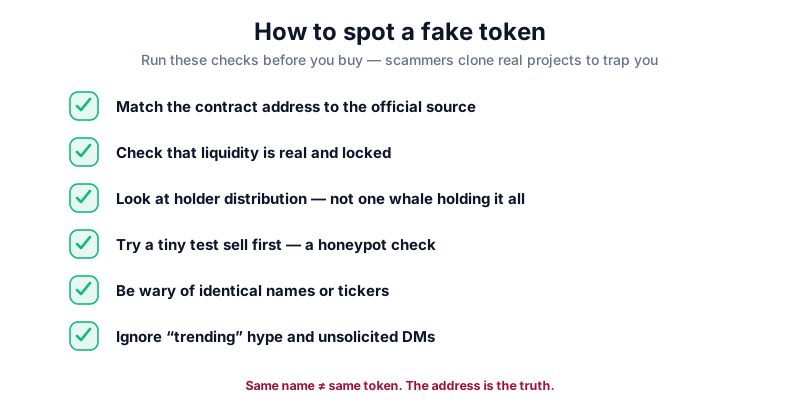
Start by making sure you even have the right coin. Get the correct contract address from a source you trust, because scammers routinely create copycat tokens with identical names and logos to catch people who searched and clicked the first result. A right-looking name on the wrong contract is how a lot of money disappears. Then run that address through free, independent contract-scanner tools.
- Confirm it isn't a honeypot — that you can actually sell, not just buy. This is non-negotiable.
- Check whether the contract can mint new tokens, which would dilute you on demand.
- Look at buy/sell taxes and, crucially, whether they can be changed after launch.
- Note whether ownership is renounced — useful context, but, as the rug-pull lesson warned, not a guarantee on its own.
Cross-check, don't trust one tool
Scanners can be fooled, and scammers test their contracts against the popular ones. Use at least two independent tools plus the chain's own block explorer, and weigh the results together rather than relying on a single green tick.
2. Check liquidity
As covered in how meme coins work, the liquidity pool is what lets you trade at all and what sets the price. Thin or removable liquidity is one of the most serious dangers there is, so this check sits right alongside the contract in importance.
- Is liquidity locked or burned, with a verifiable link and a meaningful duration — not a lock that expires in days?
- How deep is the pool? Thin liquidity means you may not be able to sell a real position without crashing the price yourself.
- Has liquidity been added or pulled recently? Sudden removals, or a pool that keeps shrinking, are a live rug-pull warning.
3. Inspect ownership and history
Open a block explorer and study the holder distribution and transaction history — it's free, public, and the most honest source you'll find, because it's just the raw record of what's actually happened on-chain.
| Check | What you're looking for |
|---|---|
| Top holders | No single wallet or small cluster quietly dominating the supply |
| Team/insider wallets | Locked or vested, not free to dump the moment trading opens |
| Wallet age and pattern | Signs of sybil wallets faking decentralisation, all funded from one source |
| Transaction flow | Unusual movements that hint at insider selling or wash trading |
Concentration is the recurring villain of how to spot a rug pull: if a few wallets hold most of the supply, they can crash it on you at will, no matter how clean everything else looks.
4. Assess the team and community
The on-chain checks tell you what's possible; this last set tells you who you're dealing with and whether the buzz is real. Read it with the scam tactics from meme coin risks and red flags in mind.
- Team — is anyone publicly accountable, with a real, verifiable track record? Fully anonymous teams have nothing to lose by rugging and vanishing.
- Community — is engagement genuine, or botted with identical replies and followers who've never posted anything?
- Communication — are tough questions answered openly, or deleted and the asker quietly banned?
- Materials — is the roadmap and whitepaper substantive when you actually read it, or vague, plagiarised, and pure hype?
Promotion is not proof
Influencer pushes and trending hashtags tell you about marketing spend, not safety. Many promoters are paid and never disclose it. Judge the coin on what you can independently verify, not on who happens to be shouting about it loudest.
5. The pre-buy checklist
Here's the whole course distilled into one routine. Run it top to bottom, every time, with no exceptions for the coin that feels too exciting to wait on — that feeling is precisely when this checklist earns its keep. If you punt on this end of the market anyway, keep the stake small — and keep your core holdings well away from it, in cold storage on a BitBox02.
- Confirm you have the correct contract address from a trusted source.
- Run the contract through two independent scanners; rule out honeypot, mint and tax traps.
- Verify liquidity is locked or burned, deep enough, and not recently pulled.
- Check holder distribution and team wallets on a block explorer.
- Assess whether the team and community are genuine and accountable.
- If you proceed, use a separate wallet, do a tiny test buy-and-sell, and size your stake as money you can lose entirely.
- Ignore all urgency. If anything pressures you to rush, stop — that pressure is the warning.
Never share your seed phrase
No research step, airdrop, giveaway or 'verification' ever requires your seed phrase or private key. Anyone who asks for it is trying to steal from you — see how to avoid crypto scams.
Wrapping up the course
That's the full journey. You started with what meme coins are, saw how they work under the hood, learned the risks and red flags, trained your eye to spot a rug pull, put faces to the notable coins, and now you can research one properly. The honest summary of all six lessons is short: meme coins are gambling dressed up as investing, most go to zero, and your edge is patience and a checklist — not a hot tip.
Where to go from here? If you want firmer ground under your feet, our broader how to avoid crypto scams guide applies everywhere in crypto, and the fundamentals in what is Bitcoin and what is Ethereum are worth knowing whatever you do next. Whatever you choose, take it slow, stay sceptical, and only ever risk what you can afford to lose. That's the whole game.
Key takeaways
- Researching a meme coin means vetting a contract, liquidity and holder list — not a business.
- Check for honeypots, removable liquidity and concentrated ownership before buying.
- Use independent tools and block explorers; never rely on the project's own marketing.
- Research lowers risk but never removes it — only risk what you can lose entirely.
Frequently asked questions
What does DYOR mean?
'Do Your Own Research' — verifying a coin's contract, liquidity, ownership and team yourself rather than trusting hype or a stranger's say-so. It reduces the chance of falling for an obvious scam, but it can't make a speculative meme coin safe.
Which tools should I use to research a meme coin?
Free contract scanners (to check for honeypots and risky functions) plus the chain's own block explorer (to inspect holders and liquidity). Use more than one and cross-check, since any single tool can be fooled or out of date.
If a coin passes every check, is it safe to buy?
No. Passing checks only rules out some scams and traps — meme coins remain highly volatile and can still collapse for ordinary reasons. Treat any money you put in as money you could lose completely.
Keep reading
How to Spot a Rug Pull
A practical guide to spotting rug pulls before they happen: liquidity locks, ownership concentration, contract
Meme Coin Risks and Red Flags
The core safety lesson on meme coins: the real risks, the warning signs to look for, and the scams that separa
How Meme Coins Work (Under the Hood)
How meme coins are created, traded and priced — tokens, liquidity pools, market caps and the mechanics that ma