Solana vs Ethereum in 2026: How the Race Has Changed
The Solana-versus-Ethereum debate has run for years, but the ground keeps shifting under it. Both networks shipped major upgrades over the last eighteen months, and the gaps that defined the rivalry in 2023 look different in 2026. This is a snapshot of where the race stands now — what changed, where each leads, and what an outsider should actually watch.
The 20-second version
Ethereum still leads on decentralisation, security and total ecosystem size, and its fees have collapsed thanks to layer 2s. Solana leads on raw speed and rock-bottom fees on a single chain, and its 2025 upgrades smoothed out the outages and fee spikes that used to plague it. Neither has 'won' — they've specialised.
Where the rivalry stood, and what moved
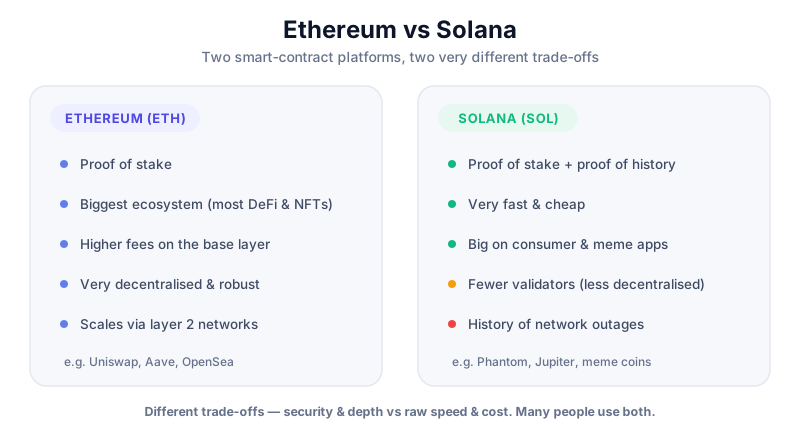
If you read our evergreen Ethereum vs Solana comparison, you already know the core trade-off: Ethereum prioritises decentralisation and a vast ecosystem while scaling through layer 2 networks, and Solana bets on raw throughput and tiny fees on one fast chain. That framing still holds in 2026. What's changed is that both sides have quietly closed some of their biggest weaknesses.
Ethereum's roadmap delivered. Following the 2024 Dencun upgrade — which slashed the cost of posting data from layer 2s — the Pectra upgrade landed in 2025 and the Fusaka upgrade followed in late 2025, with further data-capacity tweaks rolling out into early 2026. Solana, for its part, got a second independent validator client (Firedancer, built by Jump Crypto) on mainnet in late 2025, which has measurably smoothed the network congestion and fee spikes that used to embarrass it.
Read the evergreen version first
This article is a timely 2026 snapshot. For the underlying mechanics — proof of stake, smart contracts, the design philosophies — start with Ethereum vs Solana, what is Ethereum and what is Solana. Numbers below will date; the fundamentals there won't.
Fees and speed: the gap narrowed, but it's still a gap
For everyday users, fees are the headline. Here's the honest picture in 2026. Ethereum's own base layer (mainnet) is still the expensive place to transact, but almost nobody has to use it for routine activity any more — the action has moved to layer 2s like Arbitrum, Base and Optimism, where a simple transfer often costs a fraction of a cent. Solana, meanwhile, has kept fees consistently low across the whole network.
| Roughly, in 2026 | Ethereum mainnet | Ethereum layer 2s | Solana |
|---|---|---|---|
| Typical transfer fee | Cents to dollars | A fraction of a cent | A fraction of a cent |
| Where most users go | Rarely | Most activity | All activity |
| Speed feel | Slower, batched | Fast | Very fast |
| Single chain or split | Split across L2s | Split across L2s | One chain |
The nuance the headlines miss: Ethereum's L2 fees have fallen so far that the practical day-to-day difference for a small user is now small. Solana is still cheaper in absolute terms and simpler — you're on one network, not choosing between a dozen rollups and bridging between them. Ethereum's approach trades that simplicity for a security model anchored to its heavily decentralised base layer. See optimistic vs ZK rollups for how those L2s actually work.
Low fees are not the whole story
Cheap and fast is great until something breaks. A network's value also depends on how decentralised and battle-tested it is, how much capital trusts it, and how it behaves under stress. Don't pick a chain — or a coin — on fees alone.
Decentralisation, security and the trust question
This is where Ethereum still leads clearly, and it matters more than fee charts suggest. Ethereum runs on a large, geographically spread set of validators, and that breadth is the point — it makes the network very hard to censor or capture. Solana's validator set is smaller and its hardware requirements are heavier, which is part of how it goes so fast, but it's a different point on the decentralisation spectrum.
Solana's track record is the other half of the story. It suffered several full or partial network outages in 2022 and 2023 — periods where the chain stopped producing blocks entirely. Those have become rarer as the software has matured and the second validator client arrived, which is genuinely good progress. But 'fewer outages lately' is not the same as Ethereum's record of never halting. Both facts can be true at once, and an honest comparison holds both.
- Ethereum's edge — more validators, longer unbroken uptime, the largest pool of value and developers, and a security model many institutions are most comfortable with.
- Solana's edge — far simpler user experience on one fast chain, very low fees, and a maturing infrastructure stack that has closed much of the reliability gap.
- Still unresolved — whether Ethereum's L2-centric model fragments users and liquidity too much, and whether Solana's heavier hardware needs concentrate its validators over time.
Ecosystems: where each one actually leads
By 2026 the two chains have visibly specialised rather than one swallowing the other. Ethereum, counting its layer 2s, remains the deepest home for DeFi, stablecoins, tokenised real-world assets and the institutional money that follows them. It's the conservative default — where the most value sits and where the biggest, oldest protocols live.
Solana has carved out genuine strength in high-frequency, consumer-facing activity: fast trading, payments, meme coins and apps where low fees and instant confirmation matter more than maximal decentralisation. Its total value locked has at times rivalled the entire top tier of Ethereum's L2s combined, which would have sounded far-fetched a couple of years ago. The Solana ecosystem has its own risks, and we cover them separately.
A note on ETFs
Both assets now sit behind regulated US exchange-traded funds, with spot Solana products joining spot Ether funds in 2026 — some carrying staking yield. That's pulling a new kind of buyer toward both. We unpack what that means in the future of Bitcoin ETFs, and the principle is the same here: an ETF is exposure, not the asset itself. If you'd rather hold the coins themselves, keep them in cold storage on a Ledger Nano X.
So which is winning in 2026?
The honest answer is that 'winning' is the wrong frame. The clearest story of the last two years is specialisation, not a knockout. Ethereum consolidated its lead in security, decentralisation and serious capital while fixing its fee problem through layer 2s. Solana fixed its reliability problem and doubled down on being the fastest, cheapest place for everyday on-chain activity. Each one got better at the thing it was already good at.
If you're trying to understand the rivalry, watch the right signals rather than the price: how reliable Solana stays as activity grows, whether Ethereum's layer 2s feel like one network or a confusing patchwork, and where developers and real users actually go. Those tell you far more than any 'flippening' headline. And remember the obvious: both SOL and ETH are highly volatile, neither chain's success guarantees its token's price, and you can lose money. This is education, not advice.
Key takeaways
- Both chains shipped major upgrades since 2024 — Ethereum's L2 data costs fell sharply; Solana got a second validator client that smoothed fee spikes and outages.
- Ethereum still leads on decentralisation, security and ecosystem depth; Solana leads on raw speed, low fees and a simpler single-chain experience.
- Ethereum's layer 2 fees have fallen far enough that the day-to-day cost gap for small users is now modest, though Solana remains cheaper and simpler.
- The story of 2026 is specialisation, not a winner — and a chain's success never guarantees its token's price.
Frequently asked questions
Has Solana fixed its outage problem?
It has improved a lot. The network suffered several halts in 2022-2023, but those have become rare as the software matured and a second independent validator client reached mainnet in late 2025. 'Much more reliable lately' is fair; 'as battle-tested as Ethereum's unbroken uptime' is not yet. Both can be true.
Is Ethereum still more expensive than Solana?
On its base layer, yes. But almost no one uses Ethereum mainnet for routine activity now — they use layer 2 networks like Arbitrum and Base, where fees are a fraction of a cent. Solana is still cheaper in absolute terms and simpler, since it's all one chain.
Which should I buy, Solana or Ethereum?
We don't give that kind of advice. The two chains have specialised rather than one beating the other, and a network being technically strong doesn't mean its token will rise. Both SOL and ETH are volatile and you can lose money. Understand what each does and the risks, then decide for yourself.
Keep reading
Ethereum vs Solana: How Do They Compare?
A balanced comparison of Ethereum and Solana — two smart-contract platforms with very different designs, speed
What Is Solana? A Plain-English Guide
A beginner-friendly explanation of Solana (SOL): what it is, how it differs from Bitcoin and Ethereum, what it
What Is Ethereum? A Plain-English Guide
A beginner-friendly explanation of Ethereum: what it is, how it differs from Bitcoin, what smart contracts do,