The 'Boost' Economy: When a Crypto Leaderboard Is Something You Buy
We've shown how crypto directories sell press placement and how vote rankings get purchased from third parties. This is the next layer down, and the most brazen: directories where the leaderboard position itself is an item on the price list. On one, a project can literally buy 'boosts' that outrank votes; on another, the homepage insists rankings are decided by 'real community engagement, not paid promotions' — one click from an ads page selling a permanent front-page slot for $100 a day. Trust, on these platforms, has a menu.
The 20-second version
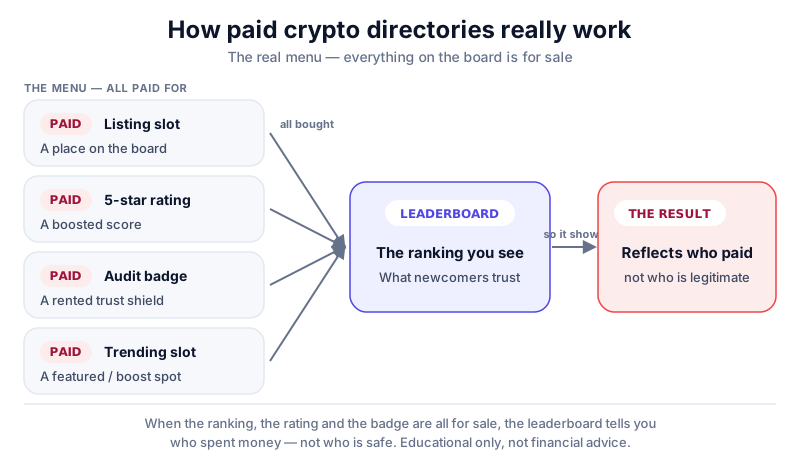
When rank is a product, rank is worthless as evidence. CoinSniper's own blog states projects are 'ranked based on the amount of boosts first' and 'anyone can purchase a package with Boosts'. CoinMooner says rankings aren't decided by paid promotions — while selling a permanent homepage 'Promoted Spot' for $100/day. Both also sell trust badges and even audits. Read the leaderboard as an advertising board, because that's partly what it is.
What these directories are
CoinSniper (coinsniper.net) and CoinMooner (coinmooner.com) are 'discover new coins' directories — the kind of site a token points to as proof that it's trending. Both list brand-new tokens, rank them by user votes, and invite projects to pay for visibility. CoinSniper's own homepage describes itself around finding 'crypto moonshots… listed here before CoinMarketCap, CoinGecko and major exchanges'. That early-stage, pre-vetting audience is exactly who a presale wants in front of — and exactly who has the least ability to check what they're looking at, which is what our presale checklist exists to fix.
CoinSniper: rank, itemised
Here's the contradiction, straight from CoinSniper's own material. Its homepage frames ranking as democratic: *'Our ranking is simple: the highest votes is #1 on our website.'* But a post on its own blog, titled 'Boost Ranking System', tells a different story: *'projects will be ranked based on the amount of boosts first, followed by the amount of votes'*, and — the quiet part, out loud — *'Anyone can purchase a package with Boosts directly on Coinsniper… The more boosts a project receives, the higher its ranking will be.'* Its terms confirm the frame: promoted listings are *'subject to payment of a fee'* and *'not verified by CoinSniper.'* When a platform tells you, in writing, that the top spot is bought first and voted second, believe it.
The rest of the menu
CoinSniper's published services list has priced everything: promoted spots (a day rate), banner ads, push notifications to a large subscriber list, a Telegram AMA — and a 'KYC Badge + Certificate' from around $300, a purchasable badge that, in its own words, signals a project's identity has been verified. A trust signal you can buy is a trust signal worth exactly what it costs.
CoinMooner: 'not paid promotions' — next to the ad rate card
CoinMooner is more direct in its denial and just as revealing. Its homepage states, verbatim: *'Real community engagement is what decides the rankings, not paid promotions.'* One click away, its advertising page sells a 'Promoted Spot' described as *'Your project is always shown on our main page… Immediate massive exposure for your coin'* — at $100 a day, alongside rotating banners, pop-up banners, and an email blast to tens of thousands of subscribers. Promoted coins are visibly flagged on the site (a rocket badge, a highlighted row). Both statements can't be the whole truth; the ad page is the one with prices on it.
A directory selling audits
CoinMooner's ad page also offers, verbatim, a 'Contract Audit — We will audit your smart contract for security' from around $400. A listings directory selling the security audits for the projects it lists is a conflict of interest you rarely see stated so plainly — the 'referee' also sells kit to the players.
And then the third-party layer
On top of what the platforms sell themselves, an open industry sells the *votes* — the same pattern we documented for other vote directories. Resellers advertise CoinSniper and CoinMooner upvotes 'from $8–$10', with sales copy that gives the whole game away: one promises upvotes that *'mimic organic activity and raise no suspicion from the platform'*; another features a customer review boasting a project *'jumped from page four to top ten in under 48 hours'*. To be precise: these sellers are third parties, and we've no evidence the platforms sanction them. But between purchasable boosts (sold by the platform) and purchasable votes (sold by everyone else), the leaderboard is bought from both ends.
It isn't just us saying the vetting is thin. A 2026 academic study of the meme-coin ecosystem by researchers at Sapienza University of Rome noted that CoinSniper *'requires only a basic application process, after which the projects appear immediately on their New Listings Page without further verification.'* Anyone can be listed; rank is for sale; and a token we've already torn down — Maxi Doge — was flagged as a promoted coin in CoinMooner's own page data on the day we checked. The machine works exactly as the pieces suggest.
In fairness
Both platforms are more honest in their small print than their leaderboards imply, and that deserves saying. CoinSniper's footer warns plainly that *'the cryptocurrencies listed on this website could potentially be scams'*; its terms state it *'does not verify any Submitted Coins'*; and it publishes an Anti-Scam Guide signed by its owner. CoinMooner carries standard do-your-own-research disclaimers too. Neither hides that it sells promotion. Our criticism isn't that these sites are secretly evil — it's that the product they headline (a community-voted leaderboard) is one they simultaneously sell the ability to climb, whether by boosts, promoted slots, or the third-party votes swirling around them. The disclaimers are honest; the leaderboard is theatre. Read the former, discount the latter.
The badge paradox
A verification badge, a five-star rank, an 'audited' shield — the more a trust signal can be bought, the less it's worth. The signals that actually mean something are the ones no directory can sell you: a named, verifiable team, a real audit on the audit firm's own site, and on-chain money that matches the marketing.
How to use these sites safely — and how we checked
Treat CoinSniper, CoinMooner and their cousins as discovery, not verification — a place to find names, never a reason to trust them. Then run the free checks no boost can fake: the team, the whitepaper, the on-chain money, and the full presale checklist. Several tokens we've flagged in Scam Watch carried healthy directory rankings the whole way down.
How we checked (July 2026): direct review of coinsniper.net and coinmooner.com — homepages, submission and advertising pages, terms, disclaimers and (for CoinSniper) its published Boost Ranking System post — quoting each verbatim; review of third-party upvote-sellers' own sales pages; a Sapienza University research paper on the meme-coin ecosystem; and CoinMooner's live page data. Some CoinSniper pages were reviewed via archived copies of its own published material. This is independent editorial commentary on published commercial practices, in the public interest — not an allegation of unlawful conduct, and not financial advice. If you represent either platform and believe anything here is inaccurate, email hello@latestcrypto.co.uk with verifiable evidence and we will review and correct promptly.
Key takeaways
- CoinSniper's own blog: projects are 'ranked based on the amount of boosts first' and 'anyone can purchase' boosts
- CoinMooner says rankings aren't paid — while selling a permanent homepage 'Promoted Spot' at $100/day
- Both sell trust products too: a ~$300 KYC badge (CoinSniper) and ~$400 audits (CoinMooner)
- Third parties separately sell the votes — 'mimics organic activity', 'page four to top ten in 48 hours'
- Use these directories to discover names, never to verify them — the real checks are free
Frequently asked questions
Are CoinSniper and CoinMooner scams?
We don't say that, and the evidence doesn't either — both are functioning directories that publish real risk warnings (CoinSniper's are notably candid) and openly sell promotion. The problem is structural: their headline product, a community leaderboard, is one they also sell the ability to climb. That makes the ranking near-worthless as evidence about any token.
If a token is #1 or 'boosted' on one of these sites, does that mean anything?
By the platform's own description, a top spot can reflect purchased boosts before votes, and a 'promoted' tag means someone paid. Treat rank and badges as advertising, and judge the token on things that can't be bought: a verifiable team, a real audit, and on-chain activity that matches the claims.
Do the platforms themselves sell the fake votes?
No evidence of that — the platforms sell boosts, promoted slots, banners and badges (their own pricing pages); the votes are sold by separate third-party services. We keep the distinction because it's true and it's fair. For your purposes the outcome is the same: the number can be bought.
Keep reading
Votes for Sale: How Crypto 'Community Ranking' Sites Really Work
Sites like CoinVote and CoinHunt rank tokens by 'community votes' — while third-party sellers openly retail th
How Coin Gabbar's Paid Listings Really Work — In Its Own Words
Coin Gabbar's own pages describe paid listing promotion, a press-release product with refunds, and 'featured'
How Paid Crypto Listings and 5-Star Ratings Really Work
Presale directories and crypto 'news' sites look like independent journalism — but much of it is paid placemen