Votes for Sale: How Crypto 'Community Ranking' Sites Really Work
Beneath the big crypto directories sits a second tier: vote-ranking sites, where tokens climb a leaderboard powered by 'community votes'. The pitch is democratic — the crowd surfaces the gems. The reality, documented below in the platforms' and vote-sellers' own words, is that the votes are openly for sale at around $5 per thousand, promoted slots are a day-rate price list, and one platform's own terms and conditions state plainly that its promoted coins *'are paid advertisement… not verified coins'*. If a presale you're researching points to its ranking on one of these sites as social proof, this page shows you what that proof costs.
The 20-second version
A leaderboard whose votes retail at $5 per thousand is a price list, not a popularity contest. Vote-ranking sites sell visibility (that's their business, openly); third-party sellers sell the votes themselves; and the projects that buy both then quote their ranking back to you as 'community support'. Assign vote-based rankings zero evidential weight — here's what to check instead.
What vote-ranking sites are
Sites like CoinVote (coinvote.cc — 'Discover early-stage crypto gems before they hit major platforms') and CoinHunt (coinhunt.cc — '#1 Platform to discover newest coins') list brand-new tokens, most of them too small or too early for the major trackers, and rank them by user votes. Both let projects submit a coin, both display a 'Promoted' section, and both invite projects to pay for visibility. Neither publishes a company registration number or postal address on the pages we reviewed — both name France as their governing jurisdiction, and that's roughly where the paper trail ends.
The part they say themselves
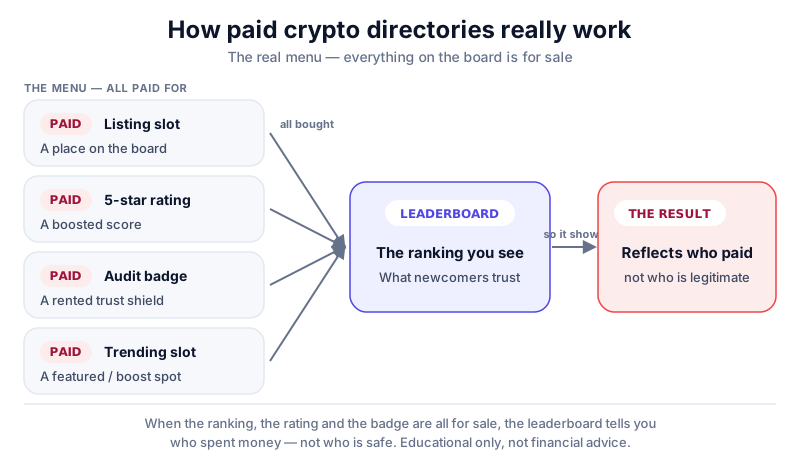
Credit where due: the platforms are semi-candid about the model, if you read the small print. When we checked (4 July 2026), CoinHunt's terms and conditions stated, verbatim: *'Any coin can be listed in the top Promoted coins section. These are paid advertisement. These are not verified coins.'* Its promote page sells the inventory by the day: a VIP spot at $15/day, a promoted spot at $25/day, search-bar ads at $35, banners at $50–$100 — 'no login required', no refunds. CoinVote's submission page pitches that *'promoted coins get significantly more traffic on average'*, its promoted slots are 'non-refundable', and its site-wide footer concedes that *'a token listed on coinvote.cc is not an endorsement, and some projects may be risky or fraudulent'*.
Read that as a buyer
'Paid advertisement… not verified coins' is the platform telling you exactly what a promoted badge means. Take them at their word — the same rule we applied to Coin Gabbar's disclaimers. The small print is usually honest; it's the leaderboard that does the misleading.
The part the vote-sellers say
The rankings themselves are 'community votes' — CoinVote says each user may vote twice per hour; CoinHunt publishes no methodology at all. Enter the third-party vote-selling industry, whose own sales pages we reviewed on the same day. One seller retails CoinHunt votes at '$5 per 1,000' and CoinVote votes at '$6 per 1,000' (bulk discounts down to $3–4, 'quick promotion' at $7 per thousand), and helpfully coaches buyers: *'You need to get at least 2-3k votes to be in the top 10 list in a day.'* Another seller offers identical price ladders for both platforms — from '500 Votes - $200' up to '40k-50k Votes - $5000' — with the pitch *'The higher in the list, the more the audience will be interested in your coin!'*, and even sells accompanying reactions because they 'will show how real your votes are'. Multiple further sellers advertise the same service from $8–10.
To be precise about who's doing what: these are third-party sellers, not the platforms — we found no evidence that CoinVote or CoinHunt sell votes themselves, and no evidence they knowingly tolerate it. What the sellers' own price lists establish is simpler and sufficient: for a few pounds, anyone can move a token up these leaderboards. A 'top 10 community pick' can be manufactured for less than the cost of a takeaway.
Why this matters to you
Because these rankings get quoted upward. A presale buys votes, tops a list, then its paid press releases cite the ranking — 'the most-voted token on X this week' — as organic community momentum. By the time it reaches your feed, a $30 purchase has been laundered into social proof through three layers. It's the same manufactured-consensus machine as bought Telegram crowds, with a scoreboard attached.
- Treat vote counts as decoration. They're the cheapest number in crypto to fake — cheaper than Telegram members.
- A 'Promoted' tag means one thing: money changed hands. CoinHunt's own terms say exactly that.
- Being listed means nothing either way — both platforms say so themselves in their disclaimers.
- No prescribed UK risk warnings appear on these listings — the protections UK promotion rules exist to provide are absent here, so the compliance burden is entirely yours.
In fairness
Both platforms do publish real warnings. CoinVote maintains a community blacklist of reported scam tokens alongside its rankings, and its risk notice appears on every page. CoinHunt's DYOR page is genuinely blunt — bluntly telling readers that without reading a contract's code *'you will never have 100% insurance on how a coin works'*, and that unlocked liquidity means *'the dev can take everything if they wish… you may wanna run away'*. Neither platform hides that it sells promotion. Our criticism isn't hypocrisy — it's that the product these sites present as their headline (a community-voted leaderboard) is structurally trivial to buy, whoever does the buying, and the projects that exploit that are counting on you not knowing.
What to use instead — and how we checked
Nothing on a vote board can't be checked better elsewhere, free: the team, the whitepaper, the on-chain money, and the full presale checklist. Several presales we've torn down in Scam Watch carried healthy vote-board rankings while failing every one of those checks.
How we checked (4 July 2026): direct review of coinvote.cc and coinhunt.cc — homepages, submission pages, promote/advertise pages, terms and conditions, DYOR and disclaimer pages, all quoted verbatim; direct review of multiple third-party vote-sellers' own sales pages and price lists; searches for company registration details (none found on either platform's pages). This article is independent editorial commentary in the public interest — not an allegation of unlawful conduct by either platform, and not financial advice. If you represent CoinVote or CoinHunt and believe anything here is inaccurate — or can evidence measures that defeat purchased votes — email hello@latestcrypto.co.uk and we will review and update promptly.
Key takeaways
- CoinHunt's own terms: promoted coins 'are paid advertisement… not verified coins' — their words
- Third-party sellers openly retail votes for both platforms from ~$5 per thousand, with top-10 coaching
- The vote-sellers are third parties — platform complicity is not established, and we don't claim it
- Vote-board rankings get laundered into press releases as 'community momentum'
- Both platforms publish honest disclaimers and warnings — read those, not the leaderboard
Frequently asked questions
Are CoinVote and CoinHunt scams?
We don't say that, and the evidence doesn't either: both are functioning directories that openly sell promotion and publish real risk warnings — CoinVote even runs a scam blacklist. The problem is structural: their headline product, a vote-based ranking, can be moved for a few pounds by anyone, which makes it worthless as evidence about any token.
A token I'm researching is #1 on a vote site — does that mean anything?
It means it received the most votes — and votes retail at roughly $5 per thousand from sellers who coach projects on exactly how many buy a top-10 slot. Treat the ranking as unverifiable and run the real checks instead: team, whitepaper, audit, on-chain money.
Do the platforms themselves sell the votes?
No — we found no evidence of that. The platforms sell promoted slots and ads (openly, on their own pricing pages); the votes are sold by third-party services. The distinction matters, which is why we make it — but for your purposes the outcome is the same: the number can be bought.
Keep reading
How Coin Gabbar's Paid Listings Really Work — In Its Own Words
Coin Gabbar's own pages describe paid listing promotion, a press-release product with refunds, and 'featured'
How Paid Crypto Listings and 5-Star Ratings Really Work
Presale directories and crypto 'news' sites look like independent journalism — but much of it is paid placemen
How to Spot Fake Crypto Community Hype (Bots, Shills and Ghost Towns)
Scam projects buy Telegram members, X engagement and five-star reviews by the thousand. Learn to tell a real c