The Future of Bitcoin ETFs
Spot Bitcoin ETFs went from 'impossible' to 'the fastest-growing fund launch in history' in a couple of years. Now the interesting question isn't whether they exist — it's where they go from here. This is an educational look at the direction of travel: the flows, the new products, and the risks that an ETF wrapper does nothing to remove.
The 20-second version
Spot Bitcoin ETFs let people own exposure to Bitcoin through a normal brokerage account. They've pulled in serious money, spread to other assets like Ether and Solana, and gained features such as in-kind redemptions and options. But flows swing both ways, and the underlying asset is still as volatile as ever.
A quick recap: what a spot Bitcoin ETF is
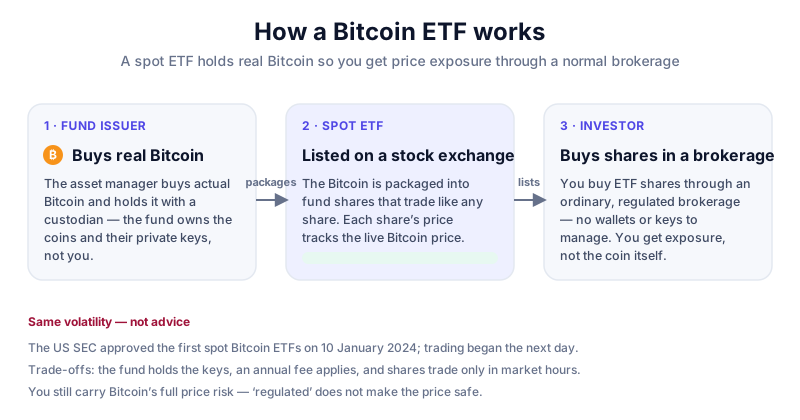
A spot Bitcoin ETF is a fund that holds actual Bitcoin and trades on a stock exchange like any other share. You buy it in an ordinary brokerage or pension account, and its price tracks Bitcoin without you ever touching a wallet, a seed phrase or an exchange. If you want the full mechanics, start with our Bitcoin ETFs explained guide.
The trade-off is the whole point. You gain convenience, familiar tax wrappers and regulated custody; you give up direct ownership of the coins. As the saying goes, 'not your keys, not your coins' — an ETF holder owns a claim on Bitcoin, not Bitcoin itself. That distinction matters, and we'll come back to it. If you do want to hold the coins themselves, a hardware wallet such as a Trezor Safe 5 keeps your keys offline.
Inflows, outflows and what they really tell you
The single most-watched number for these funds is 'flows' — how much money moves in (inflows) or out (outflows) each day. After a record-breaking launch, the flows have done exactly what you'd expect of anything tied to Bitcoin: surged in optimistic stretches and reversed hard in nervous ones. 2026 has seen both multi-billion-dollar inflow runs and multi-billion-dollar redemption streaks.
Flows are sentiment, not a forecast
It's tempting to read heavy inflows as 'the price will rise' and outflows as 'it will fall'. Resist that. Flows tell you what investors did recently, not what happens next. Treating them as a buy or sell signal is exactly the kind of prediction nobody can reliably make.
The deeper lesson is that an ETF doesn't smooth out Bitcoin's character. The same forces that drive bull and bear markets — euphoria, fear, leverage and liquidity — flow straight through the wrapper. Understanding crypto volatility tells you more about how these funds behave than any flow headline.
What they mean for adoption
The genuine significance of spot ETFs is access. They opened a regulated, familiar door for people and institutions who were never going to set up a self-custody wallet — financial advisers, pension funds, and cautious savers who trust a brokerage but not an exchange.
- Lower friction — buying exposure is now as easy as buying any other fund, inside accounts people already use.
- Institutional comfort — regulated custody and reporting make it easier for large, conservative investors to participate.
- A bridge, not a conversion — ETFs introduce Bitcoin to traditional finance, but holders never learn self-custody, which some argue weakens crypto's original 'be your own bank' promise.
- A new dependency — a lot of demand now flows through a handful of large fund providers, concentrating influence in ways the early ecosystem deliberately avoided.
Whether that's progress or a dilution of the point depends on what you valued about crypto in the first place. The Bitcoin vs Ethereum debate has always partly been about purpose; the ETF era adds a new layer to it.
Where the products go next
The first wave was plain spot funds. The second wave is about features and breadth. Several developments have already moved from speculation to reality.
In-kind creations and redemptions
Early US spot ETFs were forced to use a cash-only model, which added cost and friction. Regulators later allowed 'in-kind' creation and redemption — fund managers can hand over actual Bitcoin rather than dollars. That tightens the link between the fund's price and Bitcoin's, and trims costs behind the scenes.
Options and other assets
Options on Bitcoin ETFs now let traders build more complex (and riskier) strategies around them. And the wrapper has spread well beyond Bitcoin: spot Ether ETFs arrived, followed by funds for assets like Solana, and the clearer US commodity classification opened the door to multi-asset 'basket' funds. For proof-of-stake assets, some funds now include staking, passing a yield to holders — a feature plain Bitcoin can't offer because it doesn't stake.
| Product type | What it adds | What to keep in mind |
|---|---|---|
| Spot Bitcoin ETF | Simple, regulated Bitcoin exposure | You don't hold the keys; fees apply |
| In-kind redemptions | Lower cost, tighter price tracking | A behind-the-scenes plumbing change |
| Options on ETFs | Hedging and leverage strategies | Adds complexity and can amplify losses |
| Other-asset / staking ETFs | Exposure to Ether, Solana and yield | More moving parts and asset-specific risk |
More products, more decisions
A wider menu isn't automatically better for you. Staking yield, options and multi-asset baskets each add their own risks on top of the underlying volatility. Complexity is not the same as safety.
The risks an ETF doesn't remove
It's easy to assume a regulated, exchange-listed fund is 'safe'. The wrapper is regulated; the contents are not tamed by it. The risks worth keeping front of mind:
- Price risk — the fund falls when Bitcoin falls, and Bitcoin can fall a long way, fast.
- Fees — ETFs charge an annual expense ratio, so over time you pay for the convenience versus holding coins directly.
- No keys — you own a claim through an intermediary, not coins you can move or spend yourself. If self-sovereignty matters to you, see how to store Bitcoin safely.
- Trading hours — Bitcoin trades 24/7, but the ETF only trades when the stock market is open, so gaps can open up overnight and at weekends.
- Concentration — heavy reliance on a few large providers and custodians introduces its own systemic questions.
An ETF changes how you hold the risk, not how much risk there is.
The bottom line
Spot Bitcoin ETFs have done something real: they've made crypto exposure reachable for millions of people through accounts they already trust, and the product line keeps maturing — in-kind redemptions, options, other-asset and staking funds. The direction of travel is more access and more features, increasingly woven into mainstream finance. How far that goes will depend partly on the regulatory picture, which is still being written.
But none of that is a verdict on whether you should hold them. An ETF is a convenient container; the thing inside is as volatile as ever, and flows tell you about the past, not the future. Whatever wrapper you choose, crypto is high-risk and you can lose money — so understand the product, the fees and the asset before deciding anything, and treat any forecast you read with healthy scepticism.
Key takeaways
- Spot Bitcoin ETFs give regulated, brokerage-account exposure to Bitcoin without self-custody — convenience in exchange for not holding the keys.
- Daily 'flows' show recent sentiment, not a price forecast; treating them as buy/sell signals is a mistake.
- The product line is maturing: in-kind redemptions, options, and ETFs for other assets like Ether and Solana, some with staking yield.
- ETFs widen access and bring Bitcoin into mainstream finance, but concentrate demand in a few large providers.
- The wrapper is regulated; the asset isn't tamed by it — price risk, fees and volatility all remain.
Frequently asked questions
Are Bitcoin ETFs safer than buying Bitcoin directly?
They remove some risks (you don't manage keys or pick an exchange, and custody is regulated) but add others (fees, no direct ownership, limited trading hours). Crucially, they don't reduce price risk at all — when Bitcoin falls, the ETF falls. 'Safer' depends on which risks you care about; it's a different trade-off, not a clearly lower one.
Do Bitcoin ETF inflows mean the price will go up?
No. Inflows tell you money moved into the funds recently, which reflects sentiment, not a guarantee about what happens next. Flows and price often move together, but reading inflows as a 'buy signal' is the kind of prediction nobody can make reliably.
Will there be ETFs for other cryptocurrencies?
There already are. Spot Ether ETFs launched, funds for assets such as Solana followed, and clearer US rules opened the door to multi-asset baskets and staking-enabled funds for proof-of-stake coins. Each new product adds its own asset-specific risks on top of the usual volatility.
Keep reading
Bitcoin ETFs Explained
What a spot Bitcoin ETF is, how the US approvals in January 2024 changed access, and the trade-offs versus hol
What Is Bitcoin? A Plain-English Guide
A beginner-friendly explanation of what Bitcoin is, how it works, and how to think about it — with no hype and
The SEC and US Crypto Regulation Explained
How the SEC and other US agencies regulate crypto: the securities question, the SEC vs CFTC divide, major enfo