The Recycled Whitepaper Trick: Expose a Template Scam in One Search
A real whitepaper is months of engineering thought. A scam factory launching five tokens a week doesn't have months — so they take an old document, run find-and-replace on the token name, and ship it. That laziness is your opening: one quotation-mark Google search can connect a 'revolutionary new protocol' to a dozen earlier scams wearing the same words.
The 20-second version
Copy 2–3 technical sentences from the whitepaper, paste them into Google inside quotation marks, and search. If the exact text appears in other tokens' documents, you've found a template factory. Then check for lazy edits: leftover old token names, wrong-chain terminology, and tokenomics that don't add up to 100%.
Why plagiarism is the factory's weak spot
Everything else about a scam presale is easy to fake at scale — websites are templates, teams are AI faces, ratings are paid placements. But a whitepaper has to contain thousands of words of technical-sounding substance, and generating genuinely original, coherent documentation for every launch is the one corner that always gets cut. The result: recycled text, and recycled text is searchable.
The quotation-mark search, step by step
- Open the whitepaper (PDF, GitBook or docs page) from the presale site.
- Skip the marketing intro — go to a *technical* section: tokenomics, staking mechanics, liquidity routing, consensus.
- Copy two or three full sentences. Longer and more specific beats short and generic.
- Paste into Google wrapped in double quotation marks —
"...exactly like this..."— which forces an exact-phrase match. - Read the results. The project's own site and mirrors are fine. *Other tokens'* whitepapers using identical sentences are the smoking gun — and often you'll find a whole graveyard of them, some already collapsed.
Try two or three passages
Factories sometimes paraphrase the opening sections and get lazier deeper in. If the first passage comes back clean, test one from the middle of the tokenomics section — that's where copy-paste lives.
The three lazy edits that give the game away
- Leftover names. Find-and-replace misses one instance, and page 14 of the 'MoonDog' whitepaper suddenly mentions 'the RocketCat ecosystem'. Search the document for token names that aren't this token's.
- Wrong-chain terminology. A 'Solana-native' project whose staking section describes ERC-20 approvals and Ethereum gas mechanics copied its text from an Ethereum document. The tech words have to match the chain.
- Tokenomics that don't add up. Add the allocation percentages: presale + team + liquidity + marketing + staking. Copy-paste jobs routinely total 105% or 92%. A team that can't add its own pie chart to 100 didn't write it — and shouldn't hold your money either way.
Any one of these is disqualifying on its own. A document is the most deliberate artefact a project produces — errors of this kind aren't typos, they're fingerprints.
What a real whitepaper looks like
Original diagrams rather than clip-art. Specific engineering choices, with trade-offs acknowledged rather than everything being 'revolutionary'. Citations to real prior work. Named authors — or an anonymous team whose GitHub actually implements what the paper describes. And crucially, consistency: the paper, the site, the contract and the on-chain reality all tell the same story. When those layers disagree, believe the blockchain, not the PDF.
The whitepaper check takes two minutes and slots into the full presale checklist alongside the team, audit and on-chain checks. Run all four before any presale sees a penny.
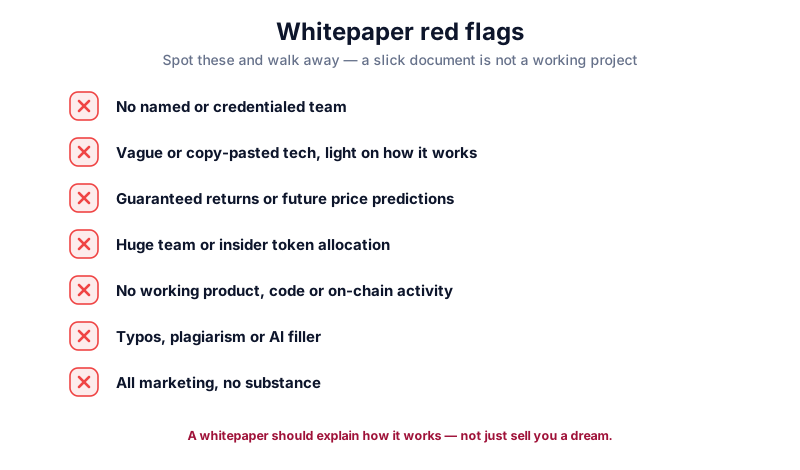
Key takeaways
- Scam factories recycle whitepapers — exact-phrase Google searches expose the template
- Quote 2–3 technical sentences in double quotation marks; other tokens using them = factory
- Leftover token names, wrong-chain jargon and pie charts that don't total 100% are fingerprints
- Test passages from deep in the document, where the copy-paste gets laziest
- When the paper and the blockchain disagree, the blockchain wins
Frequently asked questions
Couldn't a legitimate project just have a badly written whitepaper?
Clumsy writing, sure. But verbatim text shared with other token sales, references to the wrong blockchain, or allocations that don't sum to 100% aren't clumsiness — they're evidence the document was manufactured. Legitimate teams make different mistakes.
The whitepaper is original — is the project safe?
It passes one of four checks. AI tools now make producing 'original' filler cheap, which is why the team check, the audit check and the on-chain money check matter just as much. Original text with an anonymous team and an empty wallet is still a no.
What if there's no whitepaper at all?
For a meme coin that openly claims no utility, that's at least honest. For anything claiming technology — staking, an L2, an 'AI protocol' — no documentation means there's nothing to verify, and you should treat the claims as marketing fiction.
Keep reading
How to Check If a Crypto Presale Is a Scam (Step by Step)
The complete pre-flight check for any crypto presale: verify the team, the whitepaper, the audit and the actua
How to Spot Fake (and AI-Generated) Crypto Team Photos
Scam presales invent executive teams with stolen photos and AI faces. Learn the one-search reverse-image check
How Presales Fake Their 'Total Raised' Meters (And How to Check in 3 Steps)
Many presale dashboards display fabricated fundraising totals to trigger FOMO. Here's the free, three-step blo