What Is Market Cap in Crypto?
A coin priced at a few pence can be 'worth' more than one priced at thousands of pounds. The number that explains why is market capitalisation — and learning to read it is one of the fastest ways to stop being fooled by a low price tag.
The 20-second version
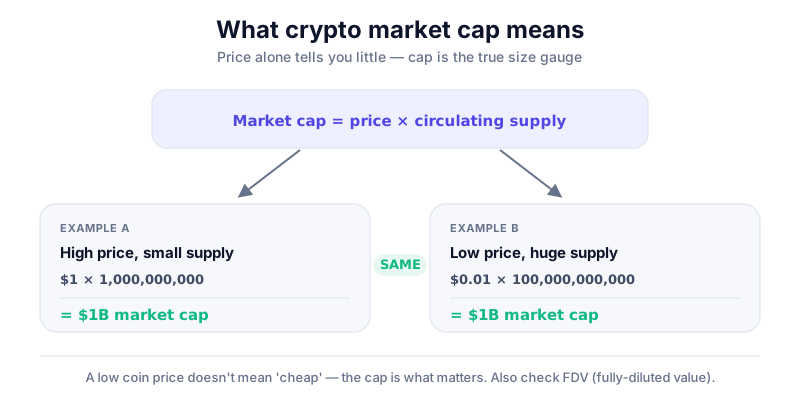
Market cap = price per coin x circulating supply. It estimates the total value of all coins in circulation, so it's a far better size gauge than price alone. A low price does not make a coin 'cheap'.
What market cap actually measures
Market capitalisation is the price of a single coin multiplied by the number of coins in circulating supply. It's a rough estimate of what the whole market thinks an asset is worth right now.
The reason it matters: price on its own tells you almost nothing about size. A coin at 0.01 with 100 billion coins in circulation has a far bigger market cap than a coin at 500 with only 100,000 coins. Always compare market caps, not prices.
Large, mid and small caps
Investors loosely group assets by size. The categories aren't official, but they're a useful shorthand for how established and how volatile something tends to be.
- Large caps (tens of billions and up) like Bitcoin and Ethereum — the most established and, usually, less wildly volatile.
- Mid caps — more room to grow, but also more risk and thinner liquidity.
- Small caps — tiny projects that can move violently in either direction and are easier to manipulate.
The fully-diluted trap
Watch for fully diluted valuation (FDV) — price multiplied by the *maximum* eventual supply, not the circulating supply. If most coins haven't been released yet, FDV can be enormous compared with today's market cap, and future unlocks may push the price down as new coins hit the market. Whichever way you lean, the storage rule doesn't change: serious amounts belong offline, on a hardware wallet like the BitBox02.
Market cap is an estimate, not a bank balance
A market cap does not mean that much money is 'in' a coin or could ever be cashed out. Thin markets can move sharply. Crypto is highly volatile — only risk what you can afford to lose, never borrow to buy, and treat this as education, not financial advice.
Key takeaways
- Market cap = price x circulating supply — a better size gauge than price.
- A low coin price does not make an asset cheap or undervalued.
- Large, mid and small caps signal roughly how established and volatile a coin is.
- Check fully-diluted valuation to spot big future supply unlocks.
Frequently asked questions
Does a higher market cap mean a coin is safer?
Larger caps tend to be more established and liquid, but size is no guarantee of safety. Big projects have failed before. Market cap is one data point, not a verdict.
What's the difference between market cap and FDV?
Market cap uses coins in circulation today; fully-diluted valuation uses the maximum supply that will ever exist. A big gap between them signals lots of coins yet to be released.
Keep reading
What Is Circulating Supply?
Circulating, total and max supply explained: what each means, how they affect market cap, and why token unlock
Understanding Crypto Volatility
Why crypto prices swing so hard: the causes of volatility, what it means for you, and how to keep a level head
Bull vs Bear Markets Explained
What bull and bear markets mean in crypto, where the terms come from, and how market cycles tend to behave — w