What Is Ethereum? A Plain-English Guide
Ethereum is a worldwide computer that anyone can use — a network that runs programs called smart contracts and powers most of the apps people mean when they say 'crypto'. This is the first stop in our Ethereum course, and it explains what Ethereum actually is, how it differs from Bitcoin, and how to think about it without the hype. Get this lesson clear in your head and everything that follows — buying, storing, fees, staking, DeFi — will slot into place much more easily.
The 20-second version
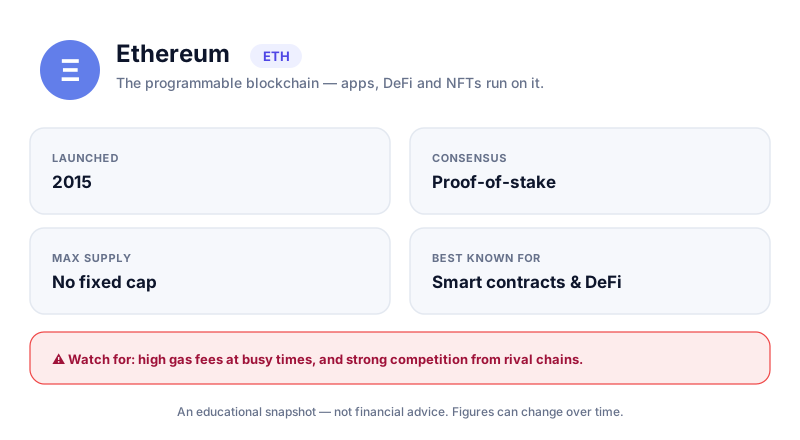
Ethereum is a global, programmable blockchain. Its coin, Ether (ETH), pays for using the network. Where Bitcoin is mainly digital money, Ethereum is a platform other apps — DeFi, NFTs, stablecoins — are built on top of.
What is Ethereum?
Ethereum is a public blockchain, like Bitcoin — a shared ledger maintained by thousands of computers around the world, with no single owner and no off switch. But Ethereum was built to do more than record payments. It can run small programs, called smart contracts, that execute exactly as written, without any company, bank or government able to step in and interfere.
People often call Ethereum a 'world computer', and it's a useful picture. Imagine a single, shared machine that nobody controls, that anyone can build on, and that keeps running whether or not any one company stays in business. That's the idea. Your laptop runs your apps; Ethereum runs apps that belong to no one in particular and are open to everyone at once. Nobody can quietly switch it off, raise the rent on a whim, or lock you out because they didn't like a post you made.
Here's a concrete way to picture the difference. When you use a normal banking app, you're trusting a company's private servers: they hold the database, they decide the rules, and you simply hope they apply them fairly. On Ethereum, the 'app' is public code that everyone can read, running on a network no one privately owns. You don't have to trust that a company will behave — you can read what the code does and know it will do exactly that, every time, for everyone. It's the difference between a handshake deal and a contract printed in full view that enforces itself.
That self-enforcing quality is the whole pitch — and, honestly, it's also where a lot of the risk hides. 'The code does exactly what it says' is wonderful right up until the code has a bug, and then it still does exactly what it says, draining funds included. There's no manager to ring, no transaction to reverse. We'll come back to that tension more than once in this course, because understanding it is what separates a sensible beginner from someone about to learn an expensive lesson.
Ethereum vs Ether
Ethereum is the network. Ether (ETH) is the coin that lives on it. You spend small amounts of ETH as a fee whenever you use the network — a bit like postage, or topping up an electricity meter to keep the machine running. People say 'Ethereum' loosely to mean both, but it's worth keeping the two straight in your head.
How it differs from Bitcoin
Bitcoin does one thing extremely well: it's secure, scarce digital money. Ethereum is more like an app platform — closer to an operating system that other things get built on. Both are decentralised blockchains, but they're built for different jobs, and comparing them is a bit like comparing a vault to a workshop. One is designed to hold value safely and change as little as possible; the other is designed to let people build, tinker and ship new things. A vault that kept rearranging itself would be a bad vault — and a workshop that never let you move anything would be a useless workshop.
- Bitcoin is mainly a store of value and a payment network — the 'digital gold' framing. It deliberately keeps its features minimal so there's less that can go wrong. Boring is a feature, not a bug.
- Ethereum is programmable. Developers deploy code that runs on the network, which is how DeFi, NFTs and most of the tokens you've heard of exist at all. More flexibility, more moving parts, more ways to trip up.
- Supply differs too. Bitcoin is capped at 21 million coins forever. Ether has no fixed cap, though its issuance rate is low and some ETH is permanently destroyed ('burned') with each transaction, which can offset — or sometimes outpace — new supply.
Neither approach is 'right'. They're answers to different questions. If you want the side-by-side, we have a whole piece on Bitcoin vs Ethereum. And if you want the mechanics of how Ethereum pulls off the programmable part, the next lesson covers how Ethereum works in plain English. For now, the key idea is that Ethereum trades a little of Bitcoin's simplicity for a lot of flexibility — and that trade-off shows up everywhere, from fees to security to how often the rules can change.
What gets built on Ethereum
Because anyone can deploy a smart contract, Ethereum has become the foundation for a huge range of applications. Most of the well-known categories in crypto either started here or copied the playbook Ethereum invented. You don't need to use any of these to own ETH — plenty of people just hold the coin and never touch an app — but it helps to know what the network is actually for. A few of the big ones:
- Stablecoins — tokens designed to track the value of a currency like the dollar, so you can hold something steady without leaving the network. They're the 'cash' that most other apps move around.
- DeFi — lending, trading and saving apps that run without a bank. Powerful, and also the riskiest corner of crypto, which we cover in the final lesson.
- NFTs — unique tokens used for art, collectibles, event tickets and proof of digital ownership.
- Other tokens and networks — a great many projects launch their own token on Ethereum before they do anything else, because the tools and the users are already there.
The pattern to notice is that Ethereum rarely builds these things itself. It provides the shared base layer, and other people build on top — the way a city provides roads, water and power so anyone can open a shop, without the council deciding what each shop sells. That openness is genuinely powerful: a developer in one country can launch an app that someone in another can use minutes later, with no gatekeeper in between. It also means the quality ranges from carefully-built and independently audited to outright fraud, with no bouncer at the door checking which is which. The freedom that lets good things happen lets bad things happen just as easily.
A fair warning before we go further
ETH is highly volatile and its price can fall sharply. Many apps built on Ethereum are experimental, and some are outright scams. This guide is education, not financial, legal or tax advice. Only ever risk what you can afford to lose entirely, and never borrow money to buy crypto.
How you own and use it
To hold ETH, you use a wallet — software, or a small hardware device, that stores the keys proving the coins are yours. As with all crypto, whoever controls the keys controls the funds. There's no bank to phone if you lose access, no 'forgot password' link, no fraud department. That sounds alarming, and it is the part that catches people out, which is exactly why protecting your seed phrase — the master backup of those keys — is the single most important habit you'll learn in this whole course. Get that right and most disasters never reach you.
A wallet like MetaMask does double duty on Ethereum: it holds your ETH and also acts as your login to apps built on the network. Instead of a username and password, you connect your wallet and approve actions yourself by signing them. It's a bit like a key that is also your passport — you carry one thing and it does both jobs. That's convenient, but it also means you are your own security team, with no IT department behind you and no one to blame but the code (and sometimes yourself) when something signs that shouldn't have. We return to this properly in how to store Ethereum safely, and it's the lesson least worth skipping.
Where to go next
That's the big picture: Ethereum is a programmable, shared 'world computer', and ETH is the fuel that runs it. It trades simplicity for flexibility, it powers most of the apps people mean by 'crypto', and being your own bank means being your own security guard too. Over the rest of this course we'll build on this step by step — starting with how Ethereum works under the hood, then how to buy Ethereum and, most importantly, how to store it safely. Take them in order and each one will make more sense than the last. None of this is written by a guru with a hot tip — it's just the Latest Crypto team trying to explain things honestly, the way we wish someone had explained them to us. And however you weigh the trade-offs, keep meaningful holdings in cold storage — a Keystone 3 Pro — rather than on an exchange.
Key takeaways
- Ethereum is a programmable blockchain — a shared 'world computer' nobody controls.
- Ether (ETH) is the coin that pays fees to use the network.
- Where Bitcoin is digital money, Ethereum is a platform for apps.
- It's volatile and many apps are risky — only risk what you can afford to lose.
Frequently asked questions
Is Ethereum better than Bitcoin?
Neither is 'better' — they're built for different jobs. Bitcoin is digital money; Ethereum is a platform for apps. Plenty of people learn about both rather than picking a side, and anyone insisting one is objectively superior usually has something to sell. See our Bitcoin vs Ethereum piece for the full comparison.
Do I need a whole ETH to start?
No. Ether is divisible to many decimal places, so you can own a tiny fraction. Just remember you'll also need a little ETH spare to cover network fees when you actually do anything, since every action costs a small amount.
Keep reading
How Ethereum Works: Smart Contracts, the EVM and Gas
A clear, high-level look at how Ethereum works — smart contracts, the Ethereum Virtual Machine, gas fees, and
How to Buy Ethereum Safely (Step by Step)
A careful, beginner-friendly guide to buying Ethereum: choosing an exchange, verifying your account, placing a
How to Store Ethereum Safely (Step by Step)
Keep your ETH safe from hackers and mistakes: hot vs cold wallets, hardware wallets, seed-phrase backups, toke