What Is USDT (Tether)? A Plain-English Guide
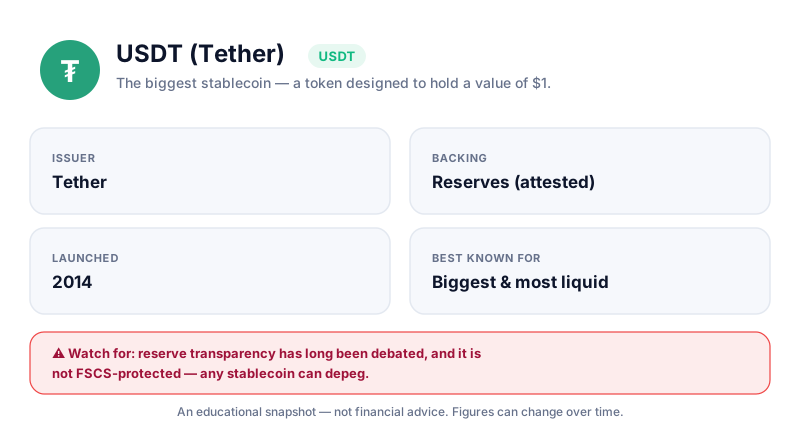
USDT — better known as Tether — is the largest stablecoin in the world, designed to hold a steady value of one US dollar. It's the currency most crypto trading actually happens in. This guide explains what USDT is, how it tries to stay at $1, who runs it, and the long-running debates you should understand before you use it.
The 20-second version
USDT is a token that aims to always be worth $1. It's issued by a company called Tether, which says it holds dollars and dollar-like assets in reserve to back every token. It's hugely useful for trading — but you're trusting a private company, not a bank.
What is USDT?
USDT is a stablecoin: a crypto token engineered to track the price of a real-world asset — in this case, the US dollar. One USDT is meant to always be worth roughly $1, so it doesn't swing in value the way Bitcoin or Ethereum do.
It's issued by Tether Limited, a private company. When someone deposits dollars with Tether, the company issues new USDT; when tokens are redeemed, they're taken out of circulation. USDT runs on many blockchains, including Ethereum and Tron, so the same dollar-pegged token can move across different networks.
By market size, USDT is consistently the biggest stablecoin and one of the most-traded crypto assets of any kind. A large share of all crypto trades are priced in USDT rather than in actual dollars.
How USDT stays near $1
USDT is a fiat-collateralised stablecoin. The core promise is simple: every token in circulation is backed by reserves Tether holds — cash, short-term US government debt and similar assets — so that USDT can be redeemed for dollars at roughly 1:1.
- Backing — Tether publishes regular attestations describing what its reserves contain.
- Redemption — eligible customers can redeem USDT for dollars directly with Tether, which keeps the market price anchored.
- Arbitrage — if USDT trades below $1, traders can buy it cheaply and redeem it for a full dollar, pushing the price back up.
Stable is not the same as risk-free
A stablecoin only holds its value as long as people trust the backing behind it and can redeem it. 'Stable' describes the goal, not a guarantee. Even dollar-pegged tokens can wobble or 'depeg' under stress.
Why people use USDT
USDT exists to solve a practical problem: moving in and out of a stable dollar value without leaving the crypto system or waiting on a bank.
- Trading — traders park funds in USDT between trades to avoid volatility, then move back into other coins.
- Moving money — USDT can be sent across borders in minutes, any time of day.
- Access to dollars — in some countries with unstable local currencies, people use USDT as a way to hold something dollar-like.
USDT is also the main settlement asset across much of DeFi and centralised exchanges alike, which is a big part of why it's so widely held.
The reserves debate
USDT has long faced scrutiny over whether its reserves are genuinely sufficient. Tether publishes attestations — reports from an accounting firm describing reserves at a point in time — rather than a full financial audit, and critics argue that's a weaker standard of proof.
In 2021, Tether settled with the New York Attorney General over claims it had misrepresented the backing of USDT during an earlier period; the company paid $18.5 million to settle, without admitting or denying the allegations, while agreeing to publish reserve breakdowns. Separately, it paid a separate $41 million penalty to the US Commodity Futures Trading Commission the same year. Tether has since said its reserves are heavily weighted toward US Treasury bills and reports large profits from them.
It's fair to say USDT works as intended in practice and is enormously widely used — and also fair to say it has attracted more transparency questions than some rivals. Both things are true, and a balanced user holds both in mind.
Risks to understand
USDT isn't volatile the way most crypto is, but it carries its own distinct risks — covered in depth in our stablecoin risks guide. Whichever way you lean, the storage rule doesn't change: serious amounts belong offline, on a hardware wallet like the Ledger Nano X.
- Issuer risk — you're trusting a private company to hold real reserves and honour redemptions.
- Depeg risk — under stress, USDT can briefly trade below $1 on the open market.
- Regulatory risk — stablecoin rules are tightening worldwide and could affect how USDT operates.
- It earns you nothing by default — holding USDT is not the same as a bank deposit, and there's no deposit insurance behind it.
Education, not advice
This guide explains how USDT works; it is not financial advice and not a recommendation to buy or hold it. A stablecoin can lose its peg, and there is no government guarantee behind it. Only ever risk what you can afford to lose, and never borrow to buy crypto.
Key takeaways
- USDT (Tether) is the largest stablecoin, designed to always be worth about $1.
- It's issued by a private company that says it holds dollar-equivalent reserves to back every token.
- It's mainly used for trading, moving money quickly, and holding a dollar-like value inside crypto.
- It's faced ongoing questions over reserve transparency — and stablecoins are never truly risk-free.
Frequently asked questions
Is USDT the same as a US dollar?
No. It's a private token that aims to track the dollar's value. It isn't issued by a government and isn't covered by deposit insurance, so it depends on trusting the issuer.
Can USDT lose its peg?
Yes — it has briefly traded below $1 during periods of market stress. The peg relies on confidence and the ability to redeem, neither of which is guaranteed. See our stablecoin risks guide.
What's the difference between USDT and USDC?
Both target $1, but they're issued by different companies with different reserve practices and transparency records. Our USDC guide explains the comparison.
Keep reading
What Is a Stablecoin? How the Peg Works (and Fails)
A clear guide to stablecoins: how they aim to hold a steady value, the different types, and the very real peg
What Is USDC? A Plain-English Guide
A clear, balanced guide to USDC — the regulated dollar stablecoin from Circle. How it stays at $1, how its res
Stablecoin Risks Explained
Stablecoins aim for $1, but they aren't risk-free. A clear, balanced guide to depeg risk, issuer and reserve r