The Best Crypto Exchanges for UK Users (2026): An Honest Comparison
"Best crypto exchange" lists usually rank platforms by shiny features and welcome bonuses. This isn't one of those. In the UK, the more useful question is *which exchanges are you actually allowed to use*, and what protection you do — and don't — get when you hand over your money. So this is a sober map of the current UK landscape: who's registered with the FCA, who's on its warning list, and who's quietly heading for the exit. Everything here is educational, not a recommendation to use any particular platform or to buy anything at all.
The 20-second version
In the UK, being "FCA-registered" only means an exchange passed anti-money-laundering checks — it does *not* mean your money is safe or protected by the FSCS. As of mid-2026 the registered names UK users tend to reach for include Kraken, Coinbase, Crypto.com and Uphold; Gemini has been winding down its UK operations; and Binance, KuCoin and MEXC have been restricted or flagged on the FCA's warning list. Whichever you use, treat it as a temporary on-ramp and get your coins into a wallet you control.
First, the part nobody wants to hear
The mandatory risk warning — and we mean it
Don't invest unless you're prepared to lose all the money you invest. This is a high-risk investment and you are unlikely to be protected if something goes wrong. Take two minutes to learn more.
That warning isn't legal boilerplate we're forced to bolt on — it's the single most honest sentence on this page. Crypto sits outside the Financial Services Compensation Scheme (FSCS), so if an exchange collapses or is hacked, there is no government-backed £85,000 safety net the way there is for a UK bank. As things stand it's also outside the Financial Ombudsman for crypto disputes. If the platform loses your coins, you are largely on your own.
So what does "FCA-registered" actually buy you? Less than most people assume. Registration under the UK's cryptoasset regime means a firm has satisfied the FCA on anti-money-laundering and counter-terrorist-financing (AML/CTF) checks — essentially, that it verifies who its customers are and watches for dirty money. That's a genuine filter, and it's why the registered pool is small and reputable. But it is *not* a stamp on the firm's security, its solvency, or the quality of its tech. It does not mean the FCA has vetted the exchange as a safe place to keep your money.
Registered ≠ recommended ≠ protected
AML registration is a floor, not a seal of approval. It tells you the firm did its identity homework — nothing more. For the wider picture of how the FCA regulates this space, see the FCA and UK crypto rules.
Who's actually allowed to serve UK users right now
This is where the landscape gets confusing, because a platform can be globally huge and still off-limits to UK retail customers. As of mid-2026, here's roughly how the main names break down. Every entry below is a snapshot in time — registration and warning-list status change, so always confirm the specific legal entity on the official FCA register and check the live FCA warning list before you sign up anywhere.
| Exchange | UK status (mid-2026) | What it means for you |
|---|---|---|
| Kraken | FCA-registered (AML) | Allowed; added an e-money licence in 2025 for direct GBP services |
| Coinbase | FCA-registered (AML) | Allowed; beginner-friendly, higher instant-buy fees |
| Crypto.com | FCA-registered (AML) | Allowed; app-first, watch the pricing screens |
| Uphold | FCA-registered (AML) | Allowed via its UK/Europe entity |
| Gemini | Winding down UK operations | Withdraw or transfer out — no longer a UK on-ramp |
| Binance | Restricted for UK retail | Binance Markets Ltd was barred from regulated activity |
| KuCoin | On the FCA warning list | Flagged as unauthorised — no UK consumer protection |
| MEXC | Restricted / warning list | Lists the UK as restricted; flagged by the FCA |
The warning list is not just a formality
The FCA has flagged well over a hundred crypto firms as unauthorised. Using one isn't illegal for you as an individual, but you lose every scrap of UK consumer protection, deposits and withdrawals can be frozen without warning, and you'll have little recourse if things go wrong. Related reading: how to spot fake exchange scams.
How to compare them: fees, FCA status, ease and security
Ignore the leaderboard-style rankings you'll see elsewhere. For a UK beginner, four honest criteria do most of the work:
- FCA status — is the specific entity you're signing up to on the AML register, or on the warning list? This is a yes/no gate before anything else matters.
- Fees — and specifically *which screen* you buy from. The friendly "instant buy" button is almost always the most expensive way to trade.
- Ease of use — a clean app matters more for beginners than a wall of pro-trading charts, as long as you're not paying a huge premium for the convenience.
- Security signals — things like published proof-of-reserves, a clean track record, and clear custody arrangements. None of these are guarantees, but their absence is a red flag.
On fees, the gap between interfaces is the thing nobody explains. As a rough guide at the time of writing, a *pro* trading interface might charge somewhere around 0.25%–0.40% per trade, while the one-tap *instant buy* on the same platform can run to roughly 2%–4%. Those are ballpark figures that change constantly — always check the exchange's own live fee schedule before you assume anything. The practical takeaway: learning the pro or "advanced" interface is usually the single biggest fee saving a beginner can make.
Proof-of-reserves, in plain English
Some exchanges publish cryptographic "proof-of-reserves" showing they hold enough assets to cover customer balances. It's a reassuring signal but not a full audit — it shows assets at a moment in time, not liabilities or good behaviour. Treat it as one data point, not a promise your funds are safe.
The exchanges, one by one
Short, honest takes on the names UK users ask about most. None of this is a signup nudge — these are editorial notes, and we deliberately don't link to any exchange's front door.
Kraken
One of the longer-standing FCA-registered names, and it added an e-money licence in 2025 (at the time of writing) that lets it offer direct GBP services rather than routing you through a partner. It runs proof-of-reserves and its pro interface has competitive fees. The trade-off is that the platform can feel a little intimidating to a total beginner. We compare it head-to-head with Coinbase in Coinbase vs Kraken.
Coinbase
The most beginner-friendly of the registered options — a clean app and a gentle onboarding flow. The catch is cost: the simple "buy" screen carries a chunky premium, and you'll pay far less by using its Advanced interface. Worth knowing before you tap the big blue button. See how it stacks up in Binance vs Coinbase.
Crypto.com and Uphold
Both are registered for the UK via their relevant entities. Crypto.com is app-first with heavy marketing, so read the pricing screens carefully; Uphold offers a broader mix of assets. As always, confirm the exact legal entity on the FCA register before you commit, since a global brand and its UK-facing company aren't always the same thing.
Gemini
The notable change of 2026: Gemini has been winding down its UK operations, moving accounts to withdrawal-only and then closing them. If you have a balance there, the job is simple — withdraw or transfer it out before the deadlines, ideally into a wallet you control. More on that in the FAQ below.
Binance, KuCoin and MEXC
These are the ones to be careful with. Binance's UK arm was barred from regulated activity, and KuCoin and MEXC have appeared on the FCA's warning list of unauthorised firms — MEXC lists the UK as restricted. Global scale doesn't equal UK permission, and using a warning-list firm means no UK protection at all. For the mechanics of how centralised platforms differ from the alternative, see centralised vs decentralised exchanges and CEX vs DEX.
The rules changing under your feet
The UK crypto rulebook is mid-overhaul, so anything you read (here included) has a shelf life. Two threads matter for choosing an exchange.
First, financial-promotion rules already in force. Any firm marketing crypto to UK consumers must show the mandatory high-risk warning, give brand-new customers a 24-hour cooling-off period, make you acknowledge a personalised risk warning, and — crucially — they're banned from dangling incentives like refer-a-friend bonuses or "free crypto" signup perks. If a platform is waving a welcome bonus at UK users, that's a warning sign, not a bargain. We break the whole framework down in UK crypto promotion rules explained.
Second, the bigger regime that's coming. The FCA finalised a landmark crypto rulebook in 2026, with an authorisation gateway scheduled to open in late 2026 and the full mandatory regime scheduled to come into force in late 2027. When it lands, retail customers are expected to gain Consumer Duty protections and Financial Ombudsman access for crypto — a real step up. But note what's *still* excluded: FSCS compensation. Even under the new rules, if your exchange fails, there's no deposit-guarantee scheme behind your coins. These dates and details are scheduled, not set in stone, so check the current position on the FCA's site.
The most important step: get your crypto off the exchange
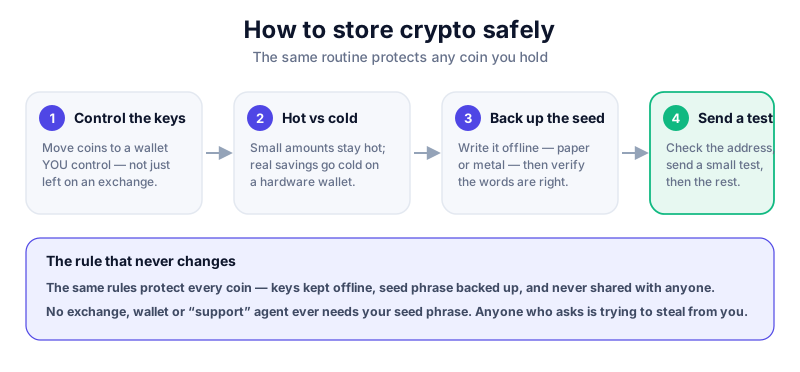
Here's the thread running through this entire piece. An exchange is a brilliant place to *buy* crypto and a poor place to *keep* it. When your coins sit on an exchange, the exchange holds the keys — which is exactly why a collapse, a hack, or a company like Gemini leaving the UK becomes your problem. The phrase to remember is "not your keys, not your coins."
So treat any exchange as a temporary on-ramp. Once you've bought, move anything you're holding for the long term into a wallet you control. For small amounts a reputable software wallet is fine; for larger balances, a hardware wallet keeps your keys offline and away from the exchange entirely. If you're weighing up the options, start with hot vs cold wallets and the best crypto wallets for beginners, and read how to avoid crypto scams before you move a penny.
A hardware wallet like the Ledger Nano X keeps your private keys offline, so your crypto isn't sitting on an exchange that could be hacked, fail, or exit the UK. It's the single most effective way to take control of what you own. Learn how cold storage works first in hot vs cold wallets.
One tasteful pick, not a shopping list
We mention one hardware wallet here because it's the logical next step, not because it's the only good option. Trezor's range and others do the same job well — the point is *self-custody*, not a specific brand.
Key takeaways
- "FCA-registered" means an exchange passed AML checks only — it does not mean your money is safe or FSCS-protected.
- As of mid-2026, UK users typically reach for registered names like Kraken, Coinbase, Crypto.com and Uphold — but always confirm the exact entity on the FCA register.
- Gemini has been winding down its UK operations, and Binance, KuCoin and MEXC have been restricted or placed on the FCA's warning list — status changes, so check the live sources.
- The friendly "instant buy" screen is usually the most expensive way to trade; the pro interface saves the most on fees. All fee figures change — check the live schedule.
- An exchange is a place to buy crypto, not store it — move long-term holdings into a wallet you control.
Frequently asked questions
Is my money safe on an FCA-registered crypto exchange?
Not in the way people assume. FCA registration covers anti-money-laundering checks only — it does not vet the exchange's security or solvency, and crypto sits outside the FSCS, so there's no £85,000 deposit guarantee if the firm fails. Registration is a useful filter, but it is not a safety promise. Treat any exchange as somewhere to buy, not to store, your crypto.
Can I still use Binance, KuCoin or MEXC in the UK?
As of mid-2026 these are restricted or flagged. Binance's UK arm was barred from regulated activity, and KuCoin and MEXC have appeared on the FCA's warning list of unauthorised firms. Using a warning-list platform isn't illegal for you personally, but you get zero UK consumer protection and little recourse if funds are frozen or lost. Warning-list membership changes, so check the live FCA warning list before relying on any of this.
What happens to my crypto now that Gemini is leaving the UK?
Nothing happens to it automatically, but you need to act before the closure deadlines. Withdraw or transfer your balance out — ideally into a wallet you control rather than another exchange, so you're not just moving the same risk elsewhere. See hot vs cold wallets for how self-custody works, and check Gemini's own notices for the current dates.
Which UK exchange has the lowest fees?
There's no fixed answer, because it depends far more on which interface you use than on which exchange. A platform's pro or advanced screen is typically many times cheaper than its one-tap instant-buy button, and headline fees change constantly. The honest advice is to learn the advanced interface, and always check the exchange's own live fee schedule before you trade rather than trusting any figure you read second-hand.
Keep reading
The FCA and UK Crypto Rules Explained
How the Financial Conduct Authority regulates crypto in the UK: registration, the financial-promotions regime,
The UK Rule That Exposes Illegal Crypto Promotions (Use It as a Scam Detector)
Since October 2023, crypto promotions to UK consumers must follow strict FCA rules — risk warnings, no refer-a
Coinbase vs Kraken (2026): Which Exchange Is Right for You?
A balanced Coinbase vs Kraken comparison: fees, security, ease of use, coin selection and support — so you can