The Biggest Meme Coin Failures of 2026
Meme coins are the fireworks of crypto: dazzling, loud, and over in seconds. For every token that briefly mints a millionaire, thousands quietly go to zero — and a handful blow up so publicly they make the news. This is a tour of the most notable meme coin failures of recent years, including 2026, and what each one teaches you about the risks before you go anywhere near one.
The 20-second version
Most meme coins fail, and the biggest collapses tend to share the same DNA: anonymous or insider-heavy launches, thin or withdrawable liquidity, and a wave of hype that empties out the moment insiders sell. Learning to recognise that pattern is worth more than any individual coin name.
The scale of the problem
Before naming names, it helps to grasp how common failure actually is. The vast majority of meme coins ever created no longer trade in any meaningful way. Industry trackers estimate that more than half of all cryptocurrencies ever launched are effectively dead, and the bulk of those casualties are low-effort tokens churned out on no-code launchpads — millions of them stopped trading in a single recent year alone.
So when we talk about the 'biggest' failures, we don't mean the unusual ones. We mean the few that got large enough, or famous enough, to drag thousands of people down with them. The quiet 99% never make headlines — they just vanish. If you want the mechanics behind why these tokens are so fragile, start with how meme coins work and how meme coin liquidity works.
Why we don't name the 'good' ones
This article is about failures, not picks. We name collapsed tokens to illustrate patterns, never to suggest which coins are safe or worth buying. No meme coin is a recommendation — they are among the riskiest things in crypto.
The celebrity-endorsed blow-ups
The most spectacular meme coin failures of the past couple of years almost all shared one ingredient: a famous name. A celebrity or politician posts about a token, retail buyers pile in within minutes, and insiders who were positioned beforehand sell into that wave of demand. The chart goes vertical, then falls off a cliff. If you punt on this end of the market anyway, keep the stake small — and keep your core holdings well away from it, in cold storage on a OneKey.
LIBRA — the presidential scandal
The clearest example is LIBRA, a token promoted in early 2025 by Argentina's President Javier Milei in a single social-media post. Its market value briefly spiked into the billions before collapsing within hours. On-chain analysts traced large insider wallets cashing out roughly $100 million as ordinary buyers were left holding tokens worth a fraction of what they paid. Studies of the wallets afterward suggested the great majority of participants lost money while a tiny number of insiders walked away with most of the gains. It triggered a criminal investigation in Argentina and became shorthand for everything that can go wrong when authority and hype collide. The mechanics — insiders selling into endorsed demand — are the same ones we describe in how to spot a rug pull.
The wider celebrity-token graveyard
LIBRA was not alone. A run of celebrity and politician tokens followed the same arc: a sharp launch surge, then a brutal decline as the attention faded and early holders exited. Several well-known examples lost the overwhelming majority of their value within months — some more than 90% from their peaks. The pattern is so consistent that 'celebrity token' has become a warning label in its own right, not a selling point.
| What happened | The lesson |
|---|---|
| A famous name posts about a token and it spikes instantly | The hype is the product. Fame creates demand insiders can sell into — it says nothing about the token itself. |
| Insiders hold a large share before the public hears about it | Check the holder distribution. Heavy insider concentration means the deck is stacked against later buyers. |
| Price collapses within hours or days of the peak | These moves are exits, not corrections. By the time you've heard about it, the early sellers are usually already gone. |
A famous face is not due diligence
Endorsements are easy to buy and easy to delete. A celebrity promoting a coin has every incentive to talk it up and no obligation to keep holding it. Treat any 'as seen on [name]' token as higher risk, not lower.
The classic rug pulls
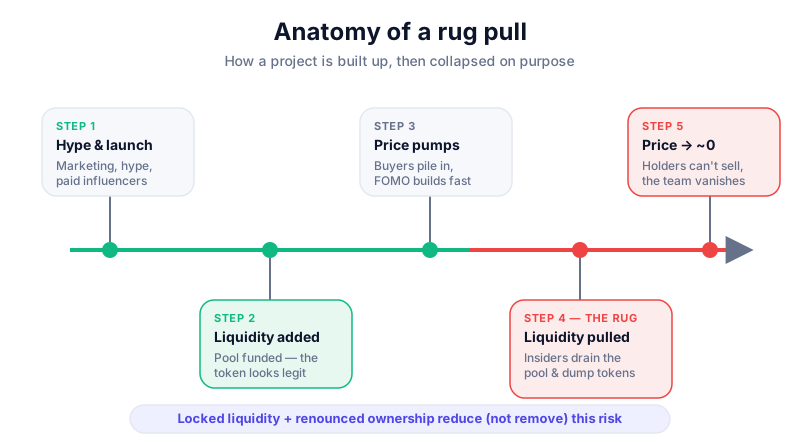
Not every failure needs a celebrity. The most common large failure is still the plain old rug pull: the creators build a coin, attract liquidity, then pull the money and disappear. With no-code launchpads making token creation almost free, these happen constantly — analysts looking at Solana launches have estimated that the overwhelming majority of tokens show patterns consistent with rug pulls or pump-and-dumps.
- Liquidity rugs — the creator withdraws the trading pool, leaving holders with tokens that can't be sold at any price. This is why locked liquidity matters so much.
- Slow rugs — instead of one dramatic exit, the team bleeds the project over weeks: selling steadily, abandoning the chat, and letting it fade to nothing.
- Honeypots — the contract is coded so you can buy but never sell, so the chart looks like it 'only goes up' until you try to exit. We break these down in honeypot tokens explained.
- Mint-and-dump — the creator quietly prints more tokens and sells them, diluting everyone else toward zero.
These are not exotic edge cases — they are the default outcome for low-effort meme coins. The full red-flag checklist lives in meme coin risks and red flags, and the wider world of crypto scams is covered in how to avoid crypto scams.
The slow fade-outs
Some meme coins don't collapse in a headline-grabbing instant — they simply run out of attention. There's no single villain and sometimes no outright fraud. The coin had a viral moment, the crowd moved on to the next thing, trading volume dried up, and the price drifted toward zero over months. For holders, the outcome is the same as a rug: money gone, just slowly enough that nobody noticed the exact moment it died.
This is arguably the most important failure mode to internalise, because it has no warning siren. A meme coin's entire value rests on people paying attention to it, and attention is the one thing nobody can guarantee. When the narrative gets stale, the buyers vanish, and a token with thin liquidity can fall 90% or more on almost no news at all.
Volume is the heartbeat
Falling trading volume is the early sign of a fade-out. If you can see daily volume drying up on a block explorer or chart, the coin is losing the attention it needs to survive — and getting out later will only get harder.
What the failures have in common
Strip away the dog mascots, the famous names and the in-jokes, and the biggest meme coin failures rhyme. They are built on hype rather than anything you can value, the people who launched them usually hold an outsized share, the liquidity is thin or removable, and the whole thing depends on a steady stream of new buyers. When that stream stops — whether through a deliberate rug, an insider exit or simple boredom — there is nothing underneath to catch the price.
A meme coin's price is a vote on attention, not a measure of worth. Attention is borrowed, and it always gets called back.
The takeaway
You don't need to memorise which coins failed in 2026; new ones will fail next year in exactly the same ways. What's worth keeping is the pattern: anonymous or insider-heavy teams, thin or withdrawable liquidity, hype that depends on a famous face or a fleeting trend, and a price that only works while fresh money keeps arriving. If you ever do choose to look at a meme coin, treat it as money you are fully prepared to lose, learn to read the warning signs in how to spot a rug pull, and know in advance what to do if you get scammed. Crypto is volatile and meme coins most of all — you can lose everything you put in, and with these tokens, most people do.
Key takeaways
- Most meme coins fail — the big collapses are just the failures large enough to make the news.
- Celebrity and politician tokens like LIBRA share one engine: insiders selling into endorsed hype.
- Rug pulls, honeypots and mint-and-dumps remain the most common large failure mode.
- Slow fade-outs are just as costly — when attention leaves, thin liquidity sends the price to zero.
- Treat any meme coin as money you can afford to lose entirely, because most holders do lose it.
Frequently asked questions
Was LIBRA a rug pull or just a bad investment?
Analysts traced large insider wallets selling into the wave of demand created by the endorsement, and it prompted a criminal investigation. Whatever the legal conclusion, the practical lesson is the same as any rug: insiders positioned beforehand exited into ordinary buyers, who were left with near-worthless tokens. The warning signs are covered in how to spot a rug pull.
How can I tell if a meme coin is about to fail?
There's no certainty, but the red flags are consistent: anonymous teams, liquidity that isn't locked, a handful of wallets holding most of the supply, and falling trading volume. Run through meme coin risks and red flags before you go near one — and remember that even a 'clean' meme coin can fade to zero when attention moves on.
Are celebrity-endorsed coins safer because someone famous is involved?
No — if anything they tend to be riskier. A famous name creates a burst of demand that insiders can sell into, and endorsements can be deleted the moment things go wrong. Fame says nothing about a token's code, its liquidity or who holds it. Treat a celebrity backing as a marketing tactic, not a safety check.
Keep reading
How to Spot a Rug Pull
A practical guide to spotting rug pulls before they happen: liquidity locks, ownership concentration, contract
Meme Coin Risks and Red Flags
The core safety lesson on meme coins: the real risks, the warning signs to look for, and the scams that separa
How Meme Coins Work (Under the Hood)
How meme coins are created, traded and priced — tokens, liquidity pools, market caps and the mechanics that ma