How to Find Promising Crypto Projects (Without Getting Rugged)
Every week brings a new coin that promises to change everything. Most won't, and a worrying number are built to part you from your money. This guide isn't about picking winners — nobody can do that reliably — it's about a repeatable process for separating projects worth understanding from the ones designed to trap you.
The 20-second version
There's no formula that finds the next big coin, but there is a checklist that filters out the obvious traps. Look hard at the team, the tokenomics, the liquidity and the community — and treat any project that resists those checks as a red flag, not a bargain.
Start with the right mindset
Before any checklist, get the framing right. "Promising" does not mean "guaranteed to go up" — it means a project you understand well enough to judge the risks honestly. The goal of research isn't to talk yourself into a coin; it's to find reasons not to buy and see whether any of them stick. If you can't find the downside, you haven't looked hard enough.
Two biases do most of the damage. The first is FOMO — the fear of missing out, which makes a chart that's already up 500% feel like a starting gun rather than a warning. The second is confirmation bias: once you want a coin to succeed, you start reading only the bullish takes. The whole point of due diligence is to act as a counterweight to both. The crypto market is extremely volatile, and the projects making the loudest promises are often the ones with the least behind them.
Hype is a marketing tactic, not a signal
A coordinated wall of "this is going to 100x" posts tells you the project has a marketing budget or an army of holders who need new buyers — not that the project is sound. Treat manufactured excitement as a reason to slow down, not speed up.
Who is behind it?
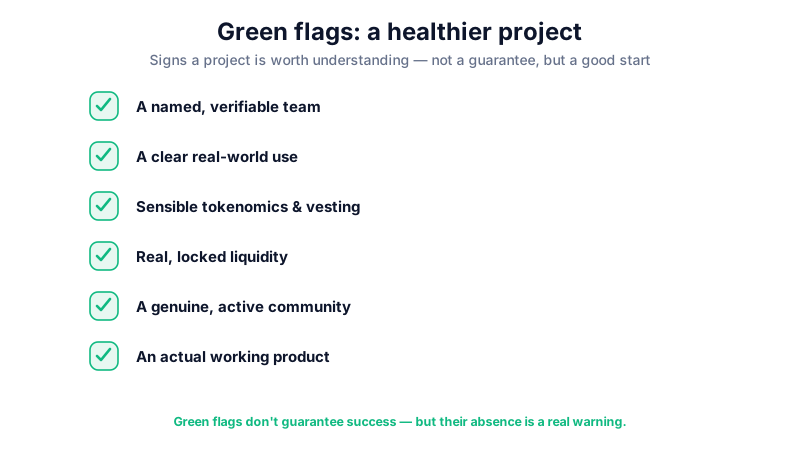
The first question for any project is simple: who built this, and what's their track record? A serious project usually has named founders, a history you can verify, and a reason for existing beyond "line goes up". An anonymous team isn't automatically a scam — plenty of respected projects keep founders pseudonymous — but anonymity removes accountability, so the rest of your checks have to work harder.
What to actually look for
- Verifiable people. Real names, real histories, prior projects you can look up. Be wary of "advisors" and "partners" listed without their knowledge — it's a common fabrication.
- A genuine problem. Can the team explain, in plain terms, what the project does and why anyone needs it? If the pitch is all tokenomics and no product, that's telling.
- A readable whitepaper. A good whitepaper explains the mechanics and the risks. A bad one is a wall of buzzwords, plagiarised sections, or pure price-talk.
- Working code or a working product. Promises are cheap. Something you can actually use — even a basic testnet — is far more convincing than a roadmap full of future milestones.
For smaller and meme-style projects, the team often is a single anonymous wallet. That's not the end of the world, but it does mean you're trusting code over people — which is exactly why the on-chain checks below matter so much. Our how to research a meme coin walkthrough goes deeper on that specific case. And if you do punt on one, keep it small — and keep your core holdings in cold storage on a Trezor Safe 5.
Read the tokenomics
Tokenomics — how a coin's supply is created, distributed and governed — is where a lot of projects quietly stack the deck against ordinary buyers. The per-token price tells you almost nothing on its own; what matters is the market cap, the supply, and who holds it. Our guide to tokenomics covers this in full, but here are the questions that matter most.
| Check | Healthy sign | Warning sign |
|---|---|---|
| Supply distribution | Spread across many wallets | Top 10 wallets hold most of it |
| Team allocation | Vested and locked for years | Unlocked and sellable from day one |
| Minting | Supply is fixed or capped | Contract can print more coins |
| Transaction taxes | None, or low and disclosed | High or changeable buy/sell fees |
| Unlock schedule | Gradual, published, predictable | Large cliffs that flood the market |
The recurring theme is concentration and control. If a handful of wallets own most of the supply, they can crash the price by selling at any moment. If the contract lets the creator mint new coins, your stake can be diluted toward nothing. And if a large team allocation unlocks all at once, the people who got their coins for free have every incentive to sell into your enthusiasm.
Use a block explorer
You don't have to take anyone's word on distribution. A block explorer lets you see the top holders of a token for yourself. If ten wallets control 80% of the supply, no amount of community hype changes what that means.
Check the liquidity
For coins trading on a decentralised exchange, liquidity is the pool of money that lets people buy and sell. It's also where the most dangerous trap lives. Thin liquidity means even small trades swing the price violently — great on the way up, catastrophic when everyone tries to exit at once. Our explainer on how liquidity pools work breaks this down in detail.
The single most important question is whether the liquidity is locked. If the project's creator can withdraw the pool, they can drain it and leave holders with worthless tokens in seconds — the classic "rug pull". Locked liquidity (held by a time-locked contract neither side can touch) removes that specific risk. Unlocked liquidity is a loaded gun.
- Is liquidity locked, and for how long? A short lock that expires next week is barely a lock at all.
- How deep is the pool? A tiny pool means you may not be able to sell any meaningful amount without crashing the price.
- Can you actually sell? Some contracts let you buy but never sell — a "honeypot token". Always check this before putting money in.
A price you can't sell at isn't a price
An "up only" chart can simply mean nobody is allowed — or able — to sell. If the liquidity is thin or unlocked, the number on the screen is a mirage. Read how to spot a rug pull before you trust any chart.
Look past the community noise
A real, engaged community can be a genuine strength — but it's also the easiest thing in crypto to fake. Bots, paid "shillers" and recycled hype campaigns can make a dead project look alive. The trick is to look at the quality of the conversation, not the volume.
- What are people actually discussing? Real communities talk about the product, the tech and the risks. Pump-driven ones talk only about price and getting rich.
- Can you ask hard questions? A healthy project tolerates criticism. If sceptical questions get you banned or swarmed, that's a flag.
- Is the engagement organic? Thousands of followers but identical, generic comments is a sign of bought activity.
- Who's promoting it? Paid influencer pushes and "presale" campaigns deserve extra scrutiny — see meme coin presales explained.
The red flags that should stop you
Some warning signs are serious enough that, on their own, they should end your interest. None of these are subtle once you know to look for them.
- Guaranteed returns. No legitimate project promises profit. "Guaranteed" anything is the language of a Ponzi scheme, not an investment.
- Pressure to buy now. Countdown timers and "last chance" urgency exist to stop you thinking. Real opportunities don't evaporate in ten minutes.
- Unlocked or withdrawable liquidity. The mechanism behind most rug pulls.
- Anonymous team plus big promises plus no product. Each is survivable alone; together they're a pattern.
- You can't sell. A honeypot contract. Always test with a tiny amount first — see how to do a test transaction.
- Copy-paste branding. A whitepaper, website or roadmap lifted from another project tells you exactly how much care went in.
If you want the meme-coin-specific version of this list, meme coin risks and red flags goes through the most common traps in detail. The principles are the same everywhere: the projects that resist scrutiny are the ones that most deserve it.
Putting it together
No checklist can tell you which project will succeed — anyone who claims otherwise is selling something. What this framework does is far more useful: it filters out the obvious traps and forces you to understand a project before any money is involved. Run through the team, the tokenomics, the liquidity, the community and the red flags, and most of the worst projects will eliminate themselves.
Treat research as the price of entry, not an optional extra. Take your time, assume nothing, and never invest more than you can comfortably afford to lose — because even a project that passes every check can still fail. Crypto is volatile, early-stage projects are riskier still, and there are no guarantees. The aim here isn't to win every time; it's to make sure you're never the one left holding a coin you never really understood.
Key takeaways
- "Promising" means a project you understand well enough to judge the risks — not one guaranteed to rise.
- Check the team, tokenomics, liquidity and community before you trust any price or chart.
- Concentrated supply, unlocked liquidity and minting rights are the big structural red flags.
- Guaranteed returns and pressure to buy now are hallmarks of scams, not opportunities.
- Research filters out the worst projects, but it can't make any crypto safe — you can still lose money.
Frequently asked questions
Can any method reliably find the next big crypto?
No, and be very wary of anyone who says theirs can. Markets are unpredictable and most new projects fail. Due diligence isn't about guaranteeing a winner — it's about understanding the risks and filtering out the projects designed to scam you, so you only ever take risks you've gone into with your eyes open.
What's the single most important check?
Liquidity, for projects trading on a decentralised exchange. If the creator can withdraw the liquidity pool, they can rug holders in seconds regardless of how good everything else looks. Checking whether liquidity is locked — and whether you can actually sell — should come before anything else.
Is an anonymous team always a scam?
No. Some respected projects keep their founders pseudonymous, and crypto has a long tradition of it. But anonymity removes accountability, so it raises the bar for everything else: the tokenomics, the liquidity and the code all have to stand up on their own, because there's no track record to fall back on.
Keep reading
How to Research a Meme Coin (Due-Diligence Checklist)
A step-by-step due-diligence checklist for vetting a meme coin: contract checks, liquidity, ownership, team an
What Is Tokenomics? How Crypto Supply and Incentives Work
Tokenomics explained in plain English: supply, distribution, emissions, utility and incentives — and how to re
How to Spot a Rug Pull
A practical guide to spotting rug pulls before they happen: liquidity locks, ownership concentration, contract