The Future of AI and Blockchain Together
"AI plus blockchain" is one of the most hyped phrases in crypto, and most of what's sold under that banner is marketing. But strip away the slogans and there are a handful of places where the two technologies genuinely fit together. This guide separates the real intersections from the buzzwords, explains how each one actually works, and flags the risks — so you can read the next "AI coin" headline with clear eyes.
The 20-second version
AI needs compute, data and a way for software to pay for things; blockchains offer open marketplaces, provenance and programmable money. The genuine overlaps are decentralised compute, proof-of-human and provenance, autonomous agents with wallets, and data marketplaces. Most of the rest is a buzzword bolted onto a token.
Why people keep pairing AI and crypto
On the surface, artificial intelligence and blockchains have nothing to do with each other. AI is about software that learns and makes decisions; a blockchain is a shared, tamper-resistant ledger. The reason they keep getting mentioned in the same breath is that each has something the other lacks. AI systems are hungry for compute power and data, and increasingly they act on their own — which means they need a way to hold value and pay for things without a human tapping a card. Blockchains happen to provide open marketplaces, a record of where data came from, and programmable money that software can use directly.
That overlap is real, but it's also where the hype lives. Slapping "AI" on a token doesn't make a project intelligent, and putting a chatbot in front of a DeFi app doesn't make it decentralised. The useful question isn't "is this AI plus blockchain?" — almost anything can claim that. It's "does this actually need a blockchain to work, or is the token just there to be sold?"
A simple test
For any "AI crypto" project, ask what the blockchain is genuinely doing. If you can describe the product without the token — and it still works — the crypto part is probably decoration. The strongest use cases are the ones where open settlement or provenance is the whole point.
Decentralised compute (DePIN)
Training and running AI models eats enormous amounts of computing power, most of it rented from a few giant cloud providers. Decentralised physical infrastructure networks, usually shortened to DePIN, try to build an open marketplace for that hardware instead. People with spare GPUs — the chips AI relies on — connect them to a network, jobs get matched to whoever has capacity, and the chain handles payment and accounting between strangers who don't know or trust each other.
This is one of the clearest places where a blockchain earns its keep, because the core problem is coordination and payment between thousands of untrusted participants — exactly what open ledgers are for. Projects like Render Network for graphics and AI rendering, and storage networks such as Filecoin, are the most established examples of the DePIN idea. The pitch is cheaper, more competitive compute and storage; the reality is that quality, reliability and uptime are harder to guarantee than with a single big cloud.
- What's real: an open market lets idle hardware get used and paid for automatically, without a central middleman taking the whole margin.
- What's hard: matching enterprise-grade reliability, keeping latency low, and stopping providers from cheating on the work they claim to have done.
- What to watch: whether real paying customers use the network for actual workloads, not just token holders speculating on it.
Provenance and proof-of-human
As AI gets better at generating text, images and video, a new problem appears: how do you know whether something was made by a person or a machine, and where a piece of content or data actually came from? This is the provenance question, and it's one of the more interesting frontiers because a public ledger is good at exactly one thing — keeping a permanent, verifiable record that nobody can quietly rewrite.
The idea is to stamp content or credentials onto a chain so their origin can be checked later. "Proof-of-human" systems try to prove there's a real person behind an account without revealing who they are — useful in a world where bots can flood any platform. A related concept is the soulbound token, a non-transferable marker of an identity or credential. These are genuinely early and genuinely controversial: privacy campaigners worry about who controls the verification, and no approach has clearly won out yet.
Provenance is not a silver bullet
A blockchain can prove that a particular file was registered at a particular time. It cannot prove the file was true, original or honestly described when it was added. Garbage stamped on-chain is still garbage — just permanently timestamped garbage.
AI agents with their own wallets
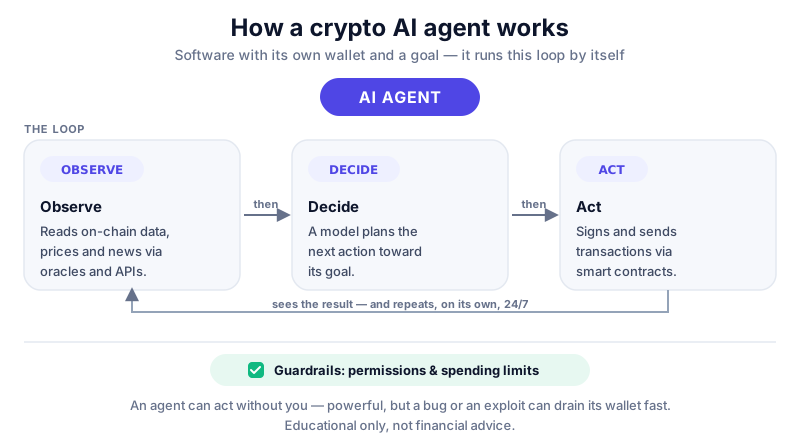
An AI agent is software that doesn't just answer questions but takes actions on your behalf — booking, buying, negotiating, or managing a task end to end. Once software starts acting independently, it needs a way to pay for things and prove what it did. A traditional bank account assumes a human owner; a crypto wallet is just a key, so an agent can hold one directly and transact without asking a person each time.
In crypto, the obvious playground is DeFi: agents that move funds between protocols, rebalance, or execute strategies automatically against smart contracts. The appeal is automation that runs 24/7 without you babysitting it. The danger is just as obvious — you're handing money to software that can make mistakes, be tricked, or be exploited through a smart contract bug, and a bad instruction executes instantly and irreversibly.
- Genuinely useful: automating tedious, rule-based tasks and letting software settle tiny payments a human never could.
- Genuinely risky: giving an agent control of a wallet means giving it the power to lose everything in it, fast.
- The honest framing: agents are a tool, not a money machine. Treat anything that promises hands-off profit with deep suspicion.
Data marketplaces and tokenised value
AI models are only as good as the data they're trained on, and most of that data is currently scraped for free or locked inside a few large companies. Data marketplaces try to flip this: contributors can register data, prove they own it, and get paid when it's used, with the chain handling ownership records and payments. It's the same coordination logic as compute markets, applied to information instead of hardware.
This overlaps with a broader trend of putting ownership of valuable things on-chain — see our explainer on real-world assets (RWAs). For data specifically, the chain provides a transparent record of who contributed what and an automatic way to split the rewards. The catch is that none of this guarantees the data is good, legally obtained, or worth anything — and verifying quality at scale is an unsolved problem. Reliable external data also tends to depend on blockchain oracles, which are their own point of trust and failure.
| Use case | What the blockchain adds | The hard part |
|---|---|---|
| Decentralised compute (DePIN) | Open market, automatic payment | Reliability and quality of work |
| Provenance / proof-of-human | Permanent, verifiable record | Proving truth, not just timing |
| AI agents | Wallets and instant settlement | Handing money to fallible software |
| Data marketplaces | Ownership records and reward splits | Verifying the data is any good |
Telling real use cases from buzzwords
Here's the honest summary. The intersection of AI and blockchain is real, but it's narrow. It works best where the problem is genuinely about coordinating and paying lots of untrusted participants, or about keeping a record nobody can fake. Decentralised compute, provenance, agent payments and data ownership all fit that shape. Most everything else — "AI-powered" trading tokens, chatbots bolted onto an app, coins whose only AI is in the name — does not.
When you meet a new "AI crypto" project, slow down and read the whitepaper for what the token actually does, who controls the network, and whether real users pay for a real service. Be especially wary of price predictions and "this will moon because AI" hype: a hot narrative is exactly the environment where scams and weak projects thrive. None of this is a recommendation to buy anything — it's a way to understand what you're looking at.
The bottom line
AI and blockchain genuinely meet in a few specific places — open compute, provenance, agents and data. Everywhere else, "AI" is usually a marketing sticker. Judge a project by what its chain does, not by the buzzwords on its homepage. And remember: any AI-themed coin is still a crypto asset, which means it's volatile and you can lose money.
Key takeaways
- The real AI–blockchain overlaps are decentralised compute, provenance, agent wallets and data marketplaces.
- A blockchain earns its place when the problem is coordinating or paying untrusted parties, or keeping an unfakeable record.
- Provenance proves when something was registered, not that it's true — and agents can lose money as fast as they make it.
- Most "AI crypto" is a buzzword on a token; judge projects by what the chain actually does, and remember crypto is volatile.
Frequently asked questions
Does adding "AI" to a crypto project make it more valuable?
No. "AI" is one of the easiest labels to attach to a token, and most projects using it have no meaningful AI at all. The label tells you nothing about value. Look instead at whether the network solves a real coordination or provenance problem, whether real customers pay for it, and who controls the token. A hot narrative attracts both genuine builders and opportunists.
What is DePIN in simple terms?
DePIN stands for decentralised physical infrastructure network. It's an open marketplace where people connect real hardware — like GPUs for AI, or storage drives — and get paid in crypto when others use it. The blockchain handles matching and payment between strangers. Render and Filecoin are well-known examples of the idea, though reliability is harder to guarantee than with a big central cloud.
Should I let an AI agent control my crypto wallet?
Only with extreme caution, if at all. An agent with wallet access can act instantly and irreversibly — which means it can also lose your funds instantly if it makes a mistake, is tricked, or hits a smart contract bug. This isn't advice to use or avoid them; just understand that you're trusting software with money, and never hand over more than you could afford to lose entirely.
Keep reading
What Is DeFi? Decentralised Finance Explained
A beginner's guide to decentralised finance: what DeFi is, how lending, trading and yield work without a bank
What Are Real-World Assets (RWA) in Crypto?
A clear guide to real-world assets (RWAs): how tokenising bonds, real estate and gold works on-chain, why it's
What Is Render Network (RNDR/RENDER)? A Plain-English Guide
A beginner-friendly explanation of Render Network: the decentralised GPU rendering marketplace, how it works,