The Rise of AI Meme Coins
In late 2024 something genuinely strange happened: an AI chatbot helped spawn a meme coin worth hundreds of millions of dollars, and a wave of imitators followed. "AI meme coins" became one of the loudest stories in crypto. This guide explains what they actually are, where the trend came from, and how to tell the working ideas from the marketing fog — without telling you to buy anything.
The 20-second version
AI meme coins bolt the artificial-intelligence narrative onto meme-coin culture — sometimes a real AI agent posts and launches tokens, often it's just an AI-themed name and a logo. The mechanics and the risks are the same as any meme coin, and the AI angle does nothing to change how easily you can lose money.
What an "AI meme coin" actually is
An AI meme coin is a meme coin whose story leans on artificial intelligence. That story comes in two very different flavours, and the gap between them matters more than anything else in this article. The first is a coin tied to a genuine AI agent — a piece of software that posts on social media, talks to followers, and in some cases is connected to a wallet. The second is a coin that simply borrows the AI buzzword: an AI-themed name, a robot mascot, a whitepaper full of machine-learning words, and nothing under the bonnet.
Underneath, both are ordinary tokens. They are deployed on a chain like Solana or Ethereum, traded against a liquidity pool, and priced by supply and demand — exactly the plumbing we walk through in how meme coins work. The AI label is a narrative wrapped around that plumbing, not a different kind of asset. Treating it as something fundamentally safer or smarter than a dog-themed coin is the first mistake people make.
AI agent vs AI theme
An AI agent is software that actually does something — posts, replies, sometimes holds a wallet. An AI theme is just branding. Most "AI meme coins" are the second kind. Work out which one you're looking at before anything else.
Where the trend came from
The spark was a project called Truth Terminal, an AI agent built by researcher Andy Ayrey. He let large language models talk to each other unsupervised, and out of those rambling conversations came a stream of absurdist memes. The experiment caught the eye of venture capitalist Marc Andreessen, who sent the project a $50,000 grant in Bitcoin. That gave the agent a wallet and a budget — and an oddly serious credibility signal for something this silly.
In October 2024 a meme coin called Goatseus Maximus (ticker GOAT) was launched around the Truth Terminal lore. The agent posted about it relentlessly, the coin's market cap rocketed from a few million dollars into the hundreds of millions, and headlines crowned the bot the "first AI agent millionaire" because of the tokens sitting in its wallet. Shortly after came Fartcoin, which grew out of the same world. Suddenly every launchpad was producing AI-flavoured coins.
It's worth being precise about what happened here. An AI did not invent a business or solve a problem. It generated a meme, humans launched a token around it, and a crowd piled in chasing a story. The novelty was real; the value was a narrative trade. That distinction runs through the entire AI-meme-coin phenomenon.
Real AI agents vs AI-flavoured branding
A small number of projects have shipped genuinely working AI agents. Platforms emerged that let developers spin up agents with a personality and a memory and attach a token to them, and a few of those agents — market-commentary bots, for instance — built real followings and crossed large market caps on the strength of actually doing something. Open-source frameworks now make building such agents straightforward, which is the genuine technological story underneath the noise.
But for every agent that does something, hundreds of tokens launch daily with no working software at all — just the word "AI" and a chart. Even among the real ones, a handful of breakout agents have done almost all the heavy lifting for the entire narrative, and most AI tokens trade far below their peaks. Here's a rough way to separate the two:
| Signal | Leans real | Leans hype |
|---|---|---|
| The agent | Posts, replies, ships visible output you can check | No agent exists, or it never does anything |
| The token's job | Some link to the agent's activity or revenue | Pure speculation, no value capture |
| The team | Named builders, open-source code | Anonymous, closed, copy-paste contract |
| The pitch | Honest about being experimental | Promises returns, "next 1000x" |
"AI" is not a safety feature
An AI agent posting about a coin can manufacture hype, but it cannot give the token revenue, fundamentals or a floor. A coin can have a brilliant working agent attached and still go to zero. The label tells you nothing about risk.
The risks are the meme-coin risks, amplified
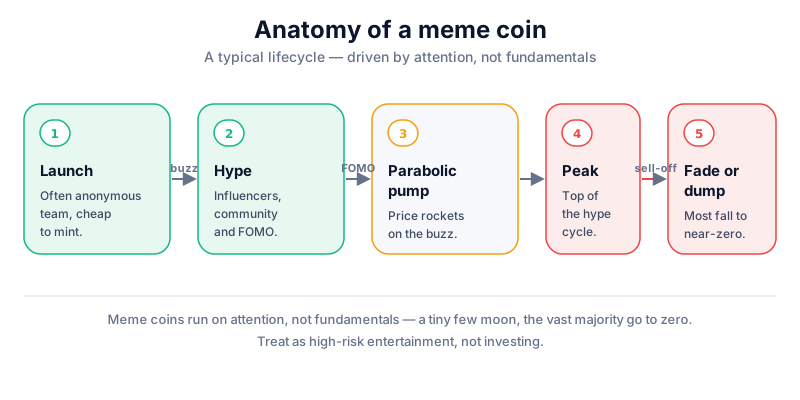
Every danger from ordinary meme coins applies here, and the AI hype tends to make them worse by drawing in people who think this time is different. The classics still bite: thin liquidity that traps you on the way down, supply concentrated in a few wallets that can dump on you, and outright rug pulls where the team drains the pool. The AI branding can lend a scam a veneer of sophistication it hasn't earned.
- Narrative momentum, not fundamentals — prices move on attention and storytelling, which can vanish overnight. This is the volatility we cover in understanding crypto volatility.
- Impersonation — anyone can launch a coin and claim it's "the official token" of a popular AI agent. Most aren't. The real agent rarely controls the token at all.
- Bot-manufactured hype — an AI posting around the clock can make a coin look organically loved when the activity is automated.
- Same old tokenomics traps — hidden mint functions, sell taxes and honeypots don't care that the logo is a robot. Run the how to research a meme coin checklist regardless.
None of this means the underlying technology is fake. AI agents that trade, research and post are a real and fast-moving area. It means the token wrapped around an agent is still a speculative meme coin, and should be understood as one. For the wider catalogue of what can go wrong, see meme coin risks and red flags.
How to look at one sensibly
We don't tell anyone what to buy. But if you're trying to understand a specific AI meme coin rather than be swept along by it, a few neutral questions cut through most of the noise. Start by separating the technology from the token, because they are almost never the same thing. If you do punt on one, keep it well away from your core holdings — those belong in cold storage on a SafePal S1.
- Is there an actual AI agent, and can you see it doing something — or is "AI" just the name?
- Does the token do anything for the agent, or is it pure speculation bolted on the side?
- Who launched the token, and is it genuinely connected to the agent or just riding its name?
- Check the boring mechanics anyway: liquidity, holder concentration, mint and tax functions.
- Ask what happens to the price when the attention moves on — because with meme coins it always does.
The technology can be real and the token can still be a lottery ticket. Those are two separate questions, and conflating them is how people get hurt.
The bottom line
AI meme coins are a genuine cultural moment built on a genuine technological shift — autonomous agents really can post, trade and launch tokens now. But the coins themselves are meme coins first and "AI" second. The narrative is louder, the imitators are everywhere, and the risks are exactly the ones that have always defined this corner of crypto: extreme volatility, thin markets, concentrated supply and a steady supply of scams dressed up in this year's buzzword.
Understand them as education, not as a tip. Learn how the machinery works in how meme coins work, study the notable meme coins that came before, and keep the red flags in front of you. Crypto is volatile and you can lose money — and an AI logo does nothing to change that. — the Latest Crypto team
Key takeaways
- AI meme coins fuse the AI narrative with meme-coin culture — sometimes a real agent, often just branding.
- The trend began with Truth Terminal and the GOAT coin in late 2024, then exploded into countless imitators.
- A few AI agents genuinely work, but the tokens around them are still speculative meme coins.
- The risks are the usual meme-coin risks — volatility, thin liquidity, rug pulls — and the "AI" label changes none of them.
Frequently asked questions
Does an AI actually run these coins?
Rarely. In a handful of cases a real AI agent posts about a coin or even holds some in a wallet, but the token's smart contract and liquidity are almost always controlled by humans. For most "AI meme coins", the AI connection is just a name and a logo with no software behind it.
Are AI meme coins safer than ordinary meme coins?
No. They carry exactly the same risks — thin liquidity, concentrated supply, hidden contract traps and rug pulls — and the AI hype can make them feel more legitimate than they are. Always run the same checks you would on any meme coin, such as the ones in our how to research a meme coin guide.
Is the AI agent technology itself a scam?
Not inherently. Autonomous AI agents that post, research and trade are a real and active area of development, and some frameworks are genuinely useful. The point is that the technology being real does not make a token attached to it a good or safe thing to hold — those are two separate questions.
Keep reading
What Is Fartcoin and Why Is Everyone Talking About It?
Fartcoin is a Solana meme coin born from an AI agent's joke that grew to a multi-billion-dollar market cap. It
How Meme Coins Work (Under the Hood)
How meme coins are created, traded and priced — tokens, liquidity pools, market caps and the mechanics that ma
What Are Meme Coins? A Plain-English Guide
A clear, no-hype explanation of what meme coins are, where they came from, why they're so risky, and how to th