What Are Meme Coins? A Plain-English Guide
Meme coins are cryptocurrencies built around an internet joke, mascot or trend rather than a product or technology. This guide is lesson one of our meme-coin course, and it sets up the whole journey: what these coins are, where they came from, and why they sit at the riskiest end of an already risky market. Get this foundation right and the lessons that follow will make far more sense.
The 20-second version
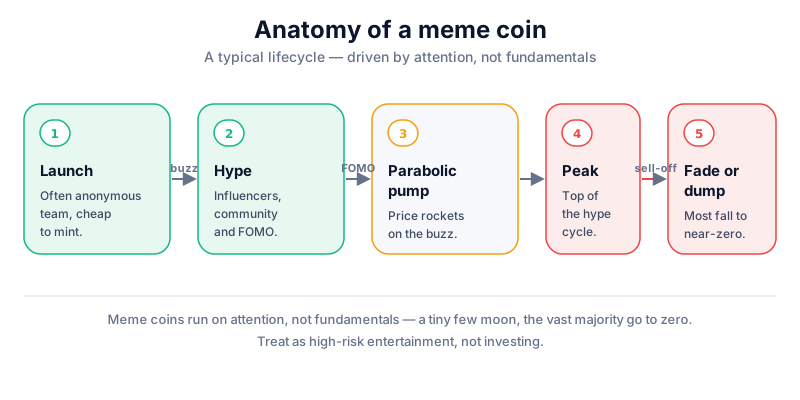
A meme coin is a crypto token whose value comes almost entirely from hype and community attention, not from any underlying use. They can be created by anyone in minutes, are extremely volatile, and most go to zero. Treat them as gambling, not investing.
What is a meme coin?
A meme coin is a cryptocurrency token created around a joke, a meme, an animal mascot or a passing internet trend. Unlike Bitcoin, which is designed as digital money, or Ethereum, which runs applications, a meme coin usually has no product, no roadmap that matters, and no real-world job to do. Its price is driven by attention — by how many people are talking about it right now, and how excited they are.
Here's an analogy that holds up well. A useful cryptocurrency is a bit like a share in a business: there's something underneath it generating value, however volatile the price gets. A meme coin is closer to a collectible — a rare trading card or a limited-edition sneaker. It's worth exactly what the next person will pay, and not a penny more. When the crowd loses interest, there's nothing left to hold the price up.
Most meme coins are tokens built on top of an existing blockchain such as Ethereum or Solana, rather than blockchains in their own right. Because launching a token is cheap and fast — often a few dollars and a few minutes — anyone can create one. The result is that tens of thousands now exist, with hundreds of new ones appearing every single day. We'll unpack exactly how that works in the next lesson, how meme coins work.
This is education, not advice
Meme coins are among the most volatile and speculative assets that exist. The overwhelming majority lose most or all of their value. Nothing here is a recommendation to buy — only ever risk money you can afford to lose entirely, and never borrow to do it.
Where meme coins came from
The first true meme coin was Dogecoin, launched in 2013 as a light-hearted parody of Bitcoin, complete with a Shiba Inu dog mascot and deliberately silly branding. The two engineers behind it built it in an afternoon, partly to poke fun at how seriously the crypto world was taking itself. It was meant as a joke — but it stuck around, built a genuine community, and years later briefly became one of the largest cryptocurrencies by market value.
That single unlikely success rewired the whole scene. If a coin made as a joke could be worth billions, the thinking went, why not launch your own? Dogecoin's run spawned thousands of imitators, and the pattern has repeated ever since. Each new market cycle brings a fresh wave: Shiba Inu, then frog and animal themes, then 'celebrity' and political coins, then whatever the algorithm is rewarding this month.
We cover the most prominent examples factually in notable meme coins — not as endorsements, but so you can recognise the landscape and understand why the famous ones are famous. The crucial thing to hold onto: for every Dogecoin that survived, there are tens of thousands of coins you've never heard of, because they quietly died.
How meme coins differ from other crypto
It helps to compare meme coins against assets that at least aim to do something useful. The differences aren't subtle, and once you see them laid out, the extra risk becomes obvious.
| Bitcoin / Ethereum | Typical meme coin | |
|---|---|---|
| Purpose | Digital money / smart-contract platform | An internet joke or trend |
| Value driver | Adoption, utility, network security | Hype and social media attention |
| Who created it | Public, established projects | Often anonymous, sometimes unknown |
| Track record | Years of operation | Frequently days or weeks old |
| Typical outcome | Survives across cycles | Most fade to near-zero |
None of this makes the established assets 'safe' — all crypto is volatile, and Bitcoin itself has fallen 70% or more in past cycles. But meme coins stack several extra layers of risk on top of that baseline: an anonymous creator who can walk away, a contract that might be rigged, and a price held up by nothing but mood. We break those layers down in meme coin risks and red flags.
Why do people buy them anyway?
If most meme coins go to zero, why do millions of people keep buying them? Because they're cheap per token, easy to access, and wrapped in fun, shareable culture. Social media constantly amplifies stories of someone turning £100 into £100,000 — but those are rare survivors, and the far more common outcome (quietly losing the lot) almost never goes viral. Nobody posts a celebratory thread about the coin that wiped out their savings. If you punt on this end of the market anyway, keep the stake small — and keep your core holdings well away from it, in cold storage on a OneKey.
- Low unit price makes them feel affordable — a coin at $0.0001 feels like free money, even though, as we'll see, that price tells you nothing about value.
- Community and humour make holding one feel like belonging to a movement, complete with in-jokes, memes and a shared us-against-the-world energy.
- Fear of missing out drives most buying near the top of a hype wave, exactly when the risk is highest and the early holders are looking to sell.
- Survivorship bias means you mostly hear about the winners and never the silent majority who lost — which makes the odds look far better than they are.
A useful mental frame
Think of a meme coin less like a company share and more like a lottery ticket or a casino chip. That framing keeps your expectations — and your bet size — realistic. People do win the lottery; you just wouldn't remortgage your house to play it.
Where to go next
That's the foundation: what meme coins are, where they came from, and why they pull people in. The rest of this course builds on it step by step. Next up, how meme coins work lifts the bonnet on the mechanics — tokens, liquidity pools and market caps — so you can see exactly where the danger hides. After that we get to the safety lessons: meme coin risks and red flags and how to spot a rug pull. We'll tour the famous coins in notable meme coins, and finish with a practical how to research a meme coin checklist you can actually use. Take them in order — each one assumes the last.
Key takeaways
- Meme coins are tokens built around a joke or trend, not a product.
- Their value comes almost entirely from hype and attention.
- Anyone can create one in minutes, and most go to near-zero.
- Treat them as gambling — only risk what you can afford to lose entirely.
Frequently asked questions
Are meme coins a good investment?
We never call anything a good or bad investment — that's not advice we give. What we can say factually is that meme coins are extremely volatile and most lose nearly all their value. Treat any money put into one as money you could lose completely.
Is Dogecoin a meme coin?
Yes. Dogecoin started in 2013 as a joke and is the original meme coin, though it has since built a large, long-standing community. We describe it neutrally in notable meme coins.
Can a meme coin become a 'real' project?
A few have built communities and uses over time, but this is the rare exception, not the rule. The vast majority never develop any utility and fade away. Never assume the coin you're looking at will be the exception — the odds say it won't be.
Keep reading
How Meme Coins Work (Under the Hood)
How meme coins are created, traded and priced — tokens, liquidity pools, market caps and the mechanics that ma
Meme Coin Risks and Red Flags
The core safety lesson on meme coins: the real risks, the warning signs to look for, and the scams that separa
How to Spot a Rug Pull
A practical guide to spotting rug pulls before they happen: liquidity locks, ownership concentration, contract