What Makes a Successful Meme Coin?
For every meme coin you've heard of, there are tens of thousands you never will. They launched, went nowhere, and vanished. So what separates the rare survivors from the rest? This is an honest look at the ingredients — not a recipe, because there isn't one, and not a tip, because nobody can predict the next one.
The 20-second version
The meme coins that last tend to share a few traits: a real community, a sticky narrative, a launch that didn't obviously favour insiders, enough liquidity to trade, and lucky timing. But these are patterns seen in hindsight, not a formula — the overwhelming majority of coins with all the right boxes ticked still go to zero.
First, what does 'successful' even mean?
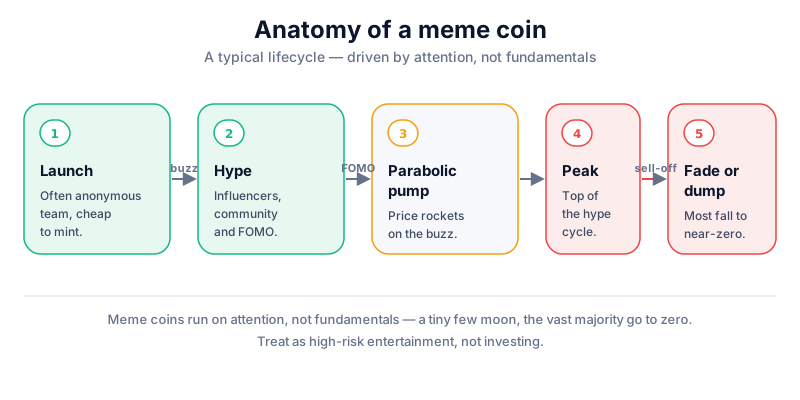
It's worth being precise, because 'success' hides a lot. A coin can spike 100x in an afternoon and be worthless by the weekend — that's a successful pump, not a successful coin. When people talk about the meme coins that 'made it', they usually mean ones that survived multiple market cycles, kept an active community, stayed liquid enough to trade, and didn't turn out to be a rug pull.
By that stricter definition, lasting success is vanishingly rare. As we cover in notable meme coins, the handful of household names exist against a backdrop of millions of dead tokens. Keep that base rate in mind for everything below: these are the traits of survivors, and survivors are the exception.
The common ingredients
Looking back at the coins that endured, a few features come up again and again. None of them guarantees anything, and many failed coins had them too — but their absence is usually fatal.
Community
This is the one nearly everyone agrees matters most. A meme coin with no product is, in effect, a coin whose only asset is its community. A large, genuinely engaged group that makes art, jokes and memes — and sticks around through a price crash — is what keeps a token alive when the hype fades. The hard part is telling a real community from a rented one: paid engagement, bot accounts and a chat that only talks about price are warning signs, not strengths.
A sticky narrative
The best-known meme coins are easy to explain in one line — a friendly dog, a famous frog, a simple in-joke. A narrative that's instantly understandable and fun to share spreads on its own. If you need three paragraphs to explain why a coin is funny, it probably isn't, and it won't travel.
A launch that looks fair
How a coin is distributed at the start shapes everything afterwards. A so-called 'fair launch' — where there's no big pre-sale, no giant team allocation and no insiders holding most of the supply — gives a coin a fighting chance of building trust. When a handful of wallets control the float, those holders can crash the price at will, and savvy buyers steer clear. You can read the mechanics in how meme coins work and the dangers in meme coin presales explained.
Liquidity
A coin that can't be traded without crashing isn't really tradeable. Deep, locked liquidity lets people buy and sell in reasonable size and signals that the creator can't simply drain the pool. Thin or unlocked liquidity is one of the most common ways holders get trapped — we break down exactly why in how meme coin liquidity works.
Timing and luck
The uncomfortable truth is that timing matters as much as anything on this list. The same coin can soar in a frothy bull market and die in a quiet one. Catching a cultural moment, a viral post, or a wave of attention is largely outside anyone's control — which is precisely why survivors can't be reverse-engineered into a formula.
A neutral scorecard
If you're trying to understand a coin rather than chase it, it can help to look at the same factors side by side. This isn't a buy signal — a coin can score well on all of these and still go to zero. It's a way to organise what you're looking at. If you're punting on meme coins anyway, keep your core holdings in cold storage on a Ledger Nano X, well away from the wallet you experiment with.
| Factor | Healthier signs | Warning signs |
|---|---|---|
| Community | Organic, creative, sticks through dips | Bots, paid hype, only talks price |
| Narrative | Instantly gettable, fun to share | Convoluted, needs explaining |
| Launch | No insider-heavy allocation | Big pre-sale, concentrated wallets |
| Liquidity | Deep and locked | Thin or withdrawable by creator |
| Contract | Verified, minting off, no honeypot | Unverified, mintable, can't sell |
Hindsight is not foresight
Every successful meme coin has a tidy story explaining why it worked — told after the fact. The same story applied to a dead coin would sound just as convincing. Be wary of anyone who claims they can spot the winners in advance; if they could, they wouldn't be telling you.
Why success is so rare
Two forces work against almost every new coin. First, the sheer numbers: anyone can launch a token in minutes for a few pounds, so the field is flooded daily and attention is the scarcest resource of all. Most coins die of indifference, not fraud. Second, the incentives often point the wrong way — many launches are designed for the creators to extract value early, not to build something lasting, which is the root of the psychology traps that pull buyers in.
- Tens of thousands of new tokens can appear in a single day, and almost all are forgotten within hours.
- Attention, not technology, is the bottleneck — and attention is fickle and easily faked.
- Even 'good' launches face a brutal base rate: surviving multiple cycles is the rare exception.
- Many coins are built to enrich insiders quickly, which is fundamentally at odds with lasting value.
This is not a how-to
Reading the traits of survivors can make it feel like you've found an edge. You haven't — and neither has the person selling you one. Understanding what these coins look like is useful for spotting risk and avoiding scams. It is not a method for picking winners, and treating it as one is how people lose money.
The bottom line
The rare meme coins that last tend to share a real community, a narrative people enjoy sharing, a launch that didn't obviously favour insiders, enough locked liquidity to trade, and a good dose of timing and luck. But that's a description of survivors seen in the rear-view mirror, not a blueprint you can follow forward. The overwhelming majority of coins that tick every box still fail, and no one — however confident — can reliably tell you which will be the exception. Treat all of this as a lens for understanding risk, not a shopping list, and remember that crypto is extremely volatile and you can lose everything you put in.
Key takeaways
- Lasting meme coins tend to share community, a sticky narrative, a fair-looking launch, deep liquidity and good timing.
- These are traits seen in survivors after the fact — not a formula you can apply in advance.
- Community is the asset that keeps a no-product coin alive, but real engagement is hard to tell from rented hype.
- Most coins fail from indifference, not fraud — attention is the scarcest resource of all.
- Understanding success factors helps you assess risk, not pick winners. Nobody can reliably do that.
Frequently asked questions
Can I use these traits to find the next big meme coin?
No, and we'd gently warn you off anyone who says you can. These are patterns spotted in survivors after they succeeded; countless failed coins had the same traits. They're useful for understanding and avoiding risk — spotting a rigged launch or thin liquidity — not for predicting which coin will moon. Nobody can do that reliably.
Why is community talked about so much?
Because a meme coin usually has no product, no revenue and no fundamentals, its community is effectively its only asset. A group that keeps making memes and holding through price crashes is what keeps a token alive when the initial hype fades. The catch is that a genuine community is hard to distinguish from one inflated by bots and paid promotion.
What's a 'fair launch'?
Broadly, a launch with no large pre-sale, no oversized team allocation and no small group of insiders holding most of the supply. The idea is that no one is positioned to dump on everyone else. It's not a guarantee of anything, but a launch where a few wallets control the float is a serious red flag worth checking before anything else.
Keep reading
How Meme Coins Work (Under the Hood)
How meme coins are created, traded and priced — tokens, liquidity pools, market caps and the mechanics that ma
Notable Meme Coins (A Neutral Overview)
A factual, balanced look at the best-known meme coins — Dogecoin, Shiba Inu, Pepe and others — with heavy risk
How Meme Coin Liquidity Works (and Why It Matters)
A plain-English guide to meme coin liquidity: what a liquidity pool is, why 'locked liquidity' matters, and ho