Why Community Matters More Than Technology in Crypto
Newcomers to crypto often assume the best technology wins. Then they discover that one of the most famous coins of all started as a literal joke, while plenty of technically impressive projects quietly faded away. The uncomfortable truth is that in this market, the size and loyalty of a community frequently matters more than the cleverness of the code. This article explains why — and where that rule breaks down.
The 20-second version
Crypto is a network: a coin is only useful if enough people use, trade and believe in it. That gives community and network effects huge weight, sometimes more than the underlying tech. But for things that have to actually work — settlement, security, scaling — engineering still matters a lot.
Crypto runs on network effects
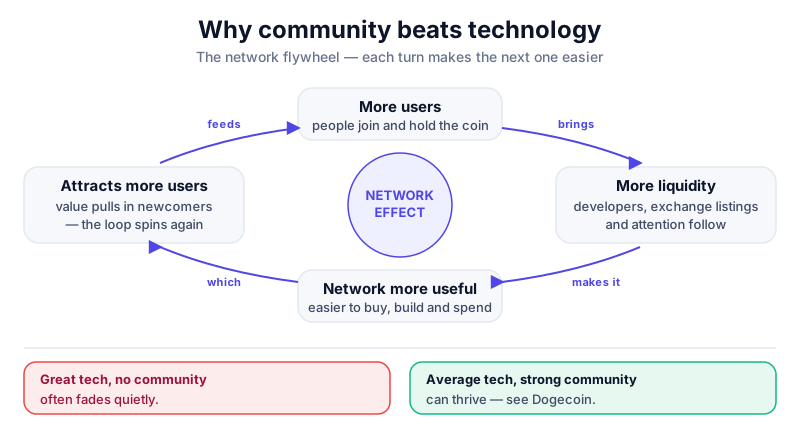
A blockchain has no intrinsic value the way a factory or a farm does. Its worth comes almost entirely from how many people accept it, trade it and build on it. That makes crypto a classic network-effect business: every extra user, developer, exchange listing and merchant makes the network more useful to everyone already there. A telephone with no one to call is useless; a token no one will accept is just a number in a database.
This is why a coin's community isn't a marketing afterthought — it is, in a real sense, the product. Liquidity (the ease of buying and selling), developer activity, and the simple willingness of strangers to treat a token as worth something all flow from people, not from code. You can read more about why prices swing so hard on attention alone in understanding crypto volatility.
Why this surprises people
In most industries, a better product can win on merit even with weak marketing. In crypto, a token with no community has no liquidity, no listings and no buyers — so 'better tech' on its own can't rescue it. Adoption is the moat.
Dogecoin: the case study everyone cites
Dogecoin is the example that breaks the 'best tech wins' assumption. It was created in 2013 as a parody, built on a fork of Litecoin's code, with an unlimited supply and no particular technical ambition. By any engineering scorecard, dozens of newer chains do more. Yet Dogecoin has persisted for over a decade, repeatedly outliving 'serious' projects, because of one thing: an enormous, good-humoured, sticky community.
That community gave it a recognisable brand, deep liquidity, and a base of holders who treat it almost as a cultural artefact rather than an investment thesis. If you're holding coins for years like that, keeping them in cold storage on a Trezor Safe 5 beats leaving them on an exchange. Endorsements from high-profile figures added fuel, but the underlying staying power is social. This is the engine behind the whole meme-coin category — we unpack the mechanics in what are meme coins and how meme coins work.
Community staying power is not a price prediction
A loyal community can keep a coin alive far longer than its tech would justify. That tells you nothing about whether the price will rise, fall or go to zero. Community-driven coins are typically more volatile and more sentiment-driven, not safer. Crypto is high-risk and you can lose everything you put in.
Where technology still wins
The honest version of this thesis is not 'technology doesn't matter'. It's that community decides which working technology actually gets adopted — and that, for some jobs, the technology has to genuinely deliver or the community never forms in the first place. Nobody builds a loyal community around a chain that loses funds, halts constantly, or can't process their transactions.
Bitcoin is the clearest example of tech and community reinforcing each other: its conservative, battle-tested engineering is precisely why people trust it to store value, and that trust is what makes the network valuable. Ethereum won developers by being genuinely programmable, then the developer community compounded that lead. Tech opened the door; community walked through it and kept it open.
| When community tends to dominate | When technology tends to dominate |
|---|---|
| Meme coins and culture-driven tokens | Settlement layers that must never fail |
| Brand recognition and liquidity | Security against hacks and exploits |
| Speculative, sentiment-led markets | Scaling to handle real transaction volume |
| Coins competing on attention | Infrastructure other apps are built on |
For chains carrying serious value or activity, engineering quality is not optional. A flashy network with weak security is one smart contract exploit away from losing everything — and no amount of community spirit brings drained funds back.
The two feed each other
In practice, community and technology aren't rivals — they're a feedback loop. Good tech attracts developers and users; a growing community attracts more developers, exchange listings and liquidity; that liquidity and attention attract still more people. The flywheel can spin up fast and, when sentiment turns, spin down just as fast.
- Developers decide where to build, and they follow both capability and momentum.
- Liquidity follows attention — thin communities mean thin markets and brutal price swings.
- Tokenomics shape incentives, deciding whether early holders are rewarded for sticking around or for dumping. Start with what is tokenomics.
- Narrative — the story a community tells about a coin — often moves price more than any code change.
A practical way to read a project
Don't ask only 'is the tech good?' or only 'is the community big?'. Ask whether the technology actually does a job people need, and whether a real, active community has formed around it — not just a paid hype campaign. A coin missing either leg is on shaky ground.
The takeaway
Crypto rewards networks, and networks are made of people. That's why a joke coin can outlast a polished rival, and why 'the best technology' so often loses to the most committed community. But the rule has limits: for anything that has to work reliably and securely, engineering still decides the outcome. The strongest projects pair both — solid tech and a genuine community — and reading a coin means weighing the two honestly rather than falling for whichever one is being shouted about loudest.
However you weigh them, none of this is a reason to buy anything. Community-driven coins are among the most volatile assets in an already volatile market, and a thriving community offers no protection against heavy losses. Crypto is high-risk; never put in money you can't afford to lose.
Key takeaways
- Crypto is a network-effect market: a coin's value depends on how many people use and believe in it.
- Dogecoin shows that a strong community can outlast technically superior projects for years.
- Technology still wins where reliability, security and scaling genuinely matter.
- The best projects combine both — read a coin by asking whether the tech does a real job and whether a real community exists.
- Community strength is not a price prediction; these coins are volatile and you can lose money.
Frequently asked questions
Does this mean technology doesn't matter in crypto?
No. It means community decides which working technology gets adopted, and for some jobs — security, settlement, scaling — the tech has to genuinely deliver or no community forms at all. The point is that good tech alone doesn't guarantee adoption; you need people too.
Why has Dogecoin survived so long despite basic technology?
Because of an unusually large, loyal and good-humoured community that gives it brand recognition and deep liquidity. That social staying power has let it outlast many more advanced projects, though it says nothing about where the price will go.
How can I tell if a coin's community is real or just hype?
Look for sustained, organic activity — developers building, ongoing discussion, real usage — rather than a burst of paid promotion or coordinated shilling. A community that only appears when the price pumps is a warning sign, not a foundation.
Keep reading
What Are Meme Coins? A Plain-English Guide
A clear, no-hype explanation of what meme coins are, where they came from, why they're so risky, and how to th
What Is Dogecoin? The Original Meme Coin Explained
A plain-English, no-hype guide to Dogecoin (DOGE): where it came from, how it works, what makes it different f
What Is Tokenomics? How Crypto Supply and Incentives Work
Tokenomics explained in plain English: supply, distribution, emissions, utility and incentives — and how to re