How Pump.fun Changed Crypto Forever
Before 2024, launching a crypto token took some technical know-how. Then a website called Pump.fun made it a one-click affair — and the floodgates opened. Millions of tokens followed, fortunes were made and lost in minutes, and the way meme coins are born changed for good. Here's what Pump.fun actually is, how it works, and why it's one of the most consequential and controversial things to happen to crypto in years.
The 20-second version
Pump.fun is a no-code launchpad on Solana that lets anyone create and trade a token in minutes using a bonding curve. It made token creation effortless and wildly profitable for the platform — but the overwhelming majority of the coins it spawns go to zero, and many behave like rug pulls.
What Pump.fun actually is
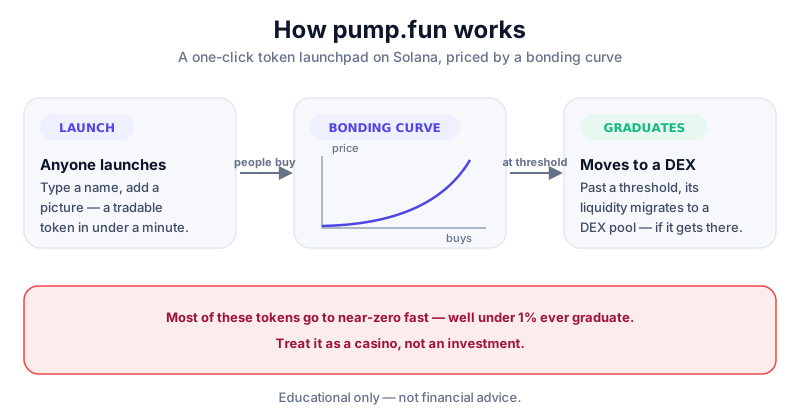
Pump.fun is a website that launched in early 2024 on the Solana blockchain. Its pitch is brutally simple: type a name, add a picture, and you have a live, tradable token in under a minute — no coding, no developer, no upfront liquidity. It turned the act of creating a coin, which used to require deploying a smart contract yourself, into something as easy as posting on social media.
Solana was the natural home for it because the network is fast and transactions cost a fraction of a penny, so spinning up and trading throwaway tokens is cheap. The result was staggering: Pump.fun became one of the most profitable applications in all of crypto, generating hundreds of millions in fees, and at its peak it accounted for the majority of all new tokens launched on Solana on a given day. To understand why the chain could absorb this, it helps to know how Solana works and the risks of its ecosystem.
How the bonding curve works
The clever part of Pump.fun is a mechanism called a bonding curve. Instead of a creator having to seed a liquidity pool with their own money, the platform handles pricing automatically with a formula. When a token launches, it starts cheap. As people buy, the price rises along a preset curve; as people sell, it falls back down. There's no order book and no need for an initial pot of cash — the curve itself sets the price based on how much has been bought.
Each token gets a fixed supply, most of which is sold along the curve. If enough buying pressure pushes the curve past a set threshold, the token 'graduates': its accumulated liquidity migrates to a proper decentralised exchange pool, where it trades like any other token. The mechanics of that pool stage are the same ones we cover in how meme coin liquidity works. If you're punting on meme coins, keep your core holdings in an air-gapped Keystone.
Graduation is rare
Only a tiny fraction of tokens launched on Pump.fun ever reach the graduation threshold — studies have put it well under one percent. The overwhelming majority stall on the curve, lose attention, and fade to nothing within hours or days.
Because early buyers pay the lowest prices, the bonding curve rewards being first. That's part of its appeal — and part of why it can behave like a race where the people closest to the launch profit at the expense of everyone who arrives later.
The explosion it created
By stripping away every barrier to launching a coin, Pump.fun didn't just make token creation easier — it made it infinite. Millions upon millions of tokens have been created on the platform. On busy days, more new coins appeared on Pump.fun than on the rest of Solana combined. It became a kind of slot machine for the internet, where any meme, news event or in-joke could become a tradable token within seconds of happening.
- Speed — a viral moment could become a coin before the moment had even peaked.
- Volume — the sheer number of launches turned meme-coin trading into a 24/7 firehose.
- Copycats — Pump.fun's success spawned rival launchpads on Solana and other chains, spreading the model everywhere.
- Revenue — the platform earned a small fee on every trade, which across millions of tokens added up to one of the biggest revenue streams in crypto.
Whether you see that as innovation or as a casino depends a lot on where you stand — which brings us to the debate.
The fairness debate
Pump.fun markets itself partly on fairness. Because every token starts on the same bonding curve with no pre-sale and no insider allocation baked into the platform, supporters argue it's more even than the old model, where founders quietly kept big chunks of supply for themselves. In theory, everyone buys from the same curve at the same time.
Critics push back hard. Even without a formal pre-sale, the people who create a token — or bots watching for new launches — can buy in the very first seconds at the lowest price, then sell into the buyers who follow. That's a 'sniping' advantage that looks a lot like the insider edge the model claims to remove. There have also been legal challenges arguing that the predictable price action around graduation makes these tokens function like unregistered securities.
| The 'fair' claim | The pushback |
|---|---|
| No pre-sale or baked-in insider allocation | Creators and bots can snipe the first blocks at the lowest price |
| Everyone trades from the same public curve | Speed and automation hugely favour the technically equipped |
| Anyone can launch, so it's democratised | Ease of launch also means an endless supply of low-effort scams |
| Transparent, on-chain pricing | Transparency doesn't stop the price from being manipulated |
Fair launch is not the same as low risk
Even a genuinely fair starting line doesn't make a coin a good idea. A token can be launched fairly and still be a worthless joke that fades in an hour. Fairness is about how the race begins, not whether it leads anywhere.
The risks and the rugs
Here is the part the hype skips over. The same frictionlessness that made Pump.fun a phenomenon also makes it a near-perfect rug-pull machine. When anyone can launch a coin anonymously in seconds, anyone can also abandon it in seconds. Independent analysis has found that the great majority of tokens launched on the platform show behaviour consistent with rug pulls or pump-and-dumps.
- Most tokens go to zero — the typical outcome for a Pump.fun launch is a quick spike followed by a collapse to nothing.
- Sniping and insider buys — early wallets often sell into later buyers, the same pattern we describe in how to spot a rug pull.
- No accountability — creators are usually anonymous, so there's rarely anyone to hold responsible when a coin dies.
- Fast losses — because everything happens in minutes, you can lose your money before you've finished reading the chart.
None of this means the technology is evil — a bonding curve is just a pricing formula. But the platform lowered the barrier to creating tokens far faster than it lowered the barrier to creating *good* ones, and the gap between those two is where most people lose money. If you want the full picture of how these coins are built and break, read how meme coins work and meme coin risks and red flags.
Why it mattered
Pump.fun changed crypto not by inventing new technology but by removing friction — and friction was the only thing keeping the meme-coin firehose in check. It proved that if you make launching a token effortless, people will launch tokens for absolutely anything, and that a platform skimming a tiny fee off endless speculation can become one of the most profitable products in the industry. It also forced a hard conversation about what 'fair' really means when bots and insiders move faster than everyone else.
For an ordinary reader, the lesson is less about Pump.fun specifically and more about what it represents: a world where creating a coin is trivially easy and the burden of telling a joke from a scam falls entirely on you. The platform isn't going away, copycats are everywhere, and the mechanics will keep reappearing under new names. Understanding the bonding curve, the graduation odds and the rug statistics is the only real protection. And the bottom line never changes: crypto is volatile, meme coins most of all, and on platforms like this one you can lose your entire stake in minutes — which, for the vast majority of tokens, is exactly what happens.
Key takeaways
- Pump.fun is a no-code launchpad on Solana that lets anyone create a tradable token in under a minute.
- It prices tokens automatically with a bonding curve, so no creator needs to seed liquidity upfront.
- It triggered an explosion of millions of tokens and became one of crypto's most profitable apps.
- Its 'fair launch' claim is hotly debated — sniping and bots still give early movers a big edge.
- The overwhelming majority of its tokens go to zero, and many behave like rug pulls.
Frequently asked questions
Is Pump.fun a scam?
The platform itself is a working, transparent tool — but it makes launching tokens so easy that the great majority of coins created on it behave like pump-and-dumps or rug pulls. So while Pump.fun isn't a scam in the sense of stealing your money directly, it's an environment where scams are extremely common. Treat any token from it as very high risk and read how to spot a rug pull first.
What is a bonding curve in simple terms?
It's an automatic pricing formula. The token starts cheap, and every purchase pushes the price up along a preset curve while every sale pushes it back down. It means a creator doesn't need to put up their own money to set an initial price — the curve does it. If enough buying happens, the token 'graduates' to a normal decentralised exchange pool.
Do most Pump.fun tokens make money?
No. The opposite is true — the typical outcome is a brief spike followed by a collapse to near-zero, and only a tiny fraction of tokens ever reach the graduation threshold. The people most likely to profit are those who buy in the first seconds and sell into later buyers. For everyone else, losing the full stake is the common result.
Keep reading
What Is Solana? A Plain-English Guide
A beginner-friendly explanation of Solana (SOL): what it is, how it differs from Bitcoin and Ethereum, what it
How Meme Coins Work (Under the Hood)
How meme coins are created, traded and priced — tokens, liquidity pools, market caps and the mechanics that ma
How Meme Coin Liquidity Works (and Why It Matters)
A plain-English guide to meme coin liquidity: what a liquidity pool is, why 'locked liquidity' matters, and ho