How to Read the Week's Biggest Gainers and Losers
Every exchange and price tracker has a 'top gainers' list, and it is one of the most magnetic — and misleading — things in crypto. A coin up 400% in a week feels like a train you're missing. This guide is about reading those lists like a sceptic instead of a hopeful: what a big move actually tells you, what it hides, and the handful of checks that turn a flashy number into something you can actually understand.
The 20-second version
A big weekly gain usually reflects hype and thin liquidity, not value — and by the time it's on the list, the easy move is often over. Always check liquidity, market cap and the reason behind a move before reading anything into it.
What a big move actually means
A percentage change measures one thing only: how far the price travelled between two points in time. It says nothing about why, nothing about whether the move is sustainable, and nothing about whether you could have bought or sold at those prices. That's the first trap — people read a number that describes the past and treat it as a forecast of the future.
It's also worth remembering that the biggest movers are almost always small coins, not the majors. Bitcoin and Ethereum are large and relatively deep, so it takes serious money to shift them a few percent. A tiny token can double on a single viral post because there's so little money in it to begin with. So 'top gainer' very often just means 'smallest and most volatile', which is the opposite of what it feels like. If you do punt on that end of the market, keep your core holdings in cold storage on a Ledger Nano X.
Percentages flatter small coins
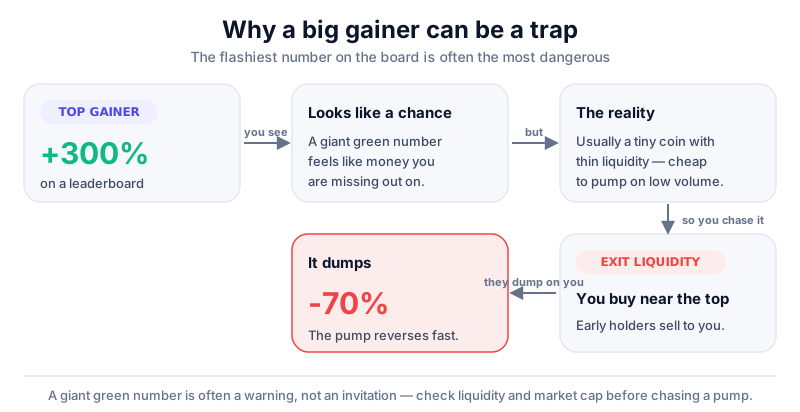
A coin going from £0.0001 to £0.0004 is up 300% and will top the gainers list — but it's still a micro-cap that could round-trip back down just as fast. Size and stability rarely make headlines; volatility always does.
Why chasing green candles is dangerous
The instinct to buy what's already rising is one of the most expensive in all of investing, and crypto turns it up to eleven. By the time a coin is on the gainers list, the move that put it there has already happened. You're not catching the wave — you're arriving after it's broken, often buying from the very people whose selling is about to start.
This is fuelled by emotion, not logic. The fear of missing out, the rush of a green screen, the story that 'this one's different' — these are well-documented mental traps, and we dig into them in the psychology of meme-coin investing. The market is very good at separating excited latecomers from their money, and the gainers list is one of its favourite tools for doing so.
A rising price is evidence that other people have already bought — not evidence that you should.
None of this means a green candle is automatically bad. It means a green candle is not, by itself, a reason — and treating it as one is how a great many people lose money in this market.
The low-liquidity trap
Here is the single most important thing the gainers list won't tell you: whether you could actually sell. Many of the biggest movers trade in tiny pools of money, and in a thin market the price you see is not the price you'll get. A modest buy can spike the chart; a modest sell can collapse it. The headline gain can be almost entirely an illusion created by a handful of trades.
This is the heart of the 'looks like it's only going up' problem. If liquidity is thin — or worse, if the creator can withdraw it — a beautiful chart can become unsellable in seconds. We explain the mechanics in full in how meme-coin liquidity works, and the same thinness is what makes a rug pull possible. Before you read any meaning into a move, ask whether real money could enter and exit at those prices.
A price you can't sell at isn't real
Thin liquidity cuts both ways: it lets a coin rocket up on tiny volume, then traps holders on the way down when everyone heads for the exit at once. The number on the screen means nothing if there's no buyer when you want out.
The context to check before reading anything in
If you only ever do one thing with the gainers and losers list, make it this: don't react to the number, investigate the context behind it. A few quick checks turn a meaningless percentage into a story you can actually judge. None of these tell you to buy or sell — they just stop you fooling yourself.
| Check | Why it matters | Where to learn more |
|---|---|---|
| Market cap | A tiny per-token price hides whether a coin is actually large or small overall | what is market cap |
| Liquidity | Thin pools make big moves cheap to manufacture and impossible to exit | how meme-coin liquidity works |
| The catalyst | A real upgrade or listing is different from an anonymous hype thread | understanding crypto volatility |
| Holder concentration | If a few wallets own most of the supply, they can crash it at will | how to research a meme coin |
| The chart in context | One green week can sit inside a long, ugly downtrend | how to read a candlestick chart |
Don't ignore the losers, either
The biggest losers list is just as instructive, and far less glamorous. Sometimes a drop reflects bad news worth understanding; sometimes it's just the hangover after last week's pump, with the same latecomers now selling at a loss. Reading both lists together — and noticing how often this week's top gainer becomes next week's top loser — is one of the fastest ways to inoculate yourself against the hype. For the wider market backdrop, bull vs bear markets is a helpful frame.
Reading the list like a sceptic
Put it all together and the gainers and losers list stops being a shopping menu and becomes what it actually is: a snapshot of where attention and volatility are pooling this week. That's genuinely useful information — it tells you what stories the market is excited about — as long as you never confuse 'lots of people are talking about this' with 'this is a good idea'.
So treat every big mover as a question rather than an answer. What moved it? Could you really get in and out? Is this a large coin having a normal week or a micro-cap having a manufactured one? Asking those questions costs you a few minutes and saves you from the oldest trap in the market. And keep the backdrop in mind: crypto is highly volatile, the flashiest movers are usually the riskiest, and you can lose money — so read these lists to understand the week, never as a nudge to act. — the Latest Crypto team
Key takeaways
- A big percentage describes the past — it is not a forecast, and by the time it's on the list the move has happened.
- The biggest movers are usually the smallest, most volatile coins, not Bitcoin or Ethereum.
- Thin liquidity makes huge gains cheap to manufacture and dangerous to exit — a price you can't sell at isn't real.
- Before reading anything in, check market cap, liquidity, the catalyst and holder concentration.
Frequently asked questions
Should I buy whatever is at the top of the gainers list?
We don't tell anyone what to buy, and chasing the top gainer is one of the most common ways people lose money. By the time a coin tops the list, the easy move is usually over, and many big movers are thin, hard-to-exit micro-caps. Read the list to understand the week, not as a shopping menu.
Why do tiny coins always dominate the gainers list?
Because there's so little money in them that a small amount of buying moves the price a long way. A coin up 300% on a single viral post is showing volatility, not value. Large coins like Bitcoin and Ethereum take serious money to move even a few percent.
What's the single most important thing to check on a big mover?
Liquidity. If the pool is thin or can be withdrawn by the creator, the displayed price may be unsellable in practice — and the headline gain is largely an illusion. See how meme-coin liquidity works for the mechanics.
Keep reading
What Actually Causes Alt Seasons?
What an alt season is, why money rotates from Bitcoin into altcoins, the liquidity and risk-appetite drivers b
The Psychology Behind Meme Coin Investing
Why meme coins hijack our brains: FOMO, herd behaviour, social proof, lottery-ticket thinking and sunk cost —
How Meme Coin Liquidity Works (and Why It Matters)
A plain-English guide to meme coin liquidity: what a liquidity pool is, why 'locked liquidity' matters, and ho